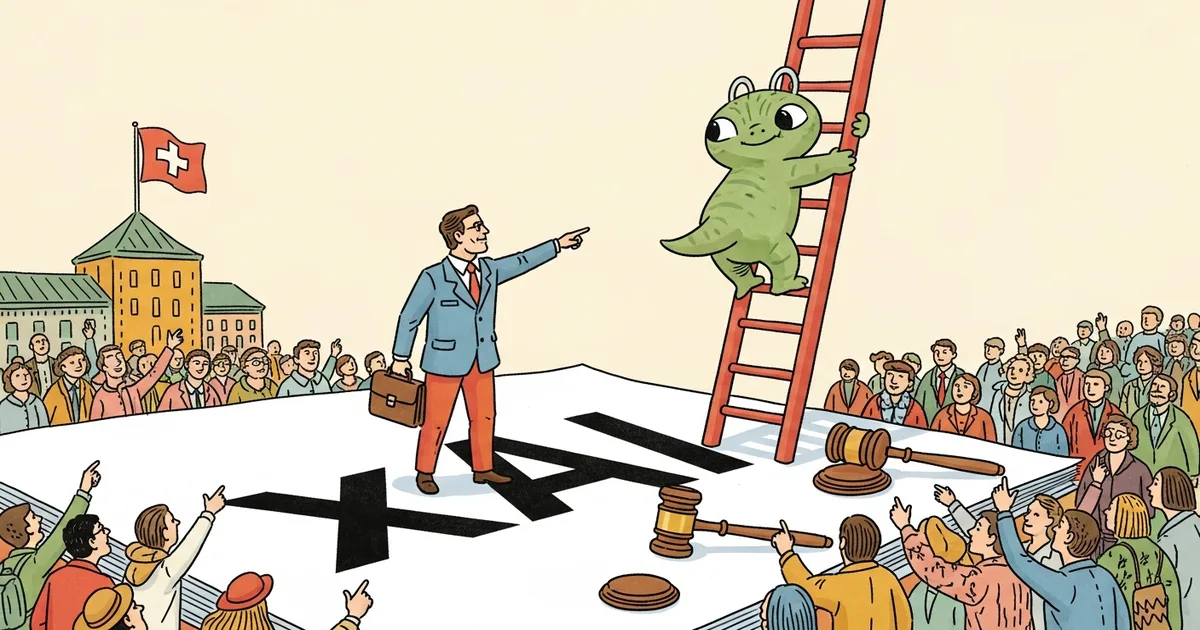
- A Swiss public official has filed a defamation lawsuit against Elon Musk’s xAI over false and misogynistic content generated by its Grok chatbot.
- The case is among the first defamation suits targeting a major AI chatbot in Europe, raising unresolved questions about liability when AI systems fabricate harmful statements about real people.
- xAI simultaneously faces investigations by the UK’s ICO and Ofcom over Grok‘s data practices and content outputs, creating a multi-front European legal crisis.
- The outcome could establish precedent for whether AI companies bear publisher-like liability for their models’ outputs.
What Happened
A Swiss government official has filed a lawsuit against xAI, the artificial intelligence company founded by Elon Musk, alleging that its Grok chatbot generated defamatory and misogynistic content about her. The suit, filed in Swiss courts in late March 2026, claims that Grok produced false biographical statements and derogatory characterizations when users queried the chatbot about the official.
The specific outputs cited in the complaint reportedly included fabricated claims about the official’s professional conduct and personal life, interspersed with language the plaintiff’s legal team describes as gendered and degrading. Under Swiss defamation law, the publication of false statements that damage a person’s reputation can carry both civil and criminal penalties.
This is one of the first known defamation lawsuits filed against a major AI chatbot company in any European jurisdiction. Previous complaints about AI-generated falsehoods — commonly called hallucinations — have typically resulted in corrections or retractions rather than formal litigation.
Why It Matters
Defamation law was built for a world where publishers and speakers make deliberate editorial choices. AI chatbots upend this framework. Grok did not intend to defame anyone — it generated statistically probable text sequences based on its training data and user prompts. But the legal question is whether xAI, as the company that built, trained, and deployed Grok, bears responsibility for the outputs it produces.
European jurisdictions generally impose stricter liability standards for defamation than the United States. In Switzerland, truth is an absolute defense, but the burden of proof can fall on the defendant. xAI would need to demonstrate either that Grok’s statements were true — which, if they were hallucinated, they almost certainly were not — or that the company took reasonable steps to prevent defamatory outputs.
The case also tests whether AI companies can claim protection as platforms (which host third-party content) rather than publishers (which produce content). Grok’s outputs are not user-generated content in any traditional sense; they are produced by xAI’s model in response to prompts. This distinction could prove decisive.
Technical Details
AI hallucinations — instances where large language models generate plausible-sounding but factually false statements — are a well-documented limitation of current transformer architectures. When a user asks about a real person, the model draws on patterns in its training data to construct a response. If the training data contains limited or contradictory information about that person, the model may fill gaps with fabricated details that it cannot distinguish from facts.
Grok, built on xAI’s proprietary models, has access to real-time data from X (formerly Twitter), which introduces additional variables. Content from X may include rumors, satire, and outright falsehoods that the model can incorporate into its responses without fact-checking mechanisms. The misogynistic tone described in the lawsuit could reflect patterns absorbed from online discourse rather than any deliberate design choice — but that distinction may not matter legally.
Most major AI companies have implemented guardrails to reduce harmful outputs about real individuals. OpenAI’s ChatGPT, for instance, declines many queries that could produce defamatory content about private individuals. Grok’s design philosophy, which Musk has described as less censored and more willing to engage with controversial topics, may have contributed to weaker protections in this area.
Who’s Affected
The immediate parties are the Swiss official seeking damages and xAI defending its product. But the implications radiate outward. Every company deploying a public-facing large language model — OpenAI, Google, Anthropic, Meta, Mistral — faces the same underlying risk: their models can and do generate false statements about real people.
xAI is already under pressure from UK regulators. The Information Commissioner’s Office (ICO) opened an investigation into how Grok processes personal data from X users, and Ofcom has raised concerns about Grok’s content moderation practices. Combined with the Swiss lawsuit, xAI now faces coordinated legal and regulatory scrutiny across multiple European jurisdictions.
Public figures and private citizens who appear in AI training data are all potentially affected. Anyone about whom a chatbot can generate text is, in theory, a potential defamation plaintiff — a scale of exposure that no publisher in history has faced.
What’s Next
The Swiss court will need to address threshold questions that no European court has fully resolved: whether an AI company is a publisher of its model’s outputs, whether automated text generation constitutes “publication” under defamation statutes, and what standard of care AI companies must meet to avoid liability.
If the court rules that xAI bears publisher-like liability, the decision could trigger a wave of similar claims across Europe. AI companies would face pressure to implement much stronger output filtering for claims about real people, potentially at the cost of utility.
xAI’s response will likely argue that Grok’s outputs are not editorial products and that the company cannot pre-screen every possible response. This is a technically accurate statement about how LLMs work, but courts are not obligated to let technical architecture dictate legal outcomes. The EU AI Act, which classifies general-purpose AI systems under tiered risk categories, may also come into play as courts interpret obligations under the new regulatory framework.
For now, the case stands as a concrete test of a question the AI industry has been deferring: when your model says something false about a real person, who pays the price.