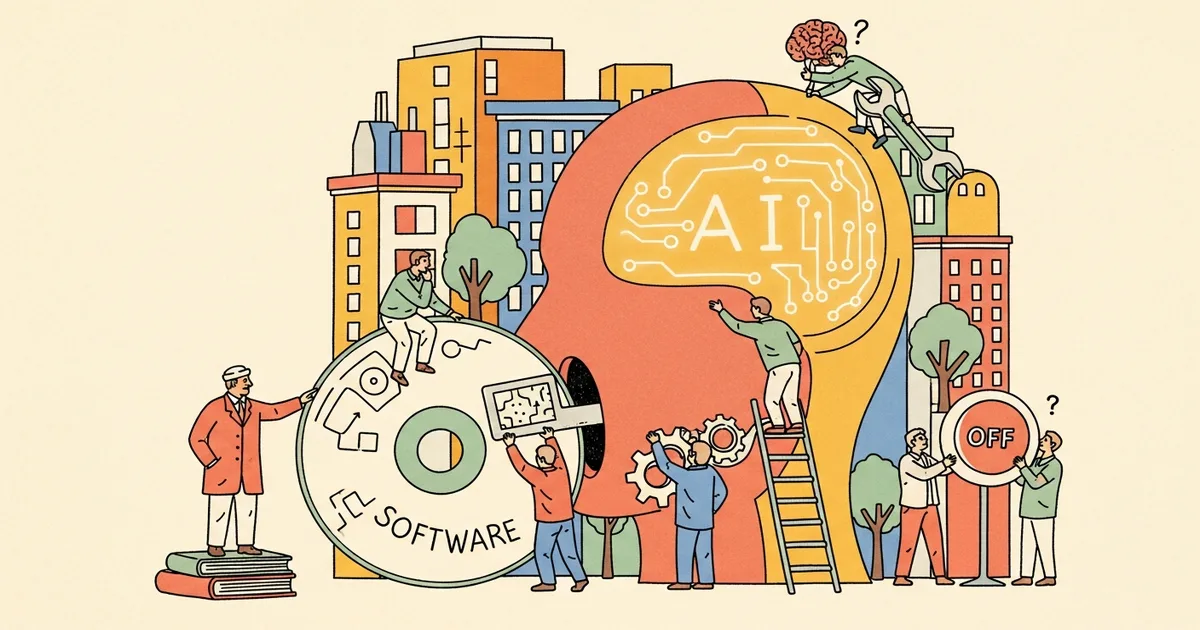
Ethan Mollick, Wharton professor and one of the most cited AI adoption researchers, wrote in The Economist that treating AI like normal IT automation kills its value. AI is a “weird” technology whose opportunities must be discovered through experimentation, not forced into sterile procurement workflows.
The Core Argument
Mollick’s thesis is specific: companies deploying AI through standard IT project management — requirements documents, vendor evaluations, implementation checklists, ROI projections — are systematically destroying the technology’s value. AI doesn’t behave like enterprise software. Its capabilities are discovered through use, not specified in advance.
“The most valuable AI applications in every organization I’ve studied were discovered accidentally by individual employees experimenting on their own,” Mollick wrote. “None of them came from IT roadmaps.”
Weird vs. Sterile
Mollick distinguishes between two deployment approaches:
Sterile deployment (failing): Company identifies a process, evaluates AI vendors, runs a pilot, measures ROI against predefined metrics, then rolls out or kills the project. This works for normal software. For AI, it produces mediocre results because the predefined use case is rarely the most valuable one.
Weird deployment (succeeding): Company gives employees broad AI access, encourages experimentation, and watches what emerges. The valuable use cases surface organically — a sales rep who discovers AI can generate personalized proposals 10x faster, an analyst who realizes AI can synthesize competitor filings in minutes, a designer who finds AI can generate production-ready assets.
Which Companies Get It Right
Mollick cites specific patterns from companies succeeding with AI:
- Broad access over controlled pilots: Companies that give every employee AI access find valuable use cases 3-5x faster than those running controlled experiments
- Bottom-up discovery: The best applications come from frontline workers, not strategy teams
- Tolerance for waste: Successful AI adoption requires accepting that most experiments will fail — the few that succeed justify the total investment
Why This Matters Now
Mollick’s argument has practical urgency. Wharton research shows users readily follow AI advice, suggesting the adoption barrier isn’t willingness — it’s organizational permission. Companies that treat AI as a controlled IT resource rather than a general-purpose tool are bottlenecking their own people.
The enterprise AI market is projected to reach $300 billion by 2028, according to IDC. Mollick’s warning is that most of that spending will be wasted by organizations applying industrial-era management to a technology that requires experimentation-era thinking. The companies that embrace the weirdness will capture disproportionate value. Those that don’t will have expensive AI subscriptions and nothing to show for them.