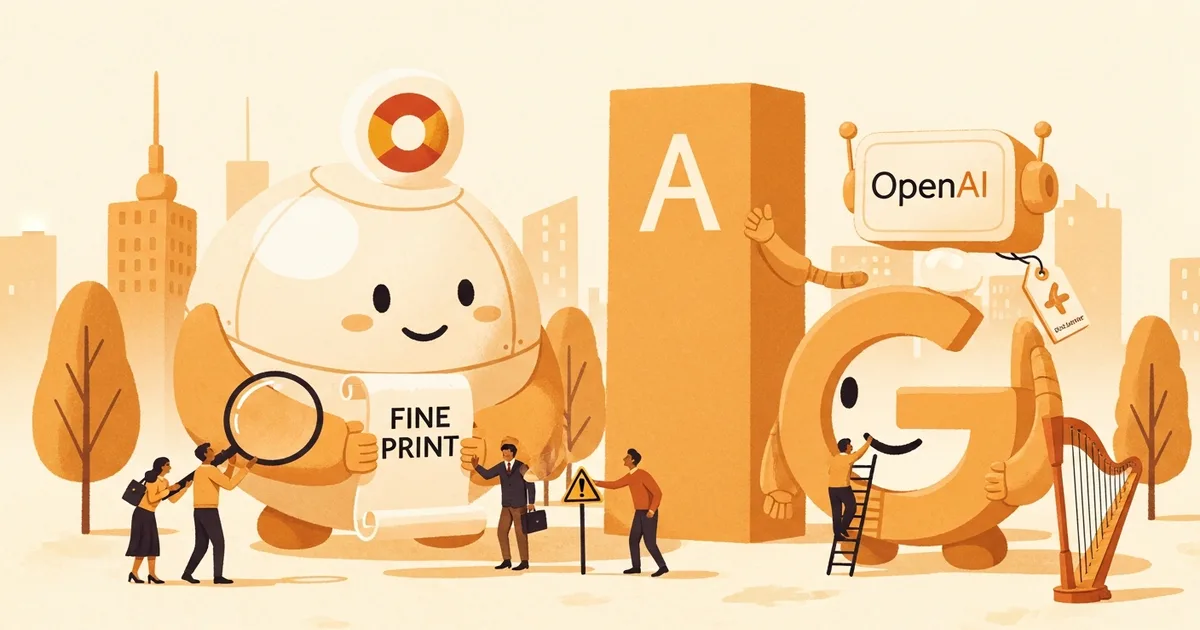
- OpenAI, Anthropic, Google, and Microsoft all include explicit disclaimers in their terms of service stating that AI outputs may be inaccurate and should not be relied upon for critical decisions.
- These legal disclaimers directly contradict the companies’ marketing messages and product designs, which position AI assistants as reliable tools for medical advice, legal research, coding, and business decisions.
- The gap between marketing claims and legal protections creates a liability shield: companies promote trust in their products while contractually requiring users to assume all risk from errors.
- As AI tools are integrated into healthcare, legal, and financial workflows, the question of who bears responsibility for AI-generated errors is becoming a concrete legal and regulatory issue.
What Happened
The loudest warnings about not trusting AI outputs are not coming from critics or regulators. They are coming from the AI companies themselves, buried in the terms of service that most users never read. OpenAI’s Terms of Use state explicitly: “You should not rely on the Output as a sole source of truth or factual information, or as a substitute for professional advice.” Anthropic’s Terms of Service include similar language, noting that outputs “may not always be accurate” and that users are “responsible for evaluating and verifying Claude‘s outputs.” Google’s Gemini terms warn that the service “may sometimes provide inaccurate or offensive content that doesn’t represent Google’s views,” and Microsoft’s Copilot terms disclaim liability for “errors, omissions, or inaccuracies in the output.”
These disclaimers are standard across every major AI provider. They are also in direct tension with how these same companies market and design their products.
Why It Matters
The disconnect between legal language and product positioning is not merely philosophical. OpenAI has partnered with healthcare companies and launched features that let ChatGPT browse the web and provide synthesized answers to complex questions. Google has integrated Gemini into Search, presenting AI-generated summaries at the top of results pages where users historically trust Google’s information hierarchy. Microsoft has embedded Copilot into Office 365, positioning it as a productivity tool for drafting contracts, financial analyses, and business communications. Anthropic markets Claude for research, analysis, and coding tasks that require precision.
In each case, the product design encourages reliance. The conversational interface, the confident tone of AI responses, and the integration into trusted platforms all signal reliability. Meanwhile, the legal documents these companies file — and require users to accept — say the opposite. This is a well-established pattern in technology law: the terms of service serve as a liability shield, transferring risk from the company to the user. But with AI tools increasingly used for medical queries, legal research, and financial decision-making, the consequences of that risk transfer are escalating.
Technical Details
The disclaimers are rooted in a real technical limitation. Large language models generate text through probabilistic next-token prediction, not through verified reasoning or factual retrieval. GPT-4, Claude, and Gemini can all produce plausible-sounding statements that are factually incorrect, a phenomenon researchers call “hallucination.” Studies have documented hallucination rates varying from 3% to over 27% depending on the model, task, and evaluation methodology. A November 2023 study by Vectara found that GPT-4 hallucinated in approximately 3.0% of summarization tasks, while Meta’s Llama 2 hallucinated at a rate of 8.5% on the same benchmark.
OpenAI’s own technical reports for GPT-4 acknowledge that the model “can still be confidently wrong” and note limitations in factuality. Anthropic’s model card for Claude 3 Opus states that the model “may occasionally generate information that is not accurate” and recommends that users “independently verify important claims.” These are not obscure disclosures. They are published by the companies’ own research teams. Yet the marketing pages for the same products emphasize capability and reliability, not these documented failure modes.
The legal structure compounds the issue. Most AI terms of service include broad limitation-of-liability clauses that cap the company’s financial exposure at the amount the user paid in the prior 12 months — often zero for free-tier users. Some include arbitration clauses that prevent class-action lawsuits. The practical effect is that if a lawyer uses ChatGPT to draft a brief that cites fabricated case law (as happened in the widely reported Mata v. Avianca case in 2023, where attorney Steven Schwartz submitted AI-generated fake citations), the lawyer bears full professional liability. OpenAI bears none.
Who’s Affected
Professional users in high-stakes fields are most exposed. Lawyers, doctors, financial analysts, and journalists who use AI tools for research and content generation are assuming all risk for errors while using products designed to feel trustworthy. Small businesses and individual users without legal teams to read terms of service are particularly vulnerable. Regulators in the EU, through the AI Act, and in the US, through the FTC’s enforcement actions, are beginning to examine whether the gap between marketing claims and legal disclaimers constitutes deceptive practice, but no enforcement action specifically targeting this disconnect has been filed as of April 2026.
What’s Next
The FTC has signaled increased scrutiny of AI marketing claims, and the EU AI Act’s transparency requirements, which took partial effect in 2025, will require high-risk AI systems to disclose limitations more prominently than a buried terms-of-service clause. Several product liability scholars, including Stanford’s Mark Lemley, have argued that courts may eventually treat AI outputs more like products than services, which would shift liability frameworks significantly. For now, the most concrete protection available to users is the one the AI companies themselves recommend in their fine print: do not trust the output without independent verification.