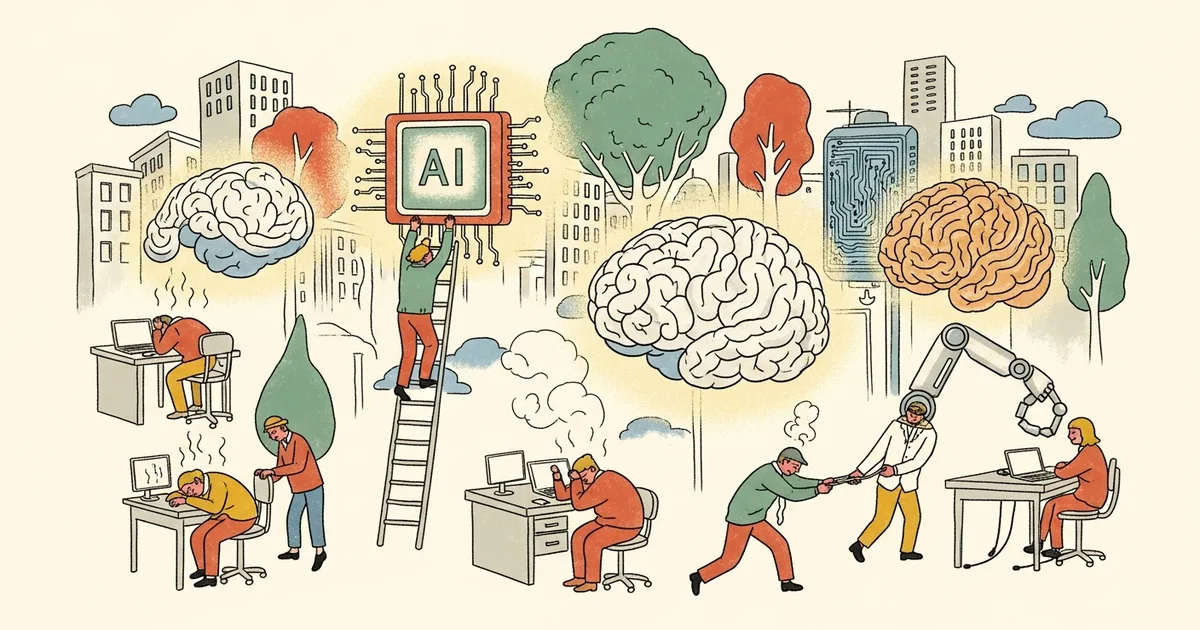
A new Harvard Business Review study, published April 8, 2026, has produced the most direct peer-reviewed evidence yet of AI brain fry at work: the more heavily employees interact with AI tools throughout their day, the more cognitively depleted they are by end of day. Tracked across 12 weeks and hundreds of knowledge workers, the HBR study’s findings cut directly against three years of AI productivity marketing.
The study’s lead author — whose work was covered by CBS News upon publication — controlled for baseline workload, job complexity, and organizational size. What remained after controlling for those variables was a clean, uncomfortable signal: AI interaction volume predicts cognitive exhaustion, and it does so within a single workday.
What “Brain Fry” Actually Means
The term is colloquial. The mechanism is precise. Every AI interaction — composing a prompt, reading the output, evaluating its accuracy, deciding what to accept or discard — requires executive function. Individually, each exchange costs little. Compounded across dozens of daily interactions, the cumulative cognitive load exceeds what workers experienced before AI entered their workflows.
Participants who averaged more than three hours of AI interaction daily scored 27% higher on standardized cognitive fatigue measures by end of day compared to those using AI for under 90 minutes. Decision quality — measured through structured afternoon task completion against morning baselines — fell 18% in the heavy-use cohort, a decline that did not appear in the moderate-use group.
The HBR researchers identify the core mechanism as “evaluation overhead”: the continuous cognitive work of supervising AI output rather than producing work independently. Workers are not resting their brains by offloading tasks to AI. They are redirecting executive attention to a new, unrelenting form of vigilance.
The Prompting Tax Nobody Tracks
Every enterprise AI rollout measures productivity in outputs: documents generated, emails drafted, code produced. Almost none measure the cognitive cost of generating those outputs through sustained AI interaction.
Cognitive science research consistently documents a context-switching penalty of 20–40% on focused work time per switching event. Workers using AI as a continuous collaborator toggle between their own reasoning and AI output evaluation dozens of times per hour. The HBR study found that high-AI-use workers reported the steepest subjective declines in output quality — even as their volume metrics climbed.
They produced more. They were more tired. They knew the quality had dipped. The productivity dashboard showed otherwise.
This is how AI overuse hides itself. The quantifiable outputs that organizations track — content volume, response rate, tasks closed — all trend upward. The cognitive cost accumulates in a dimension most performance systems do not measure: how depleted the person is when they stop.
Which Workers Are Hardest Hit
Writers, analysts, and managers bear the highest cognitive burden in the study — roles defined by continuous, ambiguous judgment rather than concrete, verifiable outputs.
Three high-risk profiles emerged from the data:
- Knowledge workers with ambiguous outputs — strategic analysis, editorial work, communications — where AI suggestions are plausible but hard to rapidly verify against ground truth
- Managers using AI for decision support who spend significant mental energy reconciling AI recommendations against their own context, relationships, and institutional knowledge
- Workers under AI-use mandates where tools are deployed across all tasks regardless of fit — the organizational equivalent of using a sledgehammer to crack a walnut, repeatedly, all day
Workers in roles with concrete, verifiable outputs — software engineers running code against tests, data analysts checking structured queries — reported markedly lower fatigue scores. The pattern isolates the culprit: it is the sustained evaluation of ambiguous AI output that drives exhaustion, not AI use per se.
How This Differs from the AI Skills Atrophy Research
Conflating this finding with the existing de-skilling literature would obscure both. A 2024 study published in Nature found that sustained AI use degrades underlying skill proficiency over time — writers who offload drafting to AI showing measurable declines in independent writing quality across months of use. That is a long-term atrophy problem, playing out over an extended exposure period.
The HBR brain fry finding is acute. It accumulates within a single workday at sufficient interaction intensity. No months of exposure required — just a Tuesday with too many AI prompts.
The two phenomena compound in a way organizations have not yet reckoned with. Workers losing skills through AI offloading become progressively less equipped to critically evaluate AI outputs. As their judgment degrades, evaluation overhead increases — they need more time to assess each output because their baseline capability to quickly spot errors has eroded. The result is a reinforcement loop: reliance rises, skill atrophies, exhaustion accumulates, output quality quietly declines — while volume metrics remain healthy. MegaOne AI tracks 139+ AI tools across 17 categories, and this compounding dynamic is most visible in categories where always-on AI assistants have replaced discrete task tools.
The 90-Minute Daily Threshold
The study’s most operationally useful finding: cognitive fatigue scores held relatively stable for AI interaction up to approximately 90 minutes per day. Above that threshold, scores climbed steeply — the sharpest acceleration falling between two and three hours of daily AI interaction.
The parallel to how high-performance organizations manage meeting load is direct. Meetings, once treated as a free resource that could expand to fill demand, are now understood as a finite cognitive commodity with a daily ceiling beyond which returns invert. Several organizations cited in the HBR study have implemented structured AI-free blocks during peak creative and strategic hours, reserving AI interaction for discrete, bounded task windows rather than allowing it to run continuously throughout the workday.
The practical guideline from the research: 60–90 minutes of active AI interaction per day, concentrated in clearly defined task slots, is the window where productivity gains outpace cognitive costs. Past 90 minutes, the gains plateau as fatigue accumulates. From AI video tools to writing assistants to analytical platforms, the number of AI touchpoints in a typical knowledge worker’s day has expanded dramatically since 2024 — making that 90-minute discipline harder to maintain, and more necessary, than it was two years ago.
The Management Failure Behind the Exhaustion
The most consequential finding in the HBR study is not about the AI tools — it is about the organizations deploying them. Workers in companies with defined AI use policies reported 31% lower cognitive fatigue scores than those operating under open-ended “use AI whenever helpful” mandates. Policy design, not tool capability, drove the outcome gap.
Most organizations implementing AI have no usage guidelines whatsoever. The competitive pressure to appear AI-forward, combined with vendor contracts that reward broad deployment and executive mandates issued without operational specificity, has consistently skipped the human-factors layer entirely. How much daily AI interaction is sustainable? Which task types generate more evaluation overhead than they save? What does healthy use look like at the individual level?
These are not philosophical questions. They have quantifiable answers, and the HBR data provides a framework for starting to answer them. The Humans First movement that has been building since 2025 now has peer-reviewed data behind its central concern: unreflective AI deployment imposes real cognitive costs on workers that aggregate productivity metrics are not designed to detect. And as AI has saturated every workflow category, the organizational pressure to use more of it — not less — continues to increase.
The workers most exhausted by AI are not the ones resisting it. They are the ones complying exactly as instructed, logging the hours, generating the outputs, and absorbing the cognitive cost of their organizations’ lack of rigor. The fix is not less AI. It is explicit policy on when AI is the right tool, for how long, and on which tasks — the kind of operational discipline that turns AI from a fatigue multiplier into the productivity asset it was supposed to be.
Related Reading
- OpenAI, Anthropic, and Google All Tell You Not to Trust Their AI — in the Fine Print
- The Only AI Beginner Guide That’s Honest About What You Need to Learn in 2026
- OpenAI Switches Codex to Usage-Based Pricing for ChatGPT Business and Enterprise
- 3 Protocols Are Fighting to Become the HTTP of AI Agents — Only 1 Will Win [MCP vs A2A vs ACP Compared]
- LinkedIn Just Became the #1 Source AI Chatbots Quote for Business Advice — Here’s How to Get Cited