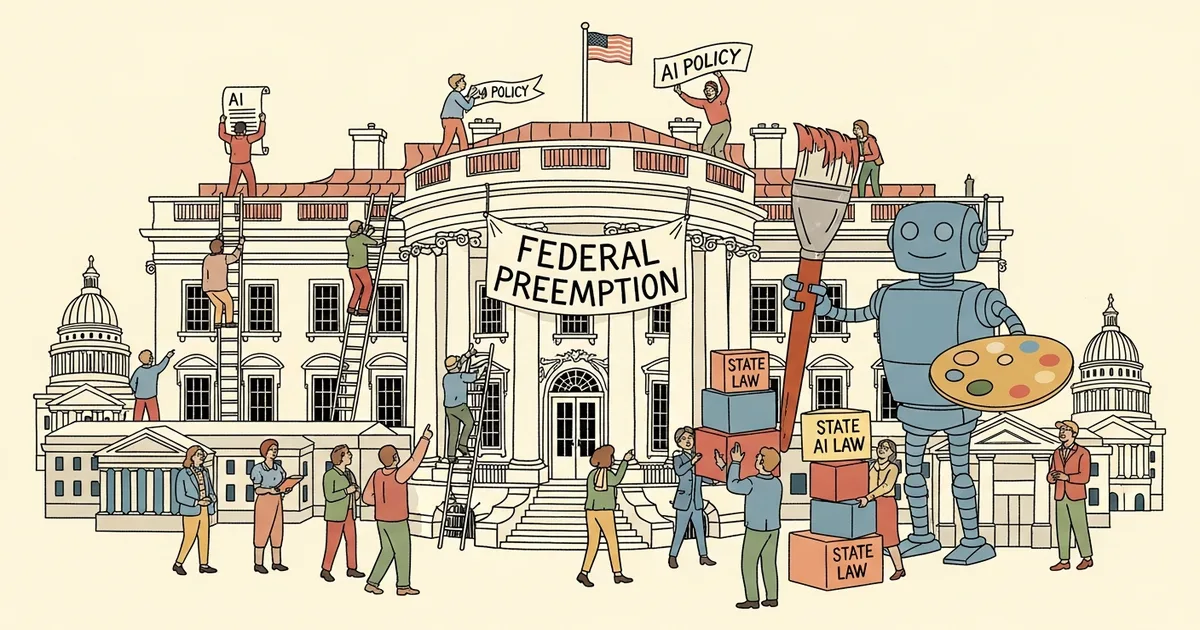
- The National Governors Association published a summary of the White House’s National Legislative Policy Framework for Artificial Intelligence, detailing a federal-first governance structure that would preempt conflicting state AI laws.
- The framework applies a risk-tiered regulatory model, subjecting high-risk AI systems in employment, healthcare, and critical infrastructure to mandatory transparency and human oversight requirements.
- The administration’s proposal would consolidate AI regulatory authority under a single designated federal agency, replacing the current fragmented multi-agency oversight model.
- Enacted state AI legislation in California, Colorado, Illinois, and Texas would be among the laws potentially rendered unenforceable where they conflict with the federal baseline.
What Happened
The National Governors Association released a structured summary of the White House’s National Legislative Policy Framework for Artificial Intelligence, providing state executives a policy-by-policy analysis of the administration’s proposed federal approach to AI governance. The framework’s core mechanism is a preemption clause that would establish national AI standards as the governing law in all 50 states, displacing conflicting state-level regulation in most commercial and government AI applications.
The framework is the legislative extension of the White House AI Action Plan, which the Trump administration released in mid-2025 and which directed federal agencies to streamline AI oversight. David Sacks, the White House AI and Crypto Policy Advisor who has led the administration’s AI agenda, has publicly argued that a fragmented state regulatory environment risks slowing American AI development relative to international competitors.
Why It Matters
The framework arrives as state-level AI legislation has proliferated. By early 2026, more than 40 states have introduced AI-related bills, with enacted laws covering automated decision-making in employment and credit, biometric data collection, synthetic media disclosure, and algorithmic accountability requirements. Federal preemption of those laws would represent the most significant restructuring of the AI regulatory landscape since states began filling the absence of federal standards in 2023.
The NGA’s decision to publish a dedicated analytical summary signals that the association — which represents governors of both parties — is preparing members for formal engagement on the framework as it advances through the legislative process. The NGA has previously advocated for preserving state authority in technology governance proceedings at the federal level.
Technical Details
According to the NGA’s summary, the White House framework divides AI systems into two regulatory tiers. High-risk AI — defined as systems making or directly influencing consequential decisions in employment, credit, healthcare, housing, education, and critical infrastructure — would be subject to mandatory pre-deployment documentation, ongoing transparency obligations, and human oversight requirements before market deployment. General-purpose AI systems not operating in those domains would face lighter disclosure requirements only.
The framework proposes designating a single lead federal agency as the primary AI regulator, consolidating jurisdiction currently spread across the FTC, EEOC, CFPB, and sector-specific regulators. The NGA summary notes that the framework calls for expedited federal rulemaking to implement its requirements; specific statutory deadlines were not detailed in the published NGA analysis. The framework also includes provisions allowing federal agency waivers for AI applications in national security contexts, explicitly carving those systems out of the standard oversight structure.
The NGA’s analysis characterizes the framework as designed to ensure that “AI developers and deployers are subject to a consistent national standard rather than divergent requirements across jurisdictions” — a formulation that directly addresses the compliance fragmentation that technology industry groups have cited as a barrier to domestic AI deployment at scale.
Who’s Affected
State governments face the sharpest immediate consequences. Enacted AI laws in California, Colorado, Illinois, and Texas — which collectively cover areas including automated employment screening, consumer algorithmic rights, and biometric data — could be unenforceable in areas where they exceed or conflict with the federal baseline. The NGA’s analytical framing is a direct signal that governors plan to contest preemption provisions during the legislative negotiation process.
AI developers and deployers operating across multiple states stand to gain from regulatory uniformity, as a single federal standard would eliminate the compliance overhead of mapping divergent state requirements. Consumer protection organizations and civil rights advocates have consistently opposed broad preemption frameworks, arguing that state laws frequently provide protections against discriminatory automated decision-making that proposed federal baselines have not matched.
What’s Next
The NGA’s summary is intended to equip governors with the technical and policy detail needed to engage formally as the framework advances. Whether the White House framework is introduced as standalone legislation or attached to a broader bill will shape its timeline and the amendment process available to preemption opponents. The administration’s ability to hold Republican governors in states with enacted AI laws — particularly Texas and Florida — will be a key variable in building the legislative coalition needed to pass the framework.