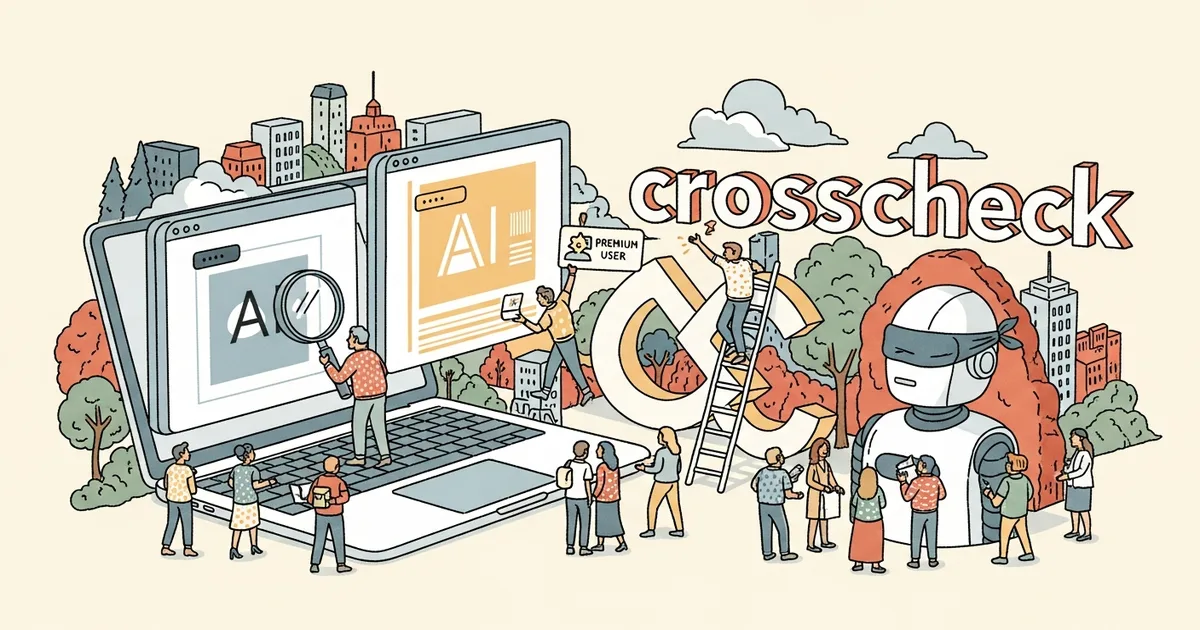
- LinkedIn launched Crosscheck to US Premium subscribers, enabling free side-by-side AI model comparisons with no additional cost or separate subscriptions.
- The feature withholds model identities until after users select a preferred response, operating as a structured blind preference test.
- Supported models include offerings from Anthropic, Google, MoonshotAI, Mistral, and Amazon; the feature is currently limited to text-only prompts.
- LinkedIn shares anonymized, occupation-segmented preference data with participating model providers, with no personally identifiable information transferred.
What Happened
LinkedIn has rolled out Crosscheck, a feature that lets Premium subscribers in the United States compare responses from competing AI models without requiring separate platform accounts or additional paid subscriptions. The feature is live now through LinkedIn Labs, the platform’s internal product experimentation division. Hari Srinivasan, LinkedIn’s Chief Product Officer, described Crosscheck as a “blind taste test” for AI models, adding that it is an “early product” with “work to do to make it faster and add more models and question types.”
Why It Matters
Structured AI model comparison has previously been concentrated in developer- and researcher-facing tools. LMSYS Chatbot Arena, which has operated since 2023, runs a similar blind preference format but targets users already motivated to benchmark models deliberately. LinkedIn’s version reaches professionals through a product they already use daily for job searching, industry research, and networking — tasks that generate a different class of prompts than those typical on coding or reasoning benchmarks.
The professional context also shapes the signal value of the data collected. LinkedIn’s occupationally segmented leaderboard produces preference data linked to job function, a dimension that most public academic benchmarks do not capture at scale. AI providers, rather than funding separate user studies for profession-specific evaluations, gain structured feedback derived from real-world professional usage at no disclosed cost to LinkedIn users.
Technical Details
Crosscheck presents two anonymous model responses to a single text prompt. After the user selects a preferred answer, the underlying models are identified. Initial testing by Engadget’s reporter surfaced responses attributed to Anthropic and Google models alongside MoonshotAI, Mistral, and Amazon; LinkedIn also named OpenAI and Microsoft as participating providers. The specific model versions surfaced through the interface were not disclosed by the company.
The feature supports text-only input. Image generation, file uploads, and platform-native capabilities — including tool use, web browsing, and code execution — are not available through Crosscheck. LinkedIn has not stated a cap on the number of text sessions users may conduct within a billing period.
Preference results feed a leaderboard segmented by industry. LinkedIn’s stated data policy specifies: “Anonymized data is shared with model builders to help them understand how their models are performing amongst different occupations. No personally identifiable information is shared with model builders.”
Who’s Affected
The current rollout covers LinkedIn Premium subscribers in the United States. Premium is a paid tier that already includes InMail credits, recruiter search access, and AI writing assistance; Crosscheck adds multi-model comparison at no incremental cost within that subscription. AI providers — among them Anthropic, Google, MoonshotAI, Mistral, and Amazon — receive anonymized preference data segmented by occupation, derived from a professional network that reported crossing one billion registered members in 2023.
LinkedIn stated that Crosscheck will be extended to additional countries and to free-tier users “soon,” a change that would substantially expand both the total user pool and the volume of occupation-linked preference data flowing to participating model providers.
What’s Next
Srinivasan stated that LinkedIn plans to add more models and expand support for additional prompt types beyond text, without providing a specific timeline for either. Geographic expansion beyond the United States and access for non-paying users are described as forthcoming. LinkedIn has not indicated whether industry-level leaderboard rankings will be published outside the platform or made available to researchers.