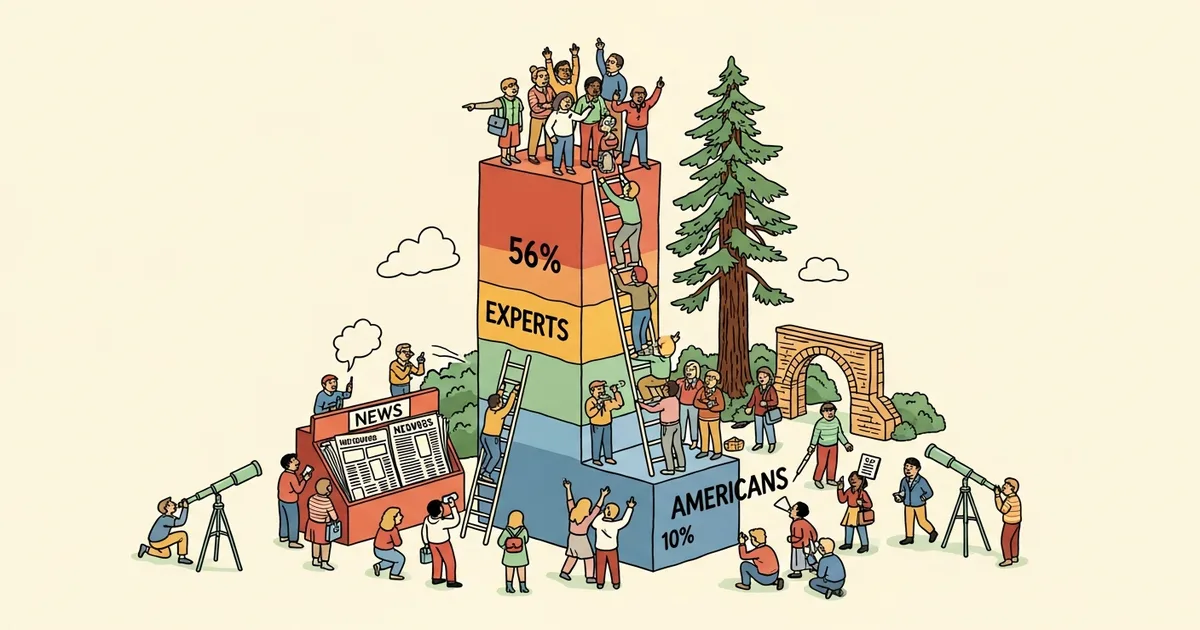
Stanford University’s 2026 AI Index Report, published this week by the Stanford Human-Centered AI Institute, documents what may be the defining political fault line of the decade: a 46-percentage-point gulf between how AI’s builders and AI’s subjects view the technology. Only 10% of Americans say they’re more excited than concerned about artificial intelligence in daily life. Among AI researchers and developers, 56% feel that way. The stanford ai index public opinion gap isn’t new — but the 2026 edition shows it widening, not closing.
The report draws on Ipsos global polling, World Economic Forum surveys, and peer-reviewed research across dozens of institutions. What it finds in 2026 isn’t an information problem. It’s a legitimacy crisis — and the numbers span every domain the public cares about most.
The Stanford AI Index Public Opinion Gap: 46 Points and Growing
The headline figure from the 2026 AI Index needs no spin. When asked about excitement versus concern for AI in daily life:
- 56% of AI experts say they’re more excited than concerned
- 10% of Americans say the same
- A 46-point gap — documented as growing compared to prior-year surveys
This is happening despite ChatGPT reaching 400 million weekly active users. Despite AI assistants shipping on every major consumer platform. Despite hundreds of billions in venture capital and years of overwhelmingly positive technology coverage. Familiarity, it turns out, is not producing acceptance.
Stanford’s methodology pulls from multiple large-sample survey sources and expert panels, making the finding robust against sampling noise. The 46-point gap is not a rounding artifact — it’s a structural signal about who controls the technology and who lives with its consequences.
Healthcare: AI’s Strongest Argument, and Still a 40-Point Gap
Medical AI is the sector’s most persuasive use case. Diagnostic imaging, drug discovery, early cancer detection — these are applications where the value proposition is unambiguous. The Stanford data on healthcare perception is still damning:
- 84% of AI experts believe AI will improve medical care
- 44% of the American public agrees
A 40-point gap on the most sympathetic possible framing. The FDA had authorized over 950 AI-enabled medical devices as of 2025, according to agency records — regulatory approval and public trust are operating on entirely different timelines.
If the industry cannot close the perception gap on healthcare — where the pitch is literally “this technology saves lives” — it has no credible path on harder cases: hiring algorithms, predictive policing, content moderation, sentencing tools. The healthcare gap exposes something deeper than messaging failure. The public doesn’t trust the institutions making these promises, and decades of pharmaceutical and insurance industry behavior explain why.
Jobs: The 50-Point Gap That Turns This Into a Political Problem
The employment numbers are where the expert-public divergence stops being a communications challenge and becomes a structural political threat.
- 73% of AI experts believe AI will mostly help workers
- 23% of the American public agrees
Fifty points. On jobs. The IMF has estimated that 40% of global employment faces high AI exposure. The experts who designed those systems overwhelmingly believe the net employment outcome is positive. The workers in those jobs overwhelmingly disagree. Both groups are looking at the same data and arriving at opposite conclusions — because they don’t share the same stakes.
The experts building AI are not, in most cases, the ones losing jobs to it. They hold equity in AI’s success. The workers absorbing displacement hold none. When 77% of the public is more threatened than hopeful about AI’s effect on employment, and 73% of experts believe the opposite, you’re not looking at a knowledge gap. You’re looking at a class divergence. Those get resolved through politics and redistribution, not better explainer videos.
The Energy Bill Nobody Voted On
The Stanford index adds a physical dimension to the legitimacy problem — one measured in tons of carbon and gallons of water rather than percentage points.
AI data center power capacity reached 29.6 gigawatts globally in 2026, roughly equivalent to New York State’s peak electricity demand. A single flagship training run now produces emissions at industrial scale: Grok 4’s training generated an estimated 72,816 tons of CO₂, equivalent to approximately 17,000 cars driving for a full year.
Water consumption is less visible but equally measurable. Annual inference operations for GPT-4o alone may consume more freshwater than several small nations combined, per environmental researchers tracking data center cooling loads. Nebius’s planned $10 billion AI data center in Finland represents a single node in an expansion adding gigawatts — not megawatts — per year.
None of this was put to a public vote. No democratic body authorized the carbon budget, the water allocation, or the grid capacity diversion. It was built by private actors with private capital and now exists as infrastructure that is difficult to reverse. This is what a legitimacy deficit looks like in concrete and kilowatts.
When the Gap Becomes Violence: Alberto Romero’s Thesis
Some analysts aren’t treating the expert-public divide as a problem to manage. They’re treating it as a fuse.
Alberto Romero, AI researcher and commentator, has argued explicitly that if AI displacement continues at scale without democratic consent mechanisms or meaningful redistribution, organized resistance — including political violence — becomes a structural outcome rather than a fringe scenario. The argument isn’t moral endorsement. It’s historical pattern recognition.
The Luddite movement of the early 19th century began as organized resistance by skilled workers whose livelihoods were being systematically eliminated by textile automation. It ended with military suppression. The 20th century saw repeated labor violence during industrial mechanization. AI’s current displacement wave is faster, broader, and cutting into white-collar professions that historically organized the most politically active segments of developed economies.
The Humans First movement, which advocates explicitly for democratic deliberation before further AI deployment, reflects mainstream anxiety rather than fringe politics. When 90% of Americans report being more concerned than excited, any movement demanding a pause has a potential constituency that dwarfs the AI industry’s political base — and the industry’s own polling now proves it.
Why Four Years of Consumer AI Has Narrowed Nothing
The conventional industry response to public skepticism is patience: let the technology prove its value, and trust will follow. The Stanford data falsifies this premise. The gap is documented as widening — not narrowing — despite years of consumer AI deployment at scale.
Three structural factors explain why the persuasion strategy isn’t working:
- Asymmetric exposure to capability versus failure. Experts interact with AI in settings optimized for its best outputs. The public primarily encounters AI at its worst — scam calls, deepfakes, content spam, hallucinated search results. Even utility tools like weather apps have become sites of AI-generated noise displacing reliable forecasts. The public’s lived experience of AI is not the researcher’s curated experience of AI.
- Unequal stakes. Researchers, developers, and investors hold equity in AI’s success. They benefit directly when adoption accelerates. The public absorbs the externalities — job displacement, privacy erosion, infrastructure costs, misinformation — without proportional upside. Divergent interests reliably produce divergent perceptions.
- Absent democratic input. No country has conducted a meaningful public deliberation on the pace or scope of AI deployment. Decisions about what to build, how fast to ship, and who bears the risks are made within private companies and research labs. Distrust generated by that exclusion is independent of whether any specific outcome is positive or negative.
MegaOne AI tracks 139+ AI tools across 17 categories. Across that coverage, the pattern holds consistently: tools designed with specific, consenting expert users systematically outperform tools deployed at scale to general consumers who weren’t consulted and didn’t request them.
The Gap Closes Through Policy, Not Persuasion
A 46-point sentiment gap — consistent across healthcare, jobs, and daily life — cannot be closed by a better press release or a more accessible explainer series. The Stanford 2026 AI Index makes that conclusion unavoidable.
The energy figures add urgency. A 29.6-GW infrastructure footprint and 72,816 tons of CO₂ per flagship training run are costs already incurred, already externalized, and accumulated without a democratic mandate. These aren’t future projections. They’re the current baseline, and the buildout continues.
The path to closing the gap runs through structural changes: redistribution of AI’s economic gains, democratic input into deployment decisions, and regulatory frameworks with actual enforcement mechanisms. The experts who are 56% excited built something that 90% of Americans are more worried about than enthused by. The Stanford index has now documented precisely how far that gap has grown. What the industry does with that measurement is the test that matters.