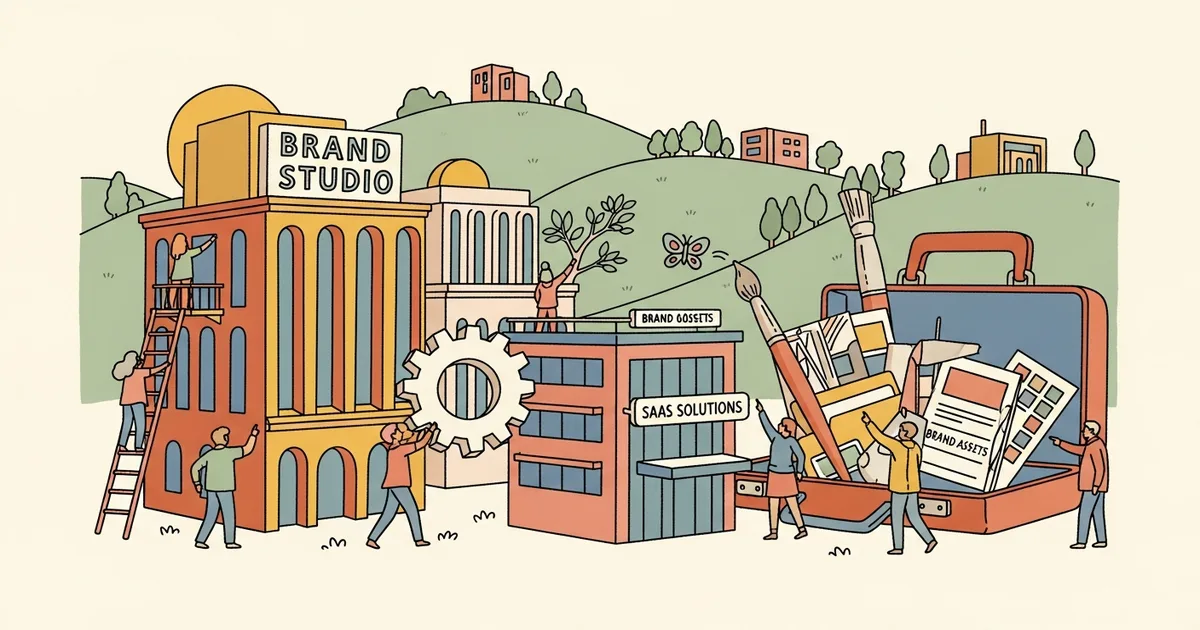
Stability AI, the company behind the Stable Diffusion open-source image model, officially launched Brand Studio in April 2026 — a commercial platform that lets enterprise creative teams train custom AI image models on their brand assets and generate on-brand visuals at production scale. The move is Stability’s most explicit pivot yet from open-source model provider to enterprise SaaS vendor, putting it in direct competition with Adobe Firefly Enterprise and Canva Magic Studio.
The timing is strategic. Enterprise AI visual tooling is one of the fastest-growing segments in creative software, and the central complaint from brand teams using generic AI tools is consistent: outputs don’t match brand identity without extensive manual correction. Stability is betting that brand fidelity — a problem generic models structurally cannot solve — is the wedge that justifies proprietary pricing and enterprise contracts.
What Brand Studio Actually Does
Brand Studio’s core offering is custom brand model training: creative teams upload a corpus of approved brand assets — product photography, approved campaign imagery, color systems, typography guidelines — and Stability fine-tunes a private model that generates new visuals consistent with that specific identity. The output isn’t generic Stable Diffusion imagery with a brand filter applied; it’s a dedicated model tuned to a specific visual language.
Beyond model training, the platform includes:
- Automated production workflows — batch generation pipelines for social media resizing, ad variants, and seasonal campaign updates
- Precision controls — style locks, color palette enforcement, and composition constraints that prevent off-brand outputs before they reach a designer
- Asset library integration — API connectors to existing DAM (Digital Asset Management) systems so generated images feed directly into existing production pipelines
- Approval gates — configurable human review checkpoints before generated assets move to production
The combination targets a specific, documented pain point: marketing teams that currently run AI generation through generic tools and then spend hours manually correcting outputs to match brand standards. Stability is offering a system where most of that correction is baked into the model itself.
The Technical Core: Fine-Tuning at Brand Scale
The mechanism underlying Brand Studio is LoRA (Low-Rank Adaptation) fine-tuning on top of a base Stable Diffusion model, applied to brand-specific datasets. What Stability is productizing is the surrounding infrastructure: data ingestion pipelines, fine-tuning compute, evaluation tooling that flags constraint violations, and a serving layer making trained models accessible through API or UI without requiring an internal ML team.
For large enterprises managing hundreds of product SKUs and multiple regional brand variants, the internal engineering cost of replicating this is substantial. A capable ML team doing this independently would need significant engineering cycles per brand variant, ongoing infrastructure costs, and dedicated tooling for output evaluation. Stability’s pricing — described as enterprise contract with minimum annual commitments, full tiers not yet publicly disclosed — is positioning Brand Studio as cheaper than building internally, not cheaper than Canva.
The fine-tuning architecture also means each brand’s model is private by default. Unlike shared generative infrastructure where training data contamination is a recurring legal concern, brand models in Brand Studio are isolated. This matters for legal and IP teams that have been the primary blockers of generative AI adoption at large enterprises and regulated brands.
Brand Studio vs. Adobe Firefly vs. Canva Magic Studio
| Feature | Stability Brand Studio | Adobe Firefly Enterprise | Canva Magic Studio |
|---|---|---|---|
| Custom brand model training | Yes (core feature) | Limited (Custom Models, limited beta Q1 2026) | No |
| Private isolated model per brand | Yes | No (shared infrastructure) | No |
| DAM integration | Yes (API) | Yes (Adobe Experience Manager) | Limited |
| Batch production workflows | Yes | Yes (via Creative Cloud) | Yes |
| IP indemnification | Enterprise contracts | Yes (Firefly Commercial) | Yes |
| Primary target | Enterprise brand teams | Adobe CC enterprise users | SMB and non-designers |
Adobe Firefly’s structural advantage is ecosystem lock-in: it lives inside Creative Cloud, the daily environment for most professional designers. Adobe reported Firefly generated over 16 billion images in its first year, demonstrating adoption scale that comes from bundling, not standalone conversion. That distribution moat is not one Stability can replicate through product quality alone.
Canva Magic Studio competes in a different segment entirely — non-designers and small businesses who need fast, acceptable creative assets. Brand Studio is not competing with Canva’s 170 million registered users; it’s competing for the enterprise procurement budget sitting above them.
Stability’s genuine differentiation is isolated, brand-specific fine-tuned model deployment — a capability neither Adobe Firefly nor Canva currently offers as a shipping product. Adobe’s Custom Models feature remained in limited beta through Q1 2026, lacking the production workflow automation Stability is bundling. For enterprise teams already evaluating AI tools across the full creative stack, Brand Studio adds a credible option in the visual layer that wasn’t available a year ago.
The Strategic Pivot: From Open-Source Darling to Enterprise SaaS
Stability AI released Stable Diffusion 1.0 in August 2022 to widespread community acclaim, democratizing high-quality image generation in a way that genuinely disrupted the AI art ecosystem. What followed was a period of organizational turbulence — executive departures, reported financial difficulties, and a compensation controversy that became public in early 2024. The company secured new funding to stabilize operations and has been executing on an increasingly commercial roadmap since.
Open-source model releases have continued — Stable Diffusion 3.5 shipped in late 2024 — but the product investment has visibly shifted toward proprietary, enterprise-facing tools. Brand Studio is the clearest expression of that shift: a closed, contract-priced product built on technology the company once gave away.
This is a well-documented trajectory in infrastructure software. HashiCorp, Elastic, and MongoDB all built early reputation on open-source and later monetized through proprietary enterprise features. The tension that emerges is structurally identical: the community that drove adoption starts to feel like a distribution vehicle rather than a constituent.
The difference with Stability is that the open-source community didn’t just use their models — they built the entire ecosystem around them. ComfyUI, Automatic1111, and thousands of community fine-tunes exist because Stability released model weights publicly. That community validated the technology, generated the goodwill, and seeded the enterprise interest Stability is now monetizing. Charging enterprise customers for a productized layer on top of community-validated technology is rational business. Whether the community reads it that way is a different question.
Will the Open-Source Community Stay?
The Stable Diffusion community’s response to Stability’s commercial turn has been observable in download data. FLUX.1, released in mid-2024 by Black Forest Labs — founded by former Stability researchers who departed amid the organizational chaos — accumulated millions of downloads on Hugging Face within months, offering competitive quality with a more permissive license. The model the community might have downloaded from Stability a year ago is now coming from its alumni.
Black Forest Labs is the most direct consequence of Stability’s instability: the researchers who built Stable Diffusion left, founded a competitor, and the community followed. That’s a talent and community loss that no enterprise product launch offsets. The broader tension between AI commercialization and open access is nowhere more structurally visible than in generative image tools, where open-source has been the default expectation since Stable Diffusion normalized it.
Stability has maintained publicly that open model releases will continue alongside commercial products. That dual-track strategy is credible in the short term — many companies have sustained it. Whether it holds as enterprise revenue grows and investor pressure for margin increases is a calculation that hasn’t yet been forced.
The risk is a feedback loop: reduced open-source investment reduces community contribution, which reduces ecosystem breadth, which reduces the pipeline of potential enterprise customers who first encountered the technology through community tools.
The Market Timing and Execution Gap
Disney’s landmark AI deal with OpenAI confirmed that even the most IP-conservative entertainment companies are moving toward AI-generated visual assets under controlled, contractual conditions. The enterprise market Brand Studio is targeting is real, growing, and no longer theoretical.
MegaOne AI tracks 139+ AI tools across 17 categories, and custom brand visual generation has emerged as one of the most-requested capability gaps in enterprise tool evaluations in 2026. The demand signal is clear. The question is execution.
Enterprise SaaS is a fundamentally different business than open-source model distribution. It requires sales infrastructure, customer success teams, SLA commitments, security certifications (SOC 2, ISO 27001), and the organizational maturity to support contracts with substantial annual values. Stability is building these capabilities against competitors who have had them for years — Adobe for four decades in creative software, Canva with a SaaS-native organizational model from day one.
The product concept is sound. Custom brand model training at enterprise scale solves a problem generic tools structurally cannot, and the IP isolation architecture addresses the legal concerns that have been the primary enterprise blocker. Whether Stability’s commercial execution matches the product vision is the open variable. The technology is credible. The market is ready. The organizational track record creates reasonable caution — but that’s a separate ledger from whether Brand Studio is a good product.
For enterprise creative teams evaluating AI visual tools in 2026, Brand Studio deserves serious evaluation alongside Firefly. For the open-source community that built Stability’s reputation: watch the model release cadence over the next 18 months. That’s the real indicator of which direction the balance tips.