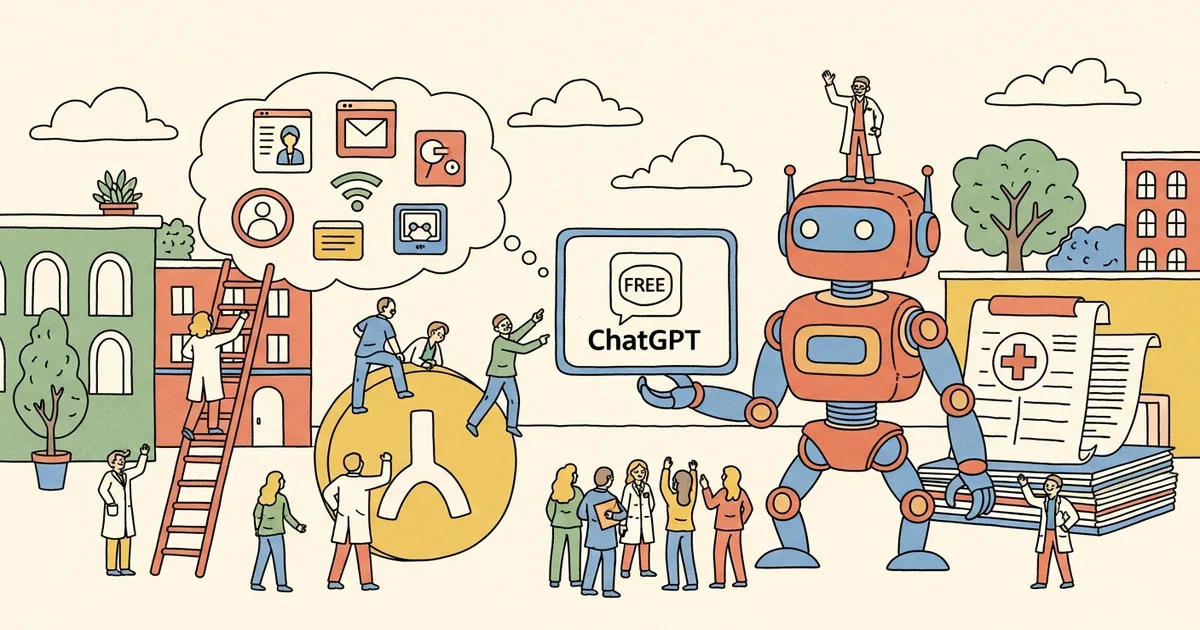
- OpenAI launched ChatGPT for Clinicians on April 23, 2026, offering free access to verified U.S. physicians, nurse practitioners, physician assistants, and pharmacists.
- Physician advisors rated 99.6% of 6,924 pre-release test conversations as safe and accurate; the system cited ground-truth sources more frequently than human physicians on a 355-example citation subset.
- OpenAI simultaneously released HealthBench Professional, an open benchmark built from physician-authored conversations with multi-stage adjudication, measuring AI on care consult, documentation, and medical research tasks.
- A 2026 American Medical Association survey found 72% of U.S. physicians now use AI in clinical practice, up from 48% the prior year.
What Happened
OpenAI on April 23, 2026 launched ChatGPT for Clinicians, a specialized workspace version of its AI assistant offered at no cost to verified U.S. physicians, nurse practitioners, physician assistants, and pharmacists. The product targets clinical documentation workflows — including prior authorization letters, referral notes, and patient instructions — alongside care consultation and medical literature review. Concurrently, OpenAI released HealthBench Professional, an open benchmark for evaluating AI performance on real clinician chat tasks across three categories: care consult, writing and documentation, and medical research.
Why It Matters
AI adoption in clinical settings has accelerated sharply. A 2026 survey by the American Medical Association found that 72% of U.S. physicians now use AI in clinical practice, up from 48% the prior year — an all-time high by the AMA’s measure. OpenAI reported that clinician usage of ChatGPT has more than doubled over the past 12 months, with millions of clinicians worldwide using the platform weekly. Earlier in 2026, the company introduced ChatGPT for Healthcare, an enterprise deployment option for health systems requiring compliance controls and administrative oversight at scale; clinicians at participating health systems are now using that product to accelerate documentation and research tasks.
Technical Details
Before release, OpenAI’s physician advisor network tested 6,924 conversations spanning clinical care, documentation, and research; 99.6% of responses were rated safe and accurate. On a separate subset of 355 examples — each assessed by three independent physicians who specified ground-truth citations — ChatGPT for Clinicians cited those sources more frequently than human physicians answering the same queries under equivalent conditions.
HealthBench Professional was constructed using physician-authored conversations and rubrics, multi-stage physician adjudication, and deliberate difficulty filtering: approximately one-third of examples involved physicians actively attempting to surface model failures, and the full dataset was filtered to select conversations 3.5 times harder than average for the models. OpenAI reports that GPT-5.4 running in the ChatGPT for Clinicians workspace outperforms base GPT-5.4, other OpenAI and third-party models, and human physicians on this benchmark. Across the broader physician advisor program, more than 700,000 model responses have been reviewed to date, with a new response evaluated approximately every few minutes.
One unnamed physician advisor quoted in OpenAI’s announcement said the product is “as close to an ideal clinical support partner as it gets” and described it as “an on-demand consultant I can engage on everything from current guidelines to billing and coding, with the added benefit of broad access to pediatric and pediatric subspecialty literature.”
Who’s Affected
The free tier is currently limited to verified U.S. physicians, nurse practitioners, physician assistants, and pharmacists. Clinicians at enterprise health systems already using ChatGPT for Healthcare gain access to the same specialized workspace with added compliance infrastructure. The HealthBench Professional paper and dataset are publicly available, giving third-party AI developers and clinical researchers a standardized rubric for evaluating competing systems. Conversations in the free tier are not used to train OpenAI models, and HIPAA Business Associate Agreement support is available for eligible accounts that need to process protected health information.
What’s Next
OpenAI stated it plans to expand access beyond U.S. borders, beginning with a pilot for verified clinicians in other countries through a partnership with the Better Evidence Network, subject to local regulatory approval. Alongside the product launch, the company released a Health Blueprint outlining a broader policy framework for AI in healthcare; no specific legislative or regulatory positions were detailed in the announcement. No timeline for international expansion was provided.