Key Takeaways
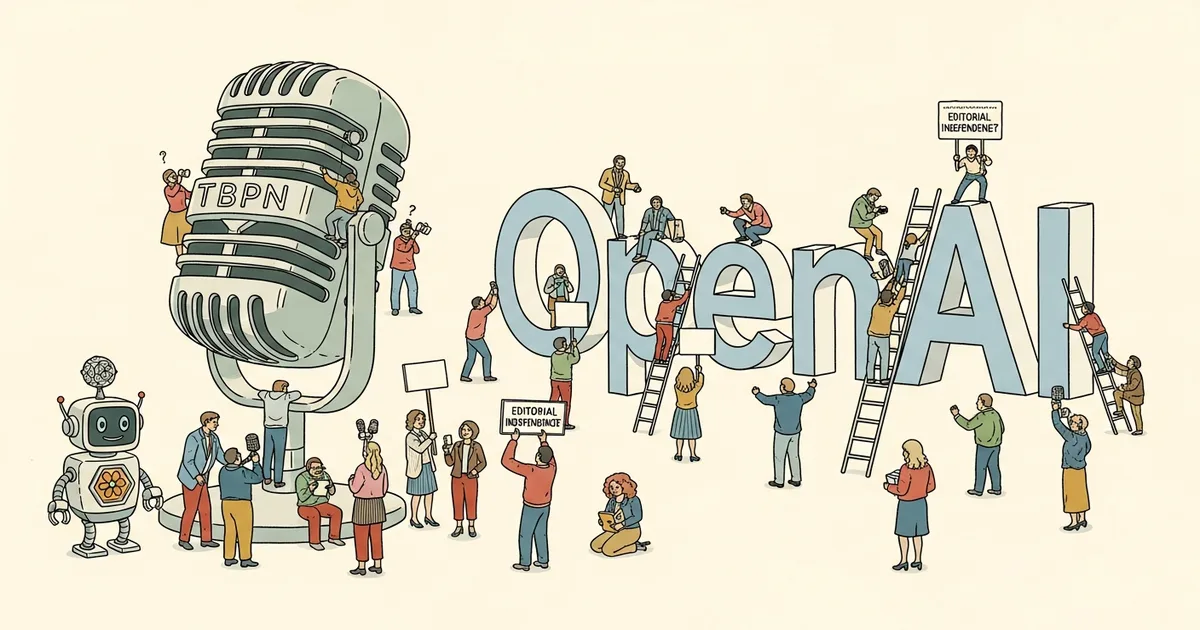
- OpenAI acquired TBPN, a tech talk show that has broadcast daily interviews with industry leaders since October 2024. The purchase price was not disclosed.
- TBPN will report to OpenAI’s Head of Communications Chris Lehane while supposedly maintaining editorial independence. The show’s advertising business will be shut down.
- TBPN averages roughly 70,000 viewers per episode across platforms and generated approximately $5 million in ad revenue in 2025, with projections of $30 million for 2026.
- The acquisition comes amid survey data showing poor public perception of AI, which Silicon Valley has partly attributed to traditional media coverage.
What Happened
OpenAI acquired TBPN, a tech-focused online talk show that has conducted daily interviews with prominent figures in the technology industry since October 2024. The purchase price was not disclosed, according to The Decoder and the Wall Street Journal.
TBPN broadcasts daily, with episodes running between 20 and 60 minutes. The show averages approximately 70,000 viewers per episode across various online platforms, according to the Wall Street Journal. TBPN generated roughly $5 million in advertising revenue in 2025, and its eleven-person team expected revenue to reach $30 million in 2026.
OpenAI’s Head of Applications Fidji Simo stated that TBPN will maintain editorial independence while also serving marketing and communication purposes. The show will report to OpenAI’s Head of Communications Chris Lehane. TBPN’s previous advertising business will be shut down.
Why It Matters
The contradiction at the center of this acquisition is structural, not speculative. A media outlet that reports to a company’s communications department cannot be editorially independent, regardless of initial assurances. OpenAI pays the salaries, controls the organizational structure, and can replace staff. The incentives are inherently misaligned with independent journalism.
The acquisition comes at a time when public perception of AI is notably poor. Surveys consistently show skepticism and concern about AI’s societal impact. According to The Decoder’s reporting, Silicon Valley has partly attributed this sentiment to how traditional media covers the technology. Acquiring a media outlet gives OpenAI a platform to shape the narrative directly.
This strategy has precedent in other industries. Tech companies have long invested in owned media, from corporate blogs to sponsored content studios. However, acquiring an existing independent show with an established audience and rebranding it as company-owned media while claiming editorial independence crosses into new territory.
Technical Details
TBPN’s operating model will change significantly under OpenAI’s ownership. The show’s advertising business, which generated $5 million in 2025, will be shut down entirely. This removes a potential source of editorial conflict, with advertisers no longer influencing content, but replaces it with a more direct conflict: the show’s sole funder is now the company it covers most closely.
The eleven-person TBPN team will continue producing daily episodes. The show will retain control over “programming, guests, and content,” according to Simo. However, the reporting line to Chris Lehane, OpenAI’s communications chief, means content decisions ultimately flow through the same department responsible for managing OpenAI’s public image.
TBPN’s projected revenue of $30 million for 2026, now eliminated as the ad business shuts down, represents the cost OpenAI absorbs for owning the platform. For a company valued at over $300 billion, this is a rounding error compared to the value of controlling a daily tech media channel.
Who’s Affected
TBPN’s existing audience of roughly 70,000 viewers per episode now consumes content produced by an OpenAI-owned entity. Viewers who tuned in for independent tech coverage must evaluate whether the show’s perspective shifts under its new ownership. The loss of advertising revenue as a business model means TBPN has no financial incentive beyond serving OpenAI’s interests.
Independent tech journalists and media outlets face a more complicated landscape. OpenAI’s move into owned media increases competitive pressure on outlets that cover AI critically. If TBPN’s 70,000-viewer platform amplifies OpenAI-favorable narratives, independent outlets must work harder to reach the same audience with alternative perspectives.
Other AI companies may follow OpenAI’s playbook. If owning a media platform proves effective at shaping public perception, Anthropic, Google, Meta, and other AI companies could pursue similar acquisitions, further blurring the line between corporate communications and journalism.
What’s Next
TBPN’s first episodes under OpenAI ownership will be closely watched for signs of editorial bias. Guest selection, topic framing, and the treatment of OpenAI competitors will serve as early indicators of whether the “editorial independence” promise holds in practice.
The broader question is whether owned media becomes a standard strategy in the AI industry’s approach to public relations. OpenAI’s $5 million annual cost for TBPN, the forgone ad revenue, is modest compared to traditional advertising budgets. If the format proves effective, expect other AI companies to launch or acquire their own media properties in 2026.