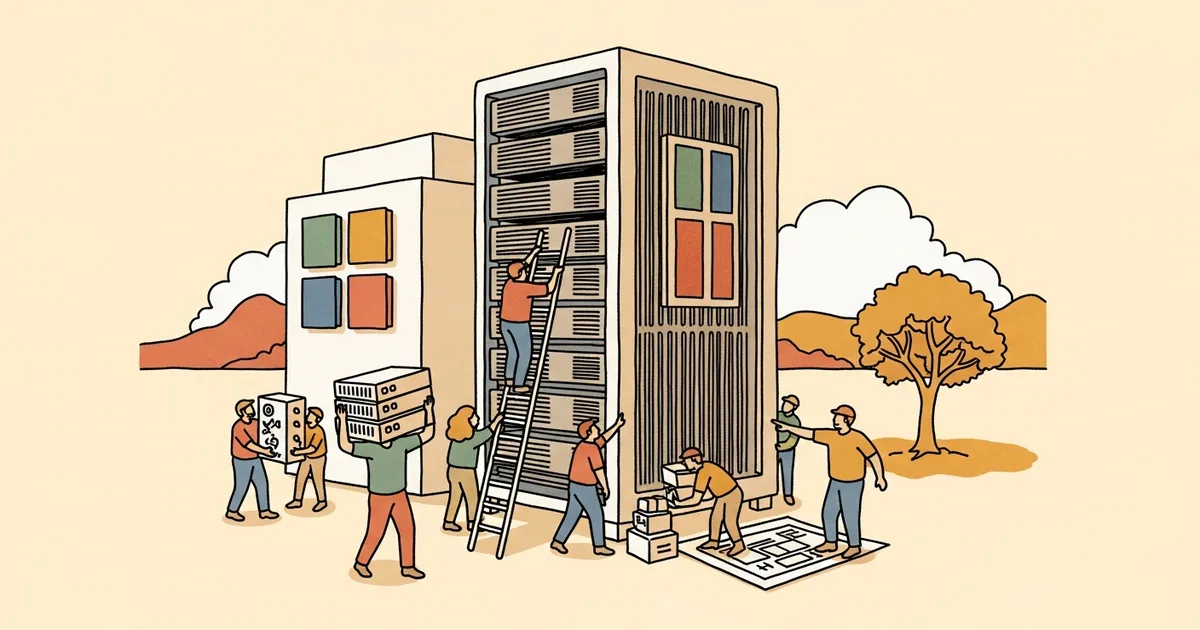
Microsoft is stepping in to take over a massive data center expansion project in Abilene, Texas, after OpenAI decided to pull back from further developing its ambitious Stargate initiative at the site. The move reshapes the AI infrastructure landscape and puts two of the most powerful players in artificial intelligence side by side at one of the largest computing complexes in the United States.
What Happened in Abilene
OpenAI originally announced the Stargate project as a cornerstone of its plan to build out computing capacity at an unprecedented scale. The Abilene, Texas facility was positioned as a key node in that effort. However, OpenAI has now decided to step back from further expansion at the site, creating an opening that Microsoft was quick to fill.
Microsoft will take over the expansion work, positioning itself as a neighbor to OpenAI at the same sprawling complex. The decision highlights how the relationship between the two companies continues to evolve, with Microsoft increasingly charting its own course in AI infrastructure development even as it remains OpenAI’s largest investor and cloud computing partner.
The Abilene complex is one of the most significant AI computing sites in the nation. The region has attracted billions of dollars in data center investment over the past two years, driven by cheap land, favorable energy pricing, and proximity to Texas’s expanding renewable energy grid.
Key Facts at a Glance
| Detail | Information |
|---|---|
| Location | Abilene, Texas |
| Original Developer | OpenAI (Stargate Project) |
| New Developer | Microsoft |
| Significance | One of the largest AI computing complexes in the US |
| Date Reported | March 28, 2026 |
| Relationship | Microsoft is OpenAI’s largest investor and Azure cloud partner |
Why OpenAI Pulled Back
OpenAI’s decision to withdraw from the Abilene expansion reflects a broader strategic recalibration. The company has been reassessing its infrastructure commitments as it balances the enormous capital requirements of training frontier AI models against the need to maintain financial flexibility. The Stargate project, while ambitious, required sustained capital expenditure that OpenAI appears to have deprioritized in favor of other initiatives.
Sources familiar with the matter suggest that OpenAI is consolidating its data center strategy, potentially focusing on fewer but more strategically located facilities rather than maintaining a sprawling network of expansion projects. This approach aligns with the company’s recent fundraising activities and its pivot toward generating revenue through consumer and enterprise products.
How Microsoft Benefits
For Microsoft, taking over the Abilene expansion is a strategic win on multiple fronts. The company gains access to a partially developed site with existing infrastructure, power agreements, and local government relationships already in place. This significantly reduces the timeline and cost compared to building from scratch.
Microsoft’s Azure cloud platform is the backbone of its AI strategy. The company needs massive amounts of compute capacity to serve its growing base of enterprise AI customers, power its Copilot product line, and support its own AI research efforts. The Abilene facility gives Microsoft additional capacity at a time when GPU availability and data center space remain among the most constrained resources in the technology industry.
The move also demonstrates that Microsoft is not solely dependent on OpenAI for its AI ambitions. While the partnership remains valuable, Microsoft has been building its own AI capabilities through internal research teams, the Phi model family, and strategic acquisitions.
The Evolving Microsoft-OpenAI Relationship
The Abilene handoff is the latest in a series of developments that illustrate the complex and evolving dynamic between Microsoft and OpenAI. When Microsoft invested $13 billion in OpenAI starting in 2019, the partnership was seen as straightforward: OpenAI would build the models, and Microsoft would provide the cloud infrastructure and enterprise distribution.
That picture has grown considerably more nuanced. OpenAI has been exploring ways to reduce its dependence on Microsoft’s Azure cloud, reportedly negotiating deals with other cloud providers. Meanwhile, Microsoft has been developing its own frontier AI models and infrastructure capabilities that could eventually reduce its reliance on OpenAI’s technology.
Despite these tensions, the two companies remain deeply intertwined. Microsoft’s Azure still hosts the majority of OpenAI’s computing workloads, and OpenAI’s models power key Microsoft products including Copilot for Microsoft 365. The Abilene situation, where both companies will operate neighboring facilities, serves as a physical metaphor for their relationship: close but increasingly independent.
Impact on the AI Data Center Market
The Texas AI data center market has become one of the hottest in the world. Major technology companies including Google, Meta, Amazon, and Apple have all announced or expanded data center operations in the state. The combination of relatively cheap electricity, vast available land, business-friendly regulations, and growing renewable energy capacity makes Texas an attractive location for the power-hungry operations that AI training and inference require.
Abilene in particular has emerged as a focal point. The city’s location in West Texas puts it near some of the state’s largest wind and solar installations, which can provide cost-effective power for energy-intensive computing operations. Local officials have actively courted technology companies with tax incentives and expedited permitting processes.
The broader AI infrastructure market continues to see record investment levels. Industry analysts estimate that global spending on AI data centers will exceed $300 billion annually by 2027, with the United States capturing the largest share. The competition for suitable sites, power capacity, and GPU allocations shows no signs of easing.
What This Means for AI Development
For the AI industry as a whole, the Abilene handoff signals several important trends. First, the era of unconstrained expansion may be giving way to more strategic and selective infrastructure investment. Companies are becoming more disciplined about where and how they build out compute capacity, rather than simply racing to secure as many sites as possible.
Second, the incident highlights the growing independence of major AI players from each other. Even within close partnerships, companies are prioritizing their own strategic flexibility. This dynamic is likely to intensify as AI becomes an even more central part of enterprise technology and consumer products.
Third, the continued concentration of AI computing in specific geographic areas like Texas raises questions about resilience and diversification. While the economic advantages of clustering are clear, the industry may need to consider the risks of concentrating too much critical infrastructure in any single region.
Bottom Line
Microsoft’s takeover of the Abilene data center expansion is more than a real estate transaction. It reflects the maturing dynamics of the AI infrastructure race, the evolving Microsoft-OpenAI relationship, and the strategic calculations that the world’s largest technology companies are making as they compete for dominance in artificial intelligence. For anyone tracking the AI industry’s direction, the developments in this small Texas city offer an outsized window into where the sector is heading.