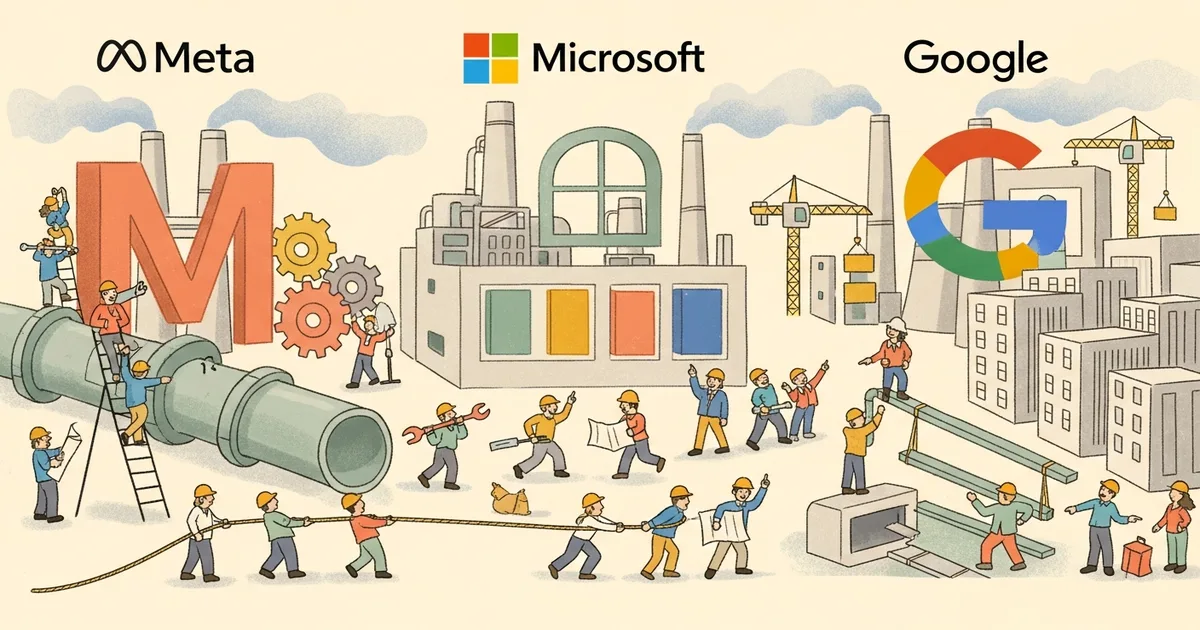
- Meta announced plans to expand its Hyperion data center in Louisiana to 7.46 GW of natural gas capacity, enough to power the entire state of South Dakota.
- Microsoft is partnering with Chevron and Engine No. 1 to build a natural gas plant in West Texas that could reach 5 GW.
- Google confirmed a partnership with Crusoe to build a 933 MW natural gas plant in North Texas.
- Natural gas turbine prices are projected to rise 195% by end of 2026 relative to 2019 prices, according to Wood Mackenzie.
What Happened
The three largest AI infrastructure investors in the United States are simultaneously building massive natural gas power plants to feed their growing data center operations. As TechCrunch reported on April 3, 2026, Microsoft announced a partnership with Chevron and Engine No. 1 to build a facility in West Texas capable of producing up to 5 gigawatts of electricity. Google confirmed it is working with Crusoe on a 933 MW natural gas plant in North Texas. And Meta revealed plans to add seven natural gas plants to its Hyperion data center in Louisiana, bringing total capacity to 7.46 GW.
The investments are concentrated in the southern United States, where some of the world’s largest natural gas deposits are located. The U.S. Geological Survey has estimated that one region alone contains enough gas to supply energy to the entire country for 10 months.
Why It Matters
The rush to secure natural gas infrastructure represents a significant strategic bet by major technology companies that electricity demand for AI workloads will continue growing faster than renewable energy capacity can be built. Each of these companies had previously made public commitments to reduce carbon emissions and achieve net-zero targets, and the pivot to fossil fuel-powered plants marks a pragmatic departure from those goals. Meta, Microsoft, and Google have all set net-zero targets, but the immediate need for reliable, high-capacity power has pushed natural gas back to the center of their energy strategies.
The scale of these projects is substantial. Meta’s 7.46 GW Hyperion facility alone would rank among the largest power-generating complexes in the United States, exceeding the output of most nuclear power stations. For comparison, the Hoover Dam produces approximately 2 GW at peak capacity, meaning Meta’s single data center complex will consume nearly four times as much power.
Technical Details
The demand for natural gas turbines has outstripped supply, creating a seller’s market for equipment manufacturers. Wood Mackenzie projects that turbine prices will rise 195% by the end of 2026 compared to 2019 levels. This price inflation reflects both increased demand from data center operators and constrained manufacturing capacity for the large-scale gas turbines required for facilities of this size.
Microsoft’s partnership with Chevron and Engine No. 1 is structured to potentially scale to 5 GW, making it one of the largest single power projects in the country. Engine No. 1, the activist investment firm that gained attention for its successful proxy fight at ExxonMobil in 2021, brings energy sector expertise and capital to the venture. Google’s 933 MW Crusoe partnership is comparatively modest in scale but still represents a significant commitment to fossil fuel infrastructure.
The concentration of these projects in Texas and Louisiana leverages existing pipeline infrastructure and proximity to natural gas supply from the Permian Basin and Haynesville Shale formations. These locations also benefit from relatively permissive state regulatory environments for energy development and construction permitting, allowing faster buildout than would be possible in many other states.
Who’s Affected
Local communities in Texas and Louisiana face both economic opportunities from construction jobs and long-term employment, and environmental consequences from increased fossil fuel combustion in their regions. Natural gas plants produce carbon dioxide, methane, and nitrogen oxide emissions, contributing to climate change and potentially affecting local air quality. Climate advocacy groups have criticized the tech industry’s growing reliance on fossil fuels, arguing it undermines the credibility of corporate sustainability pledges. Equipment manufacturers like GE Vernova and Siemens Energy stand to benefit from surging turbine demand and the 195% price increase projected by Wood Mackenzie.
What’s Next
Construction timelines for these facilities typically span 18 to 36 months, meaning the first wave of new natural gas capacity specifically built for AI data centers could come online by late 2027 or early 2028. The steep projected price increase for turbines may push some operators to explore alternative power sources, including nuclear energy, which both Microsoft and Google have pursued through separate initiatives involving small modular reactors. Whether the current pace of AI infrastructure investment proves sustainable will depend on continued demand growth for AI computing and the willingness of hyperscale companies to absorb rising energy costs as part of their operating expenses.