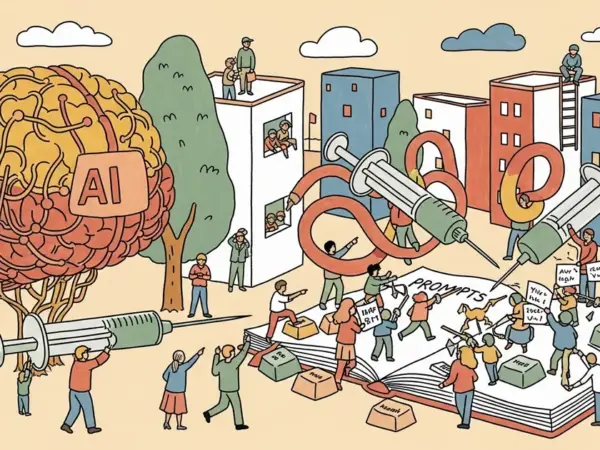
Meta Platforms (NASDAQ: META) has deployed keystroke logging and screenshot capture software on employee computers — a form of employee tracking aimed at harvesting AI training data, not monitoring productivity — according to a report by gHacks Technology News published April 23, 2026. The company is simultaneously laying off approximately 8,000 employees in its largest workforce reduction of 2026. The sequence is precise: extract expert knowledge from workers, encode it into AI model weights, then eliminate those workers.
Meta Employee Tracking: What the Software Actually Captures
The tracking software logs keystrokes and captures periodic screenshots from company-owned machines. This records the full substance of knowledge work: code written line by line, document drafts and revisions, UI interactions, internal search queries, chat messages, and communications across Meta’s internal tooling.
Keystroke data combined with screen captures allows AI systems to learn the process of producing work, not just the finished output. A software engineer’s debugging keystrokes encode the sequence of hypotheses tested, code paths explored, and error patterns recognized. A designer’s screenshot sequence documents aesthetic decision-making in progress. A product manager’s document revisions capture how priorities get weighed and discarded. These cognitive workflows are precisely what large language models and coding assistants cannot acquire from static public datasets — the internet contains outputs, not the reasoning that produced them.
Meta’s AI portfolio demands this kind of data. The Llama model family, Meta AI assistant, internal developer tooling, and AI features embedded across WhatsApp, Instagram, and Facebook each require domain-specific training that public internet scraping cannot supply at sufficient quality or depth.
How Keystroke Data Becomes AI Training Material
Modern AI training increasingly depends on process data rather than finished outputs. OpenAI’s o-series reasoning models are trained on chains of thought rather than final answers — the problem-solving sequence, not the conclusion. Meta’s keystroke captures appear designed for the equivalent purpose: documenting how expert humans approach problems at the moment they are being solved.
The pipeline from raw keystroke data to model improvement follows identifiable stages. Raw input sequences are cleaned and structured into task-level sessions. Sessions are labeled by function type — coding, writing, design, communication — and potentially tiered by employee performance rating, creating quality gradients in the training set. Those labeled sequences then feed into fine-tuning runs or RLHF (reinforcement learning from human feedback) training cycles. The result is AI behavior calibrated to the cognitive patterns of Meta’s most capable employees.
This technique mirrors robotics training methodology: capturing human motor sequences rather than programming explicit behaviors produces more generalizable AI motion. Applied to knowledge work, it is materially more effective than scraping finished documents from the internet, which lack the iterative, error-correcting quality of expert thought in progress. One internal Meta engineering document leaked in 2025 described this kind of behavioral imitation data as worth “10x to 100x” equivalent synthetic data for coding assistant tasks.
The Layoff Connection: Training Your Replacement
Meta’s approximately 8,000-person reduction follows a pattern visible across large AI-deploying firms — aggressive capability building concurrent with workforce reduction — but the addition of systematic knowledge extraction before the layoffs creates a documented sequence not seen at this scale before.
The employees being tracked and subsequently let go include software engineers, product managers, designers, and content specialists: exactly the roles whose cognitive workflows keystroke software is best positioned to capture. The Humans First movement, which has grown to an estimated 340,000 members globally, has cited Meta’s actions as direct confirmation of their central argument — that AI deployment at major corporations is designed to replace, not augment, skilled workers.
The economic calculus is straightforward. A senior engineer earning $400,000 annually whose full working pattern is captured in training data provides value that persists indefinitely in model weights at zero ongoing cost. The competitive dynamics between major AI labs create structural pressure to extract that value before competitors access equivalent training signals from their own workforces.
What makes this case distinct from ordinary AI-driven efficiency gains is the sequencing: the data collection was operational before the layoff announcements. Employees whose keystrokes were being logged had no knowledge that their work was simultaneously being used to build the system that would make their positions redundant.
Employee Reactions and the Consent Problem
Internal reaction at Meta has ranged from resignation to outright anger, according to sources familiar with the matter. The core grievance is not workplace surveillance — enterprise monitoring software is standard in corporate environments — but the undisclosed repurposing of surveillance data for commercial AI training.
Employees at major technology firms sign employment agreements stipulating that work product belongs to the employer. Whether keystroke sequences and screenshots constitute “work product” in the legal sense, and whether training a commercial AI on this data requires separate and explicit consent, is genuinely unsettled law. No U.S. court has ruled directly on the question of whether employee behavioral data captured for monitoring purposes can be repurposed for AI training without additional disclosure.
The disclosure problem is compounded by timing. Employees who were monitored and subsequently laid off have no ongoing employment relationship through which to object, negotiate, or seek remedy. The data has been collected; the employment relationship has ended. Whatever training runs incorporate that data will continue operating indefinitely after the workers who generated it are gone.
Legal Exposure: GDPR, U.S. Labor Law, and State Privacy Rights
Meta’s European operations face the most immediate and quantifiable legal risk. Under the EU General Data Protection Regulation (GDPR), employee data collected for one declared purpose — productivity monitoring — cannot be repurposed for a materially different use — AI training — without a fresh legal basis. Article 5(1)(b) of the GDPR specifies this “purpose limitation” principle directly.
The European Data Protection Board issued guidance in 2025 explicitly addressing AI training on employee data, stating that employers cannot rely on “legitimate interest” as a GDPR legal basis when employees have no meaningful ability to opt out. Consent under an employment relationship is presumed to be coerced under EU law, eliminating it as a valid basis in most member states. That leaves Meta with no clean legal pathway for this data processing in Europe.
GDPR fines for systematic, large-scale unlawful processing are capped at the higher of €20 million or 4% of global annual turnover. Meta’s 2025 revenue exceeded $160 billion, placing the theoretical maximum fine above $6.4 billion. The Irish Data Protection Commission — Meta’s lead EU supervisory authority — has not yet commented publicly on the gHacks report, but the DPC has demonstrated willingness to act against Meta: the 2022 suspension of Facebook’s EU-US data transfers, the €1.2 billion fine in 2023, and subsequent enforcement actions all originated from the same office.
| Jurisdiction | Applicable Law | Key Issue | Maximum Penalty |
|---|---|---|---|
| European Union | GDPR Article 5(1)(b) | Purpose limitation, consent validity | 4% global revenue (~$6.4B) |
| United States | ECPA, NLRA Section 7 | Repurposing consent, labor rights | Variable by state; civil liability |
| California | Labor Code §980, CCPA | Employee privacy rights, data use disclosure | Up to $7,500 per intentional violation |
| United Kingdom | UK GDPR, Data Protection Act 2018 | Purpose limitation, employee rights | £17.5M or 4% global revenue |
In the United States, the National Labor Relations Board could examine whether undisclosed training data collection on employee communications interferes with workers’ Section 7 rights — specifically the right to engage in concerted activity about working conditions. If employees discussing layoffs, compensation, or AI displacement had those communications captured and fed into training data, that crosses a distinct legal threshold separate from privacy law. Legal scholars at Stanford’s Center for Internet and Society have argued that the commercial use of employee data for AI training requires explicit disclosure beyond standard employment agreements, even in at-will employment states.
The Industry’s Open Secret: Who Else Is Doing This
Meta is unlikely to be the only company doing this. It is the first major firm caught doing it at documented scale. The competitive logic applies identically to any large AI-deploying corporation: internal expert data is more valuable than public data, employees generate it continuously, and capturing it carries minimal marginal cost where monitoring infrastructure already exists.
Microsoft, Google, Amazon, and Salesforce all operate enterprise software that, by architecture, could log detailed interaction data from employee machines. Each is simultaneously building AI systems that would benefit from exactly this training signal. The global race to build AI infrastructure creates structural pressure to exploit every available data source before competitors access equivalent signals — and internal expert behavioral data is among the highest-signal sources available.
The semantic distinction between “product telemetry” and “AI training data collection” has largely dissolved. Microsoft’s Copilot telemetry logs how users interact with AI-assisted tools. Google Workspace logs document revision histories in granular detail. Both companies began training on their own product telemetry — a practice disclosed only in updated terms of service that the overwhelming majority of users never read. The difference between employee monitoring and AI training data capture is increasingly definitional, not operational.
MegaOne AI tracks 139+ AI tools across 17 categories, and across that coverage, the pattern of capability expansion followed by workforce reduction is visible in at least 12 major technology firms since 2024. Meta’s case is the most explicit documented instance of the extraction-then-elimination model. Even firms building high-profile creator partnerships are simultaneously building the automation that renders those roles redundant — the public-facing collaboration and the internal displacement operate in parallel.
What Workers and Regulators Should Do Now
For employees at major technology firms, the immediate practical response is to assume that any work conducted on employer-owned hardware or networks is potentially captured for AI training purposes — regardless of what current employment agreements disclose. That assumption should govern which creative work, sensitive communications, and novel problem-solving occur on company systems versus personal devices.
For regulators, Meta’s case is a clear enforcement trigger with existing legal tools. The GDPR’s Article 66 urgency procedure allows EU data protection authorities to impose immediate, temporary bans on specific processing operations without completing a full investigation. The Irish DPC has deployed this mechanism against Meta before. Using it here would establish that AI training data extraction from employees is subject to the same purpose-limitation rules as any other data processing — a precedent with industry-wide consequences.
California’s legislature has a bill in committee — the successor to SB 1047’s employee AI disclosure framework — that would require explicit, separate consent before employers can use captured work data for AI training purposes. Meta’s actions provide exactly the case study that legislation needs to advance.
Meta had not responded to media requests for comment on the gHacks report as of April 25, 2026. Companies confident in the legality of their practices say so immediately. What comes next is a regulatory proceeding that will determine whether systematic employee knowledge extraction becomes an industry-wide enforcement target or an absorbed cost of building AI at scale — and which answer emerges will depend almost entirely on whether the Irish DPC moves before other regulators normalize the practice by inaction.