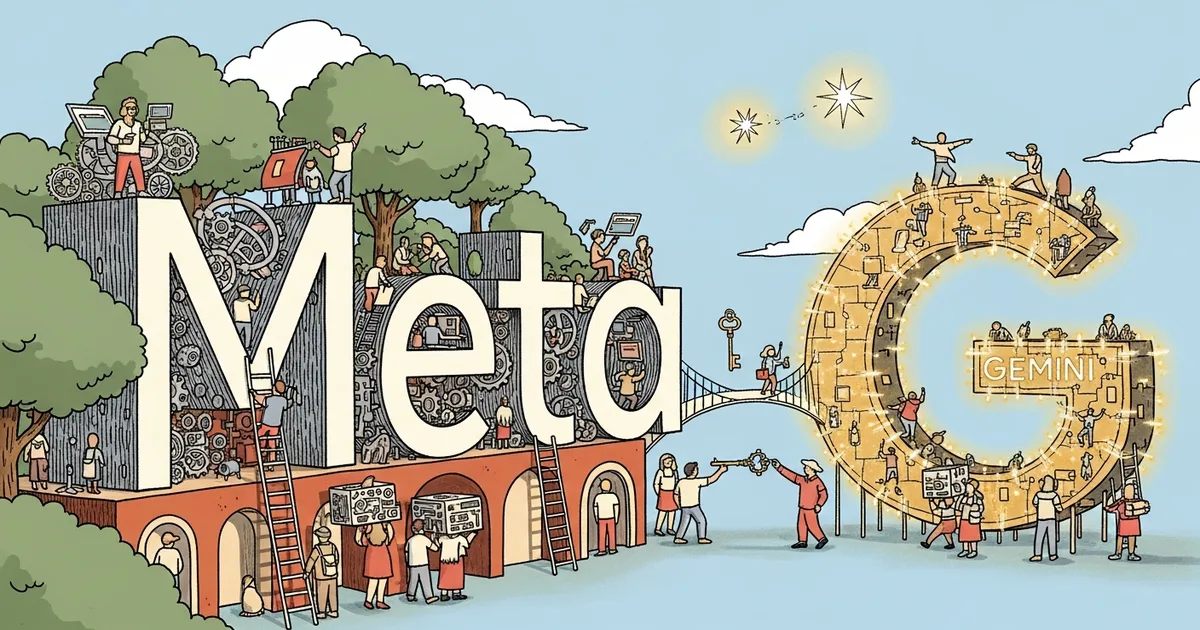
- Meta has delayed the release of an in-development AI model following internal trial runs that fell short of internal benchmarks, according to a New York Post report published April 8, 2026.
- The company is reportedly evaluating whether to license Google’s Gemini technology rather than ship its own model on the original timeline.
- The report, citing people familiar with the matter, did not identify the specific model or the metrics on which it underperformed.
- A licensing deal with Google would represent a significant departure from Meta’s open-source Llama strategy.
What Happened
Meta has delayed the scheduled release of a new AI model after disappointing internal trial runs, the New York Post reported on April 8, 2026, citing people familiar with the matter. The company is simultaneously evaluating a licensing arrangement with Google that would give Meta access to Gemini rather than deploying its own underperforming build. The report did not name the specific model, the benchmarks involved, or the original release date that was pushed.
Why It Matters
Meta has for three years pursued a distinctly open-weights AI strategy through its Llama model family — releasing Llama 2 in July 2023, Llama 3 in April 2024, and Llama 3.1 with a 128,000-token context window in July 2024. Licensing a proprietary model from Google would invert that posture and introduce a commercial dependency on a direct competitor. It would also raise questions about Meta’s ability to remain self-sufficient in foundation model development at a time when rivals including Google, OpenAI, and Anthropic have been releasing successive generations at an accelerating pace.
Technical Details
The New York Post report did not specify the architecture of the delayed model, the nature of the trial runs conducted, or which capability dimensions — reasoning, coding, multimodal performance, or instruction-following — produced results below expectations. Google’s Gemini family, commercially available since December 2023, spans multiple tiers from Gemini Nano (on-device) to Gemini Ultra (data center), with the Gemini 1.5 line introducing long-context capabilities of up to one million tokens. Meta’s Llama 3.1 405B, its largest publicly released model as of mid-2024, was benchmarked competitively against GPT-4 on several standard evaluations but lagged on others. The report’s lack of specific model identification makes direct technical comparison impossible at this stage.
Who’s Affected
Developers and enterprises that have built production workloads on Meta’s open Llama models would face a changed landscape if Meta pivots toward proprietary licensed models, which typically carry usage restrictions and API costs. Google would gain a high-profile enterprise licensing customer if the deal proceeds — a significant commercial validation of Gemini’s competitiveness. Meta’s internal AI teams, which have been scaling rapidly, could face strategic uncertainty about the direction of in-house model development.
What’s Next
The New York Post report did not include a revised timeline for the delayed model or a deadline for the Gemini licensing decision. Meta has not issued a public statement confirming or denying the report. Further clarity is likely to emerge through official announcements or additional reporting as any licensing agreement would require disclosure under standard commercial terms.