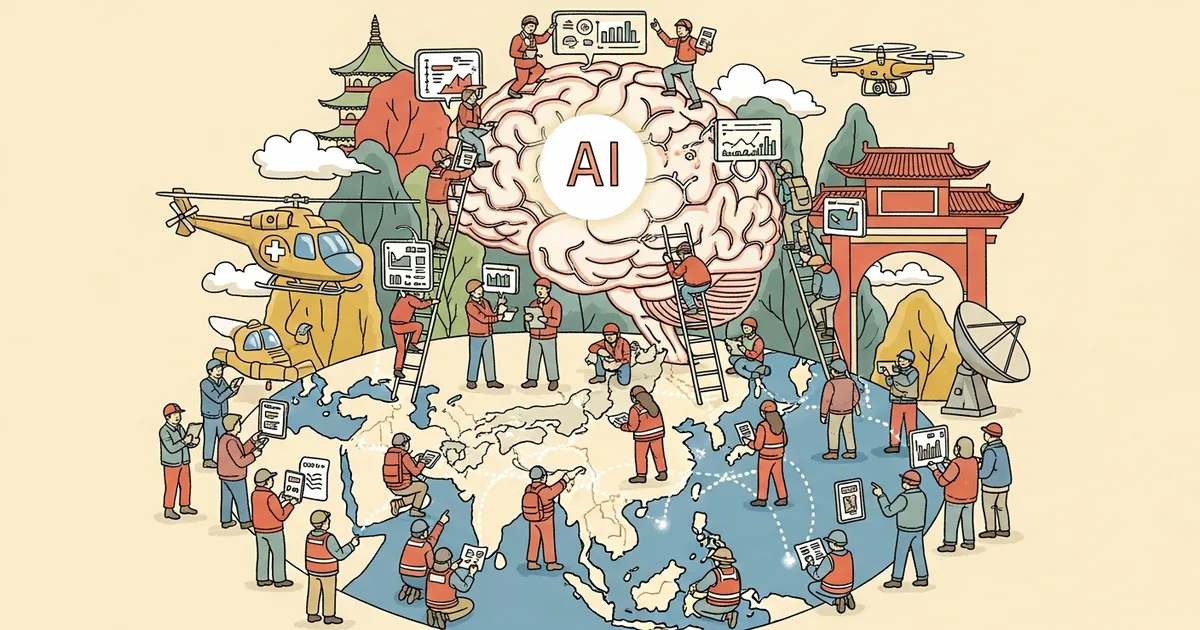
- OpenAI hosted its first AI Jam for Disaster Management, bringing together 50 disaster response leaders from 13 countries across South and Southeast Asia.
- During Cyclone Ditwah in Sri Lanka, ChatGPT saw a 17-fold increase in cyclone-related messages, showing how people already turn to AI during crises.
- Participants worked with OpenAI mentors to build custom GPTs and reusable workflows for tasks ranging from early warning systems to recovery planning.
- The initiative was organized in partnership with the Gates Foundation, the Asian Disaster Preparedness Center, and DataKind.
What Happened
OpenAI partnered with the Gates Foundation, the Asian Disaster Preparedness Center (ADPC), and DataKind to host its first AI Jam for Disaster Management. The multi-day event convened 50 disaster management professionals from 13 countries: Bangladesh, India, Indonesia, Lao PDR, Malaysia, Myanmar, Nepal, Pakistan, the Philippines, Sri Lanka, Thailand, Timor-Leste, and Vietnam.
Participants included representatives from government disaster agencies, multilateral organizations, and non-profits working on disaster preparedness and emergency response across the region. They worked alongside OpenAI mentors and technical staff to identify practical ways that AI could support their daily operations, from issuing early warnings to coordinating complex post-disaster recovery efforts across multiple agencies and jurisdictions.
Why It Matters
South and Southeast Asia face some of the world’s highest exposure to natural disasters, including typhoons, earthquakes, flooding, landslides, and tsunamis. Many of the region’s disaster response agencies operate with limited staff, constrained budgets, and fragmented communication systems across national and local levels. Faster information processing, translation, and coordination tools represent a pressing operational need for these organizations.
OpenAI’s internal usage data reveals that people are already turning to AI tools during emergencies, even without formal integration into disaster response systems. During Cyclone Ditwah in Sri Lanka, the company recorded a 17-fold increase in cyclone-related messages on ChatGPT compared to baseline usage patterns. During Cyclone Senyar in Thailand in November 2025, message volume jumped 3.2 times compared to preceding months. These usage surges indicate that affected populations are treating AI as an ad hoc information source during crises, underscoring both the demand for and the potential value of purpose-built disaster response AI tools.
Technical Details
The AI Jam focused on two main technical outputs: custom GPTs tailored to specific disaster response scenarios and reusable workflows that can be adapted across different types of emergencies and geographic contexts. Custom GPTs allow organizations to build specialized chatbots trained on local hazard data, institutional response protocols, regional maps, and situation-specific information that general-purpose models would not have access to.
Participants explored how these tools could assist with specific operational tasks such as analyzing satellite imagery after a flood to identify affected areas and prioritize response, summarizing situation reports across multiple agencies working in the same disaster zone, translating emergency communications into local languages beyond English, and generating standardized damage assessment templates for faster and more consistent reporting to national and international bodies.
The goal was to transition AI from a general-purpose information retrieval tool to an integrated component of existing disaster response operations and workflows. The event also addressed practical constraints that disaster response teams encounter in the field, including unreliable internet connectivity in affected areas, data privacy concerns when handling sensitive information about displaced populations, the need for tools that function accurately across dozens of regional languages and local dialects, and the challenge of validating AI outputs under the time pressure of active emergency operations.
Who’s Affected
The initiative directly involves disaster response agencies and humanitarian organizations across 13 Asian countries representing billions of people in disaster-prone regions. The ADPC, which coordinated participation, serves as the region’s primary intergovernmental center for disaster risk reduction and maintains relationships with national disaster management authorities throughout the Asia-Pacific.
Indirectly, the program affects vulnerable populations in coastal areas, river flood plains, and seismically active zones across South and Southeast Asia. Faster and more accurate disaster response can reduce casualties, accelerate the distribution of emergency aid, and improve recovery timelines for communities affected by natural disasters. The initiative also establishes a model for how AI companies can contribute to humanitarian efforts beyond their core commercial products and services.
What’s Next
OpenAI is exploring a second phase that would involve pilot deployments of the tools developed during the AI Jam, along with deeper technical collaboration with participating organizations. The company has not announced a specific timeline or funding commitment for these pilots. The central open question is whether tools built during a structured workshop setting can perform reliably under the infrastructure constraints, variable data quality, and intense time pressure of an actual disaster response operation in a low-connectivity environment.