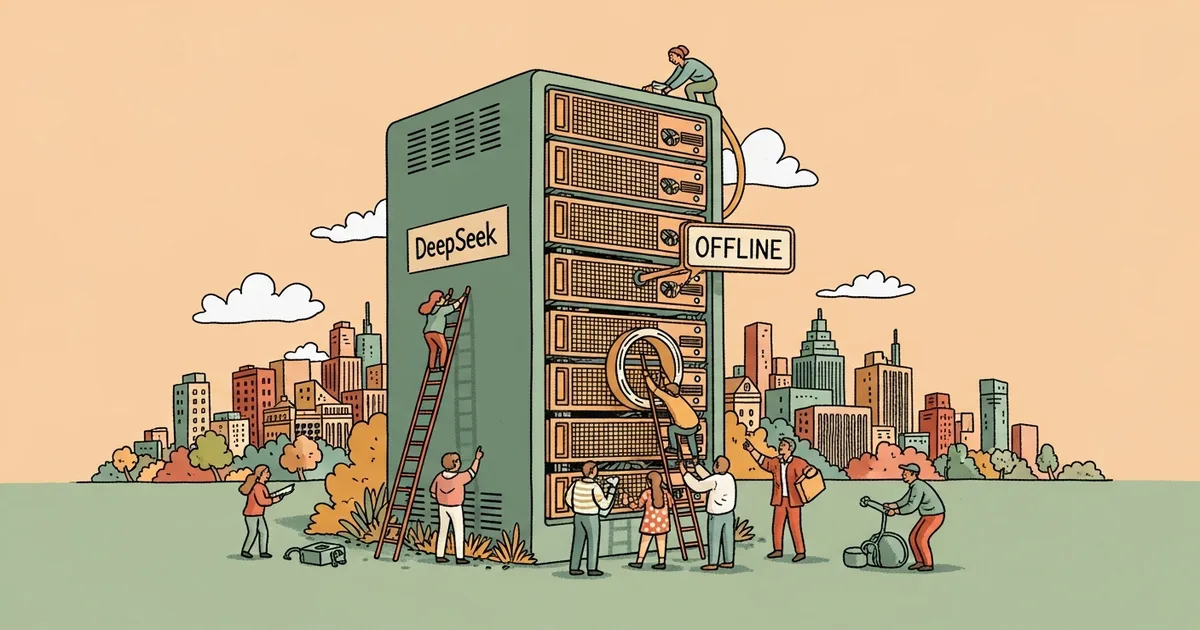
- DeepSeek‘s AI chatbot went offline for over seven hours on March 30, 2026, marking its longest consumer outage since the platform’s viral debut in January 2025.
- The disruption locked an estimated 355 million registered users out of chat histories and daily workflows across two separate incidents spanning overnight hours.
- DeepSeek has not disclosed a root cause or issued any official statement, and speculation ranges from infrastructure strain to preparation for its anticipated V4 model update.
- Prior to this event, no DeepSeek outage had exceeded two hours, and the platform maintained close to 99 percent uptime since launch.
What Happened
DeepSeek’s consumer chatbot suffered a prolonged service disruption spanning two separate incidents on the night of March 29 and morning of March 30, 2026. Outage-tracking platform Downdetector first recorded a surge of user complaints on Sunday evening, with reports concentrated in China but also appearing from users in Europe, Southeast Asia, and North America.
DeepSeek’s own status page acknowledged the initial problem at 9:35 p.m. local time and marked it resolved roughly two hours later, around 11:35 p.m. That fix did not hold.
A second wave of failures hit Monday morning and persisted until 10:33 a.m. local time, bringing the combined downtime to seven hours and 13 minutes. During both windows, users reported being unable to load conversations, start new sessions, or access their saved chat history. According to Bloomberg, the disruption affected DeepSeek’s web interface and API endpoints simultaneously, meaning developers relying on the service for automated workflows were also completely cut off.
Why It Matters
DeepSeek has grown into one of the most widely used AI platforms in the world since unveiling its R1 reasoning model in January 2025. The service now counts roughly 355 million registered users globally, according to TechRepublic, and many of those users rely on it as a primary productivity and research tool.
A seven-hour outage at that scale is not a minor inconvenience. Enterprises that have integrated DeepSeek’s API into customer service pipelines, code-generation workflows, and automated research tools faced hours of dead time with no official explanation or estimated time to recovery. The incident raises direct questions about the platform’s infrastructure resilience as it scales to compete with OpenAI, Anthropic, and Google.
Before this event, DeepSeek had maintained a near-spotless reliability record, with no previous consumer-facing outage exceeding two hours. That uptime track record was a selling point for organizations evaluating whether to build production systems on top of the platform, and a single extended failure can shift those risk assessments.
Technical Details
DeepSeek has not released a post-incident report or identified a root cause for the disruption. The company did not respond to press inquiries from multiple outlets, including Bloomberg and Techzine, which noted that “DeepSeek was offline for more than seven hours due to a malfunction. The cause is unclear; the company has not responded.”
The pattern of the outage, an initial fix followed by a recurrence hours later, suggests the underlying issue was not fully diagnosed during the first response cycle. This two-phase failure pattern is common in infrastructure incidents involving cascading dependencies or incomplete rollbacks.
In January 2025, DeepSeek experienced a separate disruption attributed to a large-scale cyberattack, but no evidence of a similar attack has surfaced in connection with this incident. Some industry observers have speculated that the downtime may be linked to infrastructure changes in preparation for the company’s rumored V4 model release, though DeepSeek has not confirmed any such timeline or connection.
Who’s Affected
The outage hit hardest in China, where DeepSeek is a dominant consumer AI tool used by students, professionals, and enterprises alike. Users in Europe, Southeast Asia, and North America also reported disruptions throughout the overnight window. Developers using the DeepSeek API for production applications lost access for the full seven-hour duration.
Individual users lost access to saved conversations and in-progress work. Organizations that had moved workflows onto DeepSeek’s platform without implementing fallback systems or multi-provider redundancy found themselves without alternatives during the extended outage window.
What’s Next
DeepSeek has yet to publish a formal post-mortem or commit to specific reliability improvements following the incident. For organizations evaluating DeepSeek as a production dependency, the absence of transparency around root cause analysis and remediation planning is itself a concrete risk factor. Until the company provides a detailed incident report explaining what failed and what has been changed to prevent recurrence, users have no way to assess whether the underlying issue has been fully resolved or could happen again.