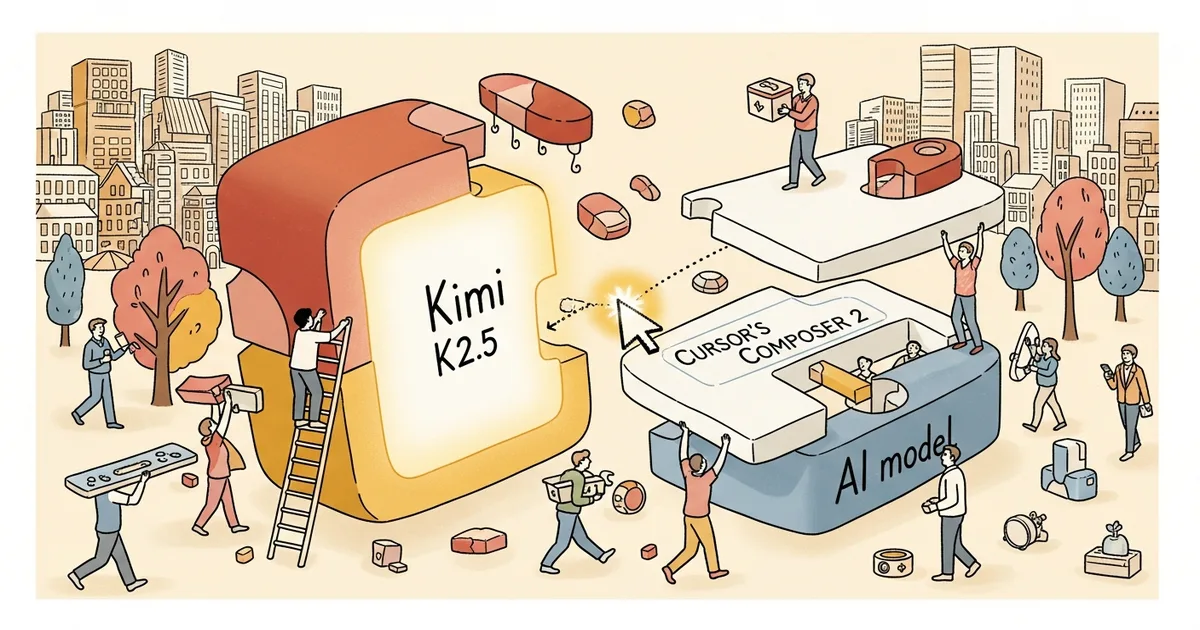
Developer Fynn discovered that Cursor’s newly launched Composer 2 coding model is built on Kimi K2.5, an open-source model from Chinese startup Moonshot AI. Fynn intercepted API traffic from the Cursor application and found requests being routed to Kimi K2.5’s infrastructure, a finding he posted on X where it accumulated 2.6 million views within days of the March 19 launch.
Cursor had marketed Composer 2 as delivering “frontier-level coding intelligence” without disclosing that the underlying model was a fine-tuned version of an open-source Chinese model rather than a proprietary system. The company initially did not respond to the discovery. Moonshot AI subsequently confirmed that Cursor was an authorized user of Kimi K2.5, stating the partnership was legitimate but had not been publicly announced.
The controversy highlights a tension in the AI coding tool market: companies build brands around model capability while the underlying models are increasingly interchangeable. Cursor’s value proposition has been its editor experience and integration quality, not exclusive access to a proprietary model. Using a strong open-source model as the backend is a rational engineering decision — but marketing it as proprietary “frontier-level” technology while concealing the source created the trust problem.
The incident also underscores the growing influence of Chinese open-source AI models in Western developer tools. Kimi K2.5 performs competitively with proprietary Western models on coding benchmarks, and its open-source license allows commercial use without royalties. If Cursor’s users experienced Composer 2 as a genuine improvement — which initial reception suggested — then the model’s origin is technically irrelevant to its utility, though the lack of transparency is not.
Cursor has not issued a formal statement addressing the discovery. The episode is likely to accelerate demands for model provenance transparency across AI-powered developer tools, where users currently have no reliable way to know which model processes their code.