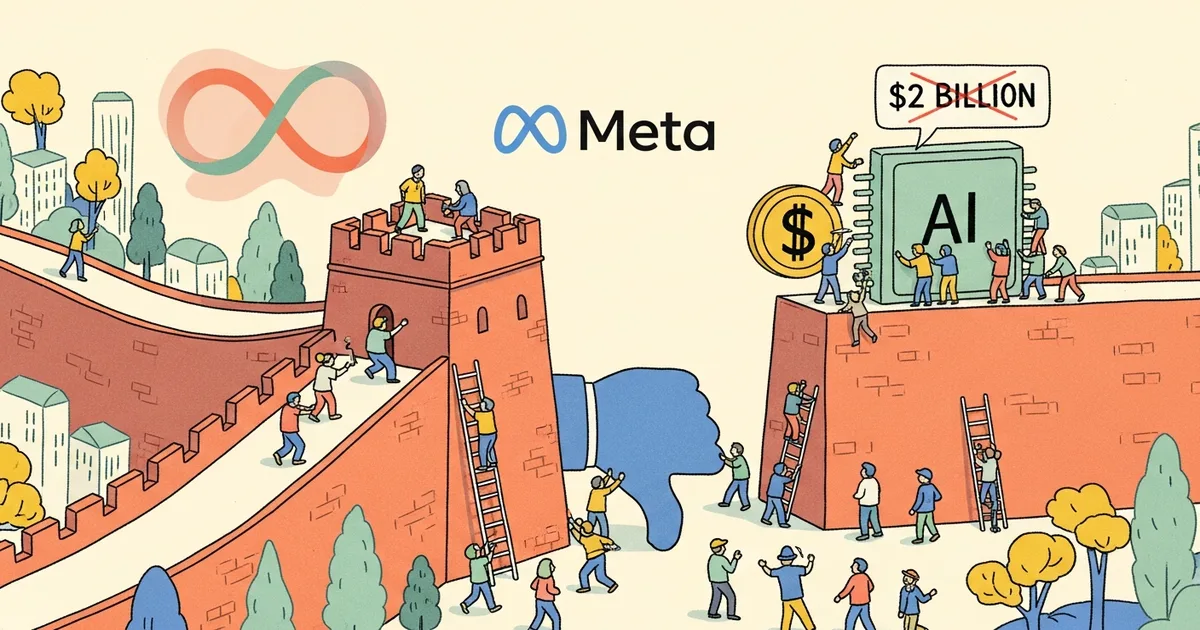
- Chinese authorities blocked Meta Platforms’ reported $2 billion acquisition offer for Manus, a Chinese autonomous-AI-agent startup, according to CNBC.
- Manus drew global attention after launching its autonomous AI agent in March 2025, accumulating a waitlist of over one million users within days.
- The decision reflects China’s intensifying regulatory posture toward foreign acquisitions of domestically developed AI companies.
- The blocked deal represents one of the largest reported AI acquisition attempts to collapse under cross-border regulatory pressure.
What Happened
Chinese authorities blocked Meta Platforms from completing a reported $2 billion acquisition of Manus, a Chinese AI startup whose flagship autonomous agent attracted significant global interest in 2025, CNBC reported on April 28, 2026. The intervention came after Meta, led by chief executive Mark Zuckerberg, moved to absorb the company into its growing AI portfolio. The block reflects a pattern of Chinese government action to keep domestically developed AI technology out of foreign corporate control.
Why It Matters
China’s decision to intervene mirrors mechanisms the United States employs through the Committee on Foreign Investment in the United States (CFIUS), which regularly screens acquisitions of American technology companies by foreign buyers. The move signals that autonomous AI agent systems — not just semiconductors — are now in scope for Chinese national-security-adjacent review. Manus’s co-founder Xiao Hong, known publicly as Peak Xiao, had positioned the company as building general-purpose AI that could act in the world on behalf of users, a capability that Chinese regulators appear to classify as strategically sensitive.
Technical Details
Manus launched its autonomous AI agent on March 6, 2025, demonstrating end-to-end task completion across software development, data analysis, research synthesis, and travel planning — without requiring iterative user prompting at each step. The system operated by controlling a virtual desktop environment, executing browser sessions, writing and running code, and managing file systems autonomously. Unlike prompt-response chatbots, Manus agents persisted across multi-hour task horizons, a technical distinction that set it apart from contemporaneous products. The company reported a waitlist exceeding one million users within days of its public debut, according to statements made at launch.
Who’s Affected
Meta’s autonomous-agent strategy suffers a concrete setback: the company had identified Manus as a potential shortcut to fielding competitive agentic AI capabilities alongside OpenAI’s Operator and Google DeepMind’s Project Mariner. Chinese AI developers more broadly now face a clarifying signal — international demand for their technology does not translate into permission to transfer it to foreign ownership. Manus’s existing enterprise customers and the estimated million-plus users on its platform face uncertainty about the company’s capitalization and product roadmap following the deal’s collapse.
What’s Next
Manus will need to pursue alternative capital paths — likely Chinese venture funding or a domestic strategic partner — now that the Meta acquisition is off the table. Meta is expected to accelerate internal agentic AI development or seek acquisition targets in jurisdictions not subject to Chinese regulatory review. The incident may push Beijing toward issuing explicit guidance on which categories of AI capability are classified as off-limits to foreign acquirers, reducing ambiguity for future cross-border deals in the sector.