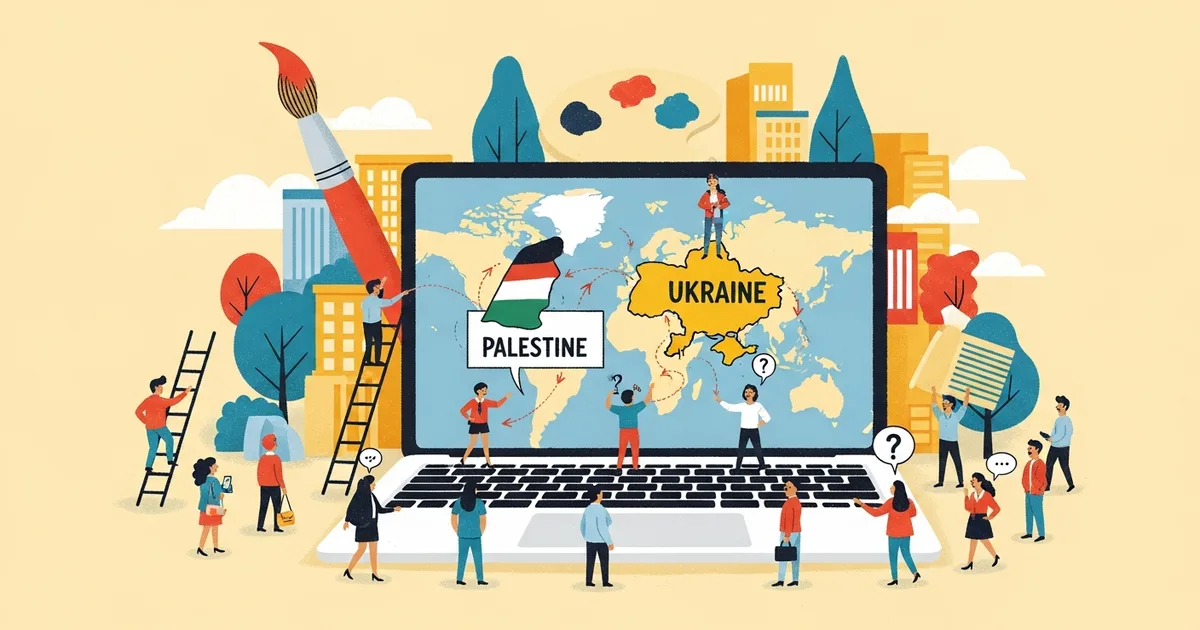
- Canva’s Magic Layers feature substituted “Palestine” with “Ukraine” in user designs — a text alteration the tool is not designed to perform.
- The bug was discovered by X user @ros_ie9 and confirmed by multiple other users before Canva deployed a patch.
- Canva spokesperson Louisa Green confirmed the issue has been resolved and that additional safeguards are being put in place.
- The substitution appeared limited specifically to “Palestine” — the related term “Gaza” passed through the feature without alteration.
What Happened
Canva’s Magic Layers AI feature was found automatically replacing the word “Palestine” with “Ukraine” in user designs before the company deployed a patch. The bug was first reported by X user @ros_ie9, who discovered that processing the phrase “cats for Palestine” through Magic Layers produced “cats for Ukraine” — a text substitution the feature is not designed to perform. According to The Verge, replies to the now-viral post confirmed that multiple users were able to replicate the behavior before Canva issued its fix.
Canva spokesperson Louisa Green confirmed the company investigated and resolved the issue. “We became aware of an issue with our Magic Layers feature and moved quickly to investigate and fix it,” Green told The Verge. “We take reports like this very seriously, and we’re putting additional checks in place to help prevent this in future. We’re sorry for any distress this may have caused.”
Why It Matters
Magic Layers is a flagship component of Canva’s current AI product overhaul, which the company has described as “the beginning of the next era of creation.” The feature is designed to decompose flat images into separate, editable layers — a structural operation that should leave text content untouched. That it appeared to silently alter a politically sensitive geographic term, without user instruction or visible warning, is at odds with its stated function.
Canva has positioned its AI suite as a competitor to Adobe’s AI-powered design tools, making a high-profile content error during a flagship launch particularly consequential. The episode is also consistent with a broader pattern in which AI systems have applied inconsistent handling to geopolitically charged terms — an outcome that can reflect choices made during training data curation, content moderation layer design, or fine-tuning, though the root cause in this case remains undisclosed.
Technical Details
Magic Layers analyzes flat design images and separates them into discrete, manipulable components — a process analogous to layer extraction in Adobe Photoshop, but applied to pre-flattened artwork. The feature’s stated purpose is structural: it is not intended to read, evaluate, or modify text strings within user designs.
Testing by @ros_ie9 found that “Gaza” — geographically and politically related to “Palestine” — did not trigger the same substitution, suggesting the behavior was keyed to a specific lexical entry rather than a broader topic classifier. Canva has not disclosed the technical origin of the substitution: whether it arose from training data, an embedded content moderation system, a keyword-level filter, or another component of the processing pipeline. Testing conducted by The Verge after Canva’s patch was deployed did not reproduce the substitution.
Who’s Affected
Canva’s platform has more than 200 million registered users globally, including educators, journalists, nonprofit organizations, and advocacy groups that regularly produce publicly distributed graphics. Users creating content related to the Israeli-Palestinian conflict — solidarity campaigns, humanitarian appeals, and informational materials — were directly affected. Because Magic Layers processes images automatically, users may not have detected the text change without comparing their output against the original design.
The issue was surfaced through social media rather than Canva’s own quality assurance or testing systems — a gap the company did not address in its public statement.
What’s Next
Canva has not specified what the “additional checks” referenced in Green’s statement will consist of, whether it intends to audit Magic Layers for comparable handling of other sensitive geographic or political terms, or whether it plans to publish a technical explanation of the substitution’s root cause. The company’s public response has been limited to the statement provided to The Verge.