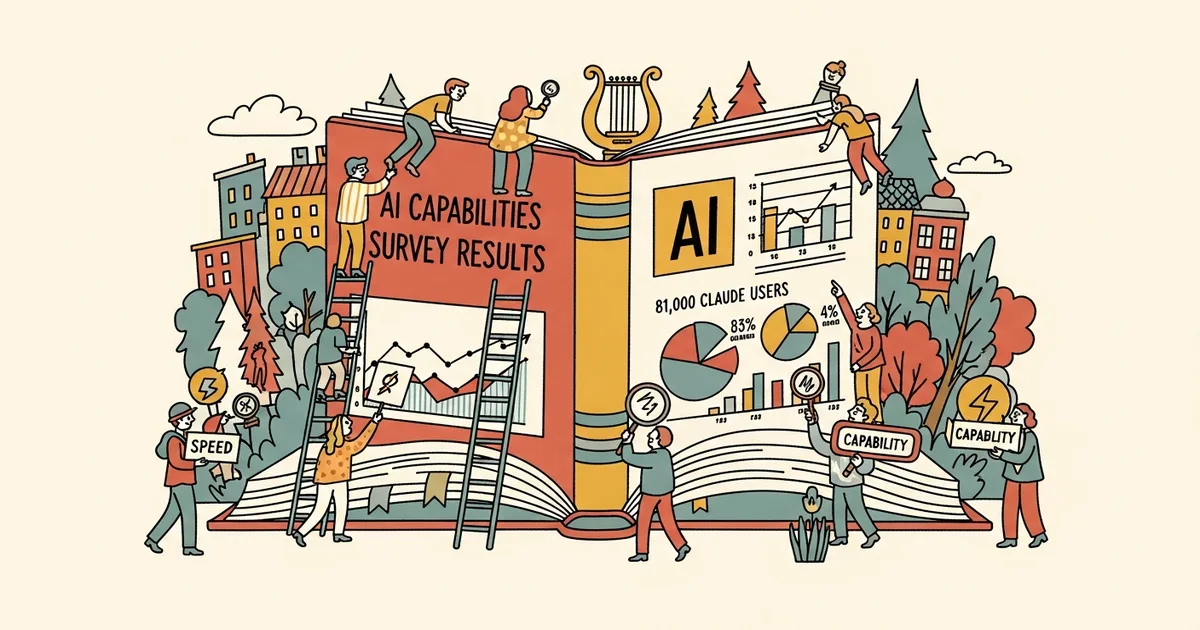
- 48 percent of surveyed Claude users cited expanded capabilities as their top productivity benefit, compared to 40 percent who cited speed gains.
- The survey excluded enterprise users entirely, a limitation the authors acknowledge skews results toward personal and solo-use cases.
- Both the highest- and lowest-paid occupational groups reported the largest productivity gains, though for different reasons.
- One in five respondents expressed concern about job loss; creative workers reported finding Claude too rigid for their own work while simultaneously fearing AI will hurt their business prospects.
What Happened
Anthropic researchers Maxim Massenkoff and Saffron Huang published survey results from 81,000 personal Claude.ai users, finding that 48 percent of respondents who described specific productivity effects cited expanding their skill set as the primary benefit, while 40 percent pointed to pure speed gains. The findings were reported by The Decoder on April 23, 2026. The survey drew exclusively from volunteer participants with personal Claude.ai accounts—a sampling constraint the authors flag directly in their own analysis.
Why It Matters
Most public discourse around AI productivity has centered on efficiency: doing the same tasks faster. A large-scale self-report showing that capability expansion—not acceleration—is the more commonly cited benefit challenges that framing, even if the sample is not representative of enterprise deployments. The finding is notable because it comes from Anthropic’s own user base rather than a third-party study, giving it a degree of scale while also raising questions about motivated reporting.
Technical Details
The 8-percentage-point gap between capability gains (48 percent) and speed gains (40 percent) held despite the acknowledged sampling bias toward intrinsically motivated individual users. The study illustrates this dynamic with examples such as a delivery driver using Claude to launch an e-commerce business and a landscaper building a mobile music application. One respondent without a technical background described themselves as no longer a “techie” but now a “full-stack developer”—a self-assessment the authors note warrants skepticism given the absence of any output-quality measurement. The average self-reported productivity rating across all respondents was 5.1 out of 7.
Income distribution in the data produced a counterintuitive pattern. Management occupations reported the highest productivity gains, followed by computer and mathematical roles—a result that held even when IT jobs were excluded. Low-wage workers also reported high gains, but Massenkoff and Huang attribute this largely to sample composition: many lower-income respondents were using Claude for technical side projects rather than primary job tasks, placing them alongside software developers in the statistics despite fundamentally different use contexts.
Who’s Affected
Creative workers—visual artists and writers specifically—emerged as a distinct outlier group. They reported finding Claude too rigid and constrained for their own creative processes, while simultaneously expressing above-average concern that AI will erode client demand for their work. The survey captured what the data shows as a U-shaped anxiety curve: both respondents who said AI slows them down and those reporting the largest speed gains expressed higher-than-average concern about job displacement. One in five respondents overall flagged job loss as a worry, with early-career workers doing so at significantly higher rates than experienced professionals. Most respondents also reported that productivity benefits accrued to themselves rather than their employer—a finding consistent with the absence of enterprise users in the sample.
What’s Next
Anthropic has not announced a follow-up study incorporating enterprise users, whose absence the authors explicitly identify as the survey’s central limitation. Without that cohort—workers using AI on employer-directed tasks rather than personal projects—the capability-versus-speed balance cannot be generalized to organizational deployments. A sample that includes enterprise use cases would likely shift reported benefits toward speed, since employer-directed workflows tend to center on accelerating existing processes rather than enabling new ones.