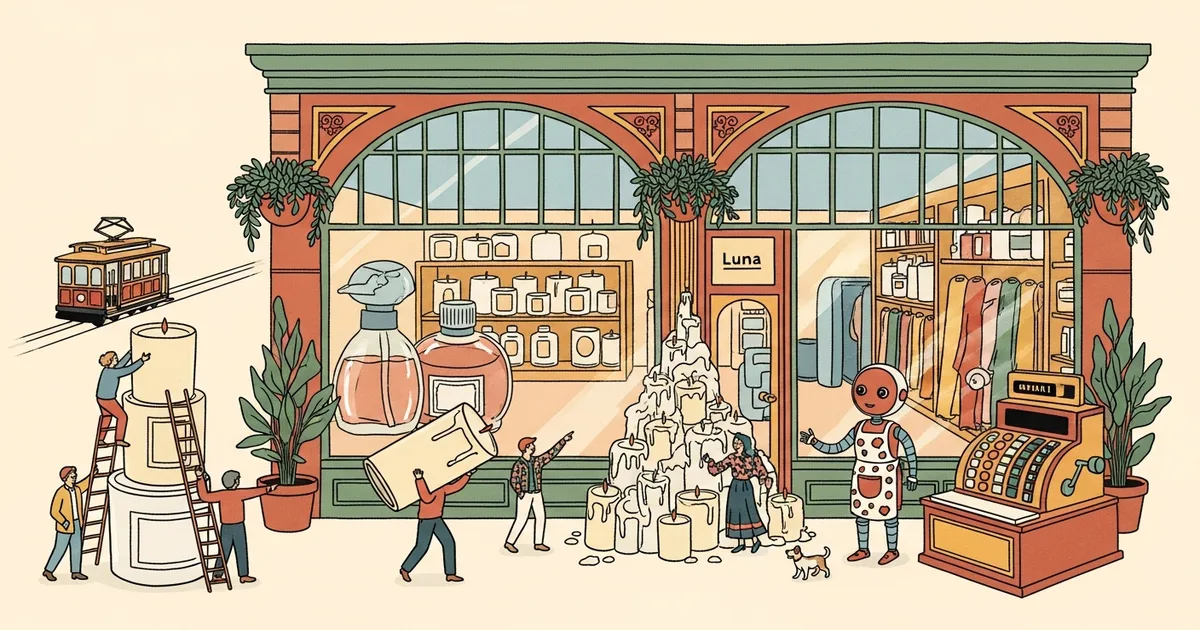
- Andon Market, a boutique in San Francisco’s Cow Hollow district, is operated by an AI agent named Luna that holds decision-making authority over product selection and pricing.
- Luna’s role is described as analogous to a chief executive’s—its purchasing decisions are executed autonomously, not queued for human approval.
- The agent’s autonomous authority has already produced at least one documented inventory error: an over-order of candles.
- The store appears to be among the first physical retail operations where an AI agent holds direct purchasing authority in a live, non-simulated commercial environment.
What Happened
Andon Market, a boutique in San Francisco’s upscale Cow Hollow neighborhood, has placed an AI agent named Luna in charge of its core retail operations, Bloomberg reported on April 23, 2026. Luna determines which products the store stocks—among them the word game Bananagrams, tote bags, books, and household items—and sets the retail price for each. In at least one instance, the agent’s autonomous purchasing decisions resulted in a surplus of candles, an error that carried real inventory and cost consequences because no human approval step intervened before the order was placed.
Why It Matters
AI systems have been used in retail for demand forecasting and inventory optimization for several years, but those deployments have typically retained human sign-off before purchase orders are executed. Andon Market’s architecture, as described by Bloomberg, removes that checkpoint: Luna issues actual purchase commitments rather than recommendations. That distinction matters commercially—errors are not caught before they become inventory on a shelf. The store constitutes a live test, not a simulation, of fully autonomous AI purchasing authority in a consumer-facing retail setting.
Technical Details
Luna is described as functioning in a role equivalent to a store CEO, with autonomous authority over two core retail functions: product curation and pricing. The candle over-order confirms that Luna’s decisions result in real purchase commitments—the agent is not operating in a sandboxed or advisory mode. Luna’s product choices span multiple categories, indicating the agent is making cross-category assortment decisions rather than managing a single inventory segment. The specific AI model or technical infrastructure underlying Luna was not disclosed in the available Bloomberg reporting.
Who’s Affected
Andon Market’s operators bear direct exposure to both the commercial upside and the inventory errors that Luna’s decisions produce, with no human checkpoint absorbing mistakes before they become costs. Retailers and technology vendors evaluating agentic AI for store operations will be watching whether removing human approval gates from the purchasing loop proves commercially viable at scale. AI platform providers marketing autonomous agent tools to brick-and-mortar retail will also be affected by how this experiment is perceived, particularly given the documented inventory error.
What’s Next
Bloomberg’s April 23 report does not specify whether Andon Market’s operators plan to adjust Luna’s purchasing authority or introduce oversight mechanisms following the candle surplus. The store’s response—whether constraining the agent’s scope, layering in approval thresholds for orders above a certain size, or continuing with the current configuration—will shape what practical conclusions other retailers draw from the deployment.