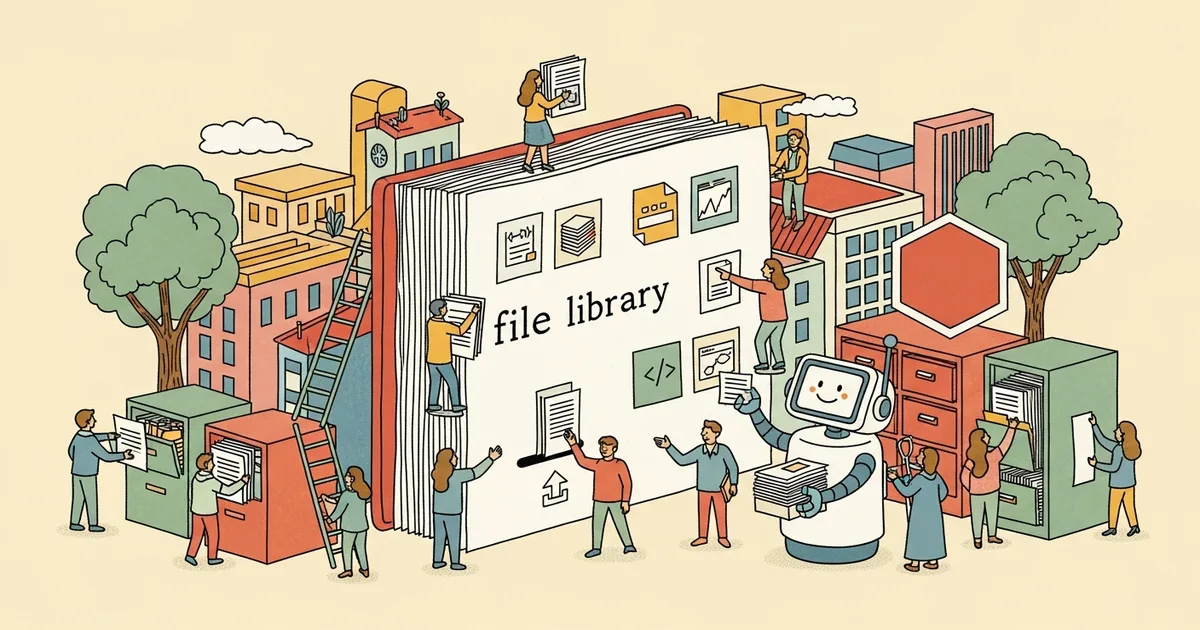
OpenAI on March 23, 2026, introduced a Library feature to ChatGPT that gives users a persistent, searchable repository for documents, spreadsheets, presentations, PDFs, and images — eliminating the need to re-upload files at the start of each new conversation. The feature is available to all ChatGPT plans, including the free tier, with storage limits that scale by subscription level. The launch was noted on Product Hunt; author and spokesperson attribution was not available at time of publication.
- ChatGPT‘s new Library feature, launched March 23, 2026, allows files to persist across multiple conversations instead of expiring at the end of a single chat thread.
- Supported formats include PDFs, Word documents, Excel spreadsheets, PowerPoint presentations, and images — all searchable by filename and content.
- Storage limits vary by plan; the feature is available on the free tier, with paid tiers receiving greater capacity.
- The Library places OpenAI in more direct competition with Anthropic’s Claude Projects and Google’s Gemini Gems, both of which provide persistent context mechanisms.
What Happened
OpenAI launched the Library on March 23, 2026, adding a dedicated file management interface to ChatGPT accessible from the platform’s sidebar, alongside conversation history. Before this feature, every file a user uploaded to ChatGPT was scoped to a single conversation thread — when that thread ended, the file and any context the model had built around it were discarded.
The Library eliminates that limitation. Files uploaded once persist indefinitely and can be attached to any new conversation with a single click. The change gives ChatGPT a form of document memory that operates independently of individual chat histories, a capability that has been absent from the platform since its public launch.
Why It Matters
The lack of persistent file storage has been a recurring friction point for users who rely on ChatGPT for document-intensive work — drafting against a standing brief, analyzing the same dataset across multiple sessions, or maintaining a corpus of reference material. Every re-upload added overhead and stripped the model of prior context it had developed about the document’s structure and content.
The Library also moves ChatGPT into territory already occupied by Anthropic’s Claude Projects and Google’s Gemini Gems, both of which offer persistent context across sessions. OpenAI’s approach differs in emphasis: it centers on flat file management rather than project-scoped organization, a design tradeoff that prioritizes simplicity over structure.
Technical Details
The Library supports the most common office and media formats: PDFs, Microsoft Word documents (.docx), Excel spreadsheets (.xlsx), PowerPoint presentations (.pptx), and images. Files are indexed for search by both filename and content, so users can locate documents without remembering exact upload dates or naming conventions.
Users can apply tags to files for manual categorization and can view a per-file history that shows which conversations have referenced each document. The interface is surfaced in the ChatGPT sidebar, keeping it within the same navigation panel already used to manage conversation history.
Storage capacity is not uniform across plans. Available space scales with subscription tier — free-tier users gain access to the feature but at lower storage limits, while higher-paid plans receive greater capacity. Specific per-tier storage figures had not been published in available reporting at time of writing.
Who’s Affected
The feature has the most direct value for users whose workflows involve recurring source material. A product manager can upload a product requirements document once and reference it across planning, drafting, and review conversations without re-establishing context each time. A researcher can maintain a curated set of papers that ChatGPT can cite and cross-reference across separate analysis sessions.
Enterprise and Team plan subscribers, who typically work with higher document volumes, stand to benefit most from the increased storage limits. However, availability on the free tier extends persistent document access to individual users and students who previously had no such capability within ChatGPT.
Developers building on the OpenAI API should note that the Library is a consumer-facing interface feature. Its behavior and availability through API-level file handling — including the Assistants API — may differ from what end users experience in the ChatGPT web application; OpenAI had not clarified this distinction in available materials.
What’s Next
OpenAI has not publicly announced plans to extend the Library with folder-level organization, file versioning, or team-shared libraries — capabilities that would close the gap with dedicated knowledge management tools. The current implementation is scoped to individual users rather than collaborative document workflows.
The Library’s flat file structure distinguishes it from Claude Projects, which scopes files to project-specific contexts, and Gemini Gems, which ties uploaded material to customized AI configurations. OpenAI has framed simplicity as the design goal, but whether that tradeoff holds for enterprise users accustomed to more granular document management is not yet established by available data.
Author and spokesperson details for the Library launch were not available at time of publication.