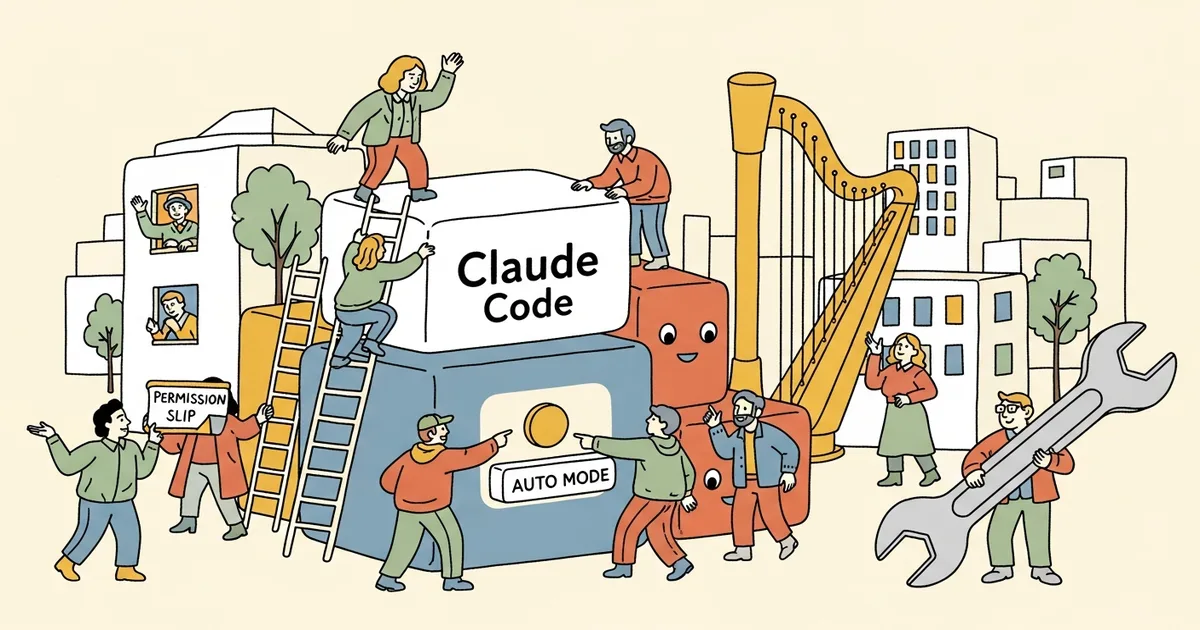
Anthropic has introduced an auto mode for Claude Code that allows the AI coding agent to autonomously decide which actions require user permission and which can proceed without approval. The feature, announced on March 24, 2026, uses an AI-powered classifier to evaluate each action before execution, automatically allowing safe operations while blocking potentially dangerous ones like mass file deletion, sensitive data access, or malicious code execution.
Auto mode addresses what developers call the “permission tax” — the friction of repeatedly approving routine operations during long coding sessions. In Claude Code’s default mode, the agent asks for permission before each file write, terminal command, or system interaction. For complex tasks that involve hundreds of such operations, the constant approval flow can turn a productive coding session into a click-through exercise.
The previous alternative was the dangerously-skip-permissions flag, which bypassed all safety checks entirely. Auto mode provides a middle path: the classifier evaluates each action against a safety model, approving routine operations like writing test files or running build commands while flagging actions that could cause irreversible damage. If Claude repeatedly attempts a blocked action, it eventually prompts the user for explicit permission rather than silently failing.
The feature is available as a research preview for Claude Team users, with Enterprise and API rollout planned for the coming days. It works with both Claude Sonnet 4.6 and Opus 4.6 models. Anthropic acknowledges that the classifier is not perfect — it may occasionally allow risky actions when user intent is ambiguous or block benign operations that appear suspicious out of context. The company recommends using auto mode in isolated or sandboxed environments.
The launch reflects a broader industry pattern. As AI coding agents become more capable of sustained, autonomous work — running for hours, modifying dozens of files, executing complex build and test cycles — the permission model needs to evolve beyond binary approve-everything or approve-nothing options. Microsoft’s Copilot, Cursor’s Composer, and OpenAI’s Codex are all navigating similar tradeoffs between developer productivity and code safety.
Auto mode ships alongside other recent Claude Code expansions including Claude Code Review for automated PR reviews, a one-million-token context window, and Dispatch for Cowork which allows mobile task assignment. Claude Code’s annualized revenue reached $2.5 billion by February 2026, making the development tool Anthropic’s fastest-growing revenue line and the product where permission UX has the most direct impact on customer retention.