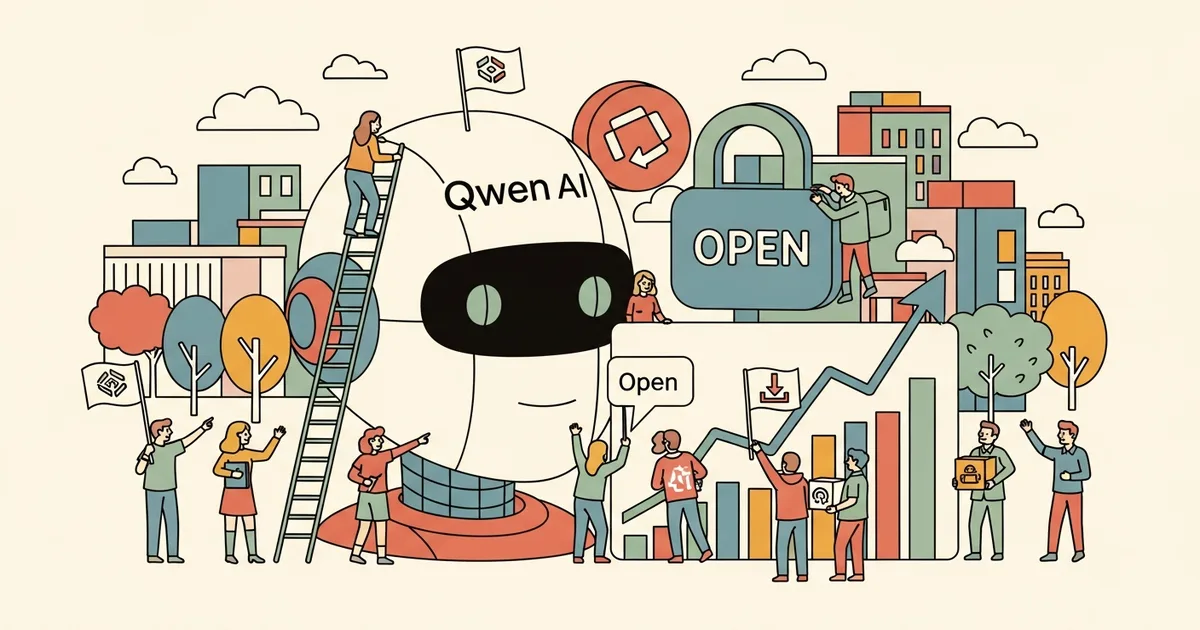
- Alibaba’s Qwen model family surpassed 700 million downloads on Hugging Face, overtaking Meta’s Llama by October 2025 to become the most downloaded open-source AI system globally.
- The company has open-sourced nearly 400 models supporting 119 languages, with over 180,000 derivative versions created by the developer community.
- Alibaba has pledged 380 billion yuan ($53 billion) over three years for AI and cloud infrastructure to sustain its open-source strategy.
What Happened
Alibaba Group publicly reaffirmed its commitment to open-source AI model releases, confirming that new entries in both its Qwen large language model family and Wan visual generation series will continue to be made freely available to developers. The announcement came as the Qwen family surpassed 700 million downloads on Hugging Face, with over 180,000 derivative models created by the community.
Alibaba stated: “A defining feature of Alibaba’s AI approach in 2025 has been its commitment to openness. Rather than gatekeeping capabilities, Alibaba has leaned into open-source software.” A Qwen team researcher told Xinhua: “Our core goal remains to keep pushing the performance frontier of LLMs while staying committed to open-source openness so that AI can truly help more people around the world.”
Why It Matters
The scale of adoption places Qwen as the most widely used open-weight model family globally. By December 2025, Qwen’s single-month downloads exceeded the combined total of the next eight most popular model providers: Meta, DeepSeek, OpenAI, Mistral, Nvidia, Zhipu.AI, Moonshot, and MiniMax. Alibaba became the first major Chinese tech company to open-source a homegrown large language model in 2023, and the download trajectory suggests that early bet is paying off.
The strategic logic follows the Red Hat model: give away the software, sell the infrastructure. Developers who build on Qwen models tend to deploy on Alibaba Cloud, generating recurring revenue from inference compute and enterprise services. More than one million corporate and individual users have accessed Qwen through Alibaba’s Model Studio development platform, and over 600 million total downloads have been recorded across all distribution channels beyond Hugging Face.
Technical Details
Alibaba has open-sourced nearly 400 models under the Qwen umbrella, supporting 119 languages and regional dialects. The latest releases include the Qwen3.5 series, with the flagship Qwen3.5-397B-A17B containing 403 billion parameters and supporting image-to-text tasks. The Qwen3-Coder-Next model, an 80-billion-parameter code generation specialist, has accumulated over 900,000 downloads on its own.
Models are distributed in multiple formats including full precision, FP8 quantized, GPTQ-Int4 compressed, and GGUF for local deployment. The multimodal lineup extends beyond text to include Qwen3-ASR for speech recognition with multi-language timestamps, Qwen3-TTS for text-to-speech with voice cloning capabilities, and Qwen-Image for both text-to-image generation and image editing via text instructions. The Qwen organization on Hugging Face lists 433 models total, 32 interactive demo spaces, 7 public datasets, and a team of 192 members contributing to the ecosystem.
Who’s Affected
The commitment has geopolitical dimensions. As US export controls restrict Chinese access to advanced Nvidia chips, Chinese AI labs face pressure to demonstrate competitiveness through model quality rather than hardware superiority. Alibaba’s willingness to release models openly and invest $53 billion in the effort suggests confidence that its models can compete on merit in a global developer market that increasingly values open weights and permissive licensing.
For developers outside China, Qwen’s dominance in downloads creates a viable alternative to Meta’s Llama ecosystem. The 180,000 derivative models indicate a self-sustaining community that no longer depends solely on Alibaba for model development. Startups and enterprises evaluating open-weight models now face a choice between two mature ecosystems with different geographic origins, licensing terms, and cloud integration pathways.
What’s Next
Alibaba’s 380 billion yuan ($53 billion) three-year infrastructure investment covers GPU clusters, data center construction, and compute for training successive model generations. That spending exceeds the individual AI infrastructure commitments of most Western companies outside of Microsoft and Google.
Whether the download numbers translate proportionally into Alibaba Cloud revenue remains unverified. The company has not disclosed conversion rates from open-source users to paying cloud customers. The download lead over Meta is also measured in volume rather than deployment quality, and it remains unclear how many of the 700 million downloads represent production use versus experimentation and benchmarking. Alibaba first open-sourced Qwen in 2023, becoming the first major Chinese tech company to release a homegrown LLM publicly. Three years later, the question is no longer whether Qwen can compete with Western alternatives but whether its cloud conversion funnel justifies the scale of investment.