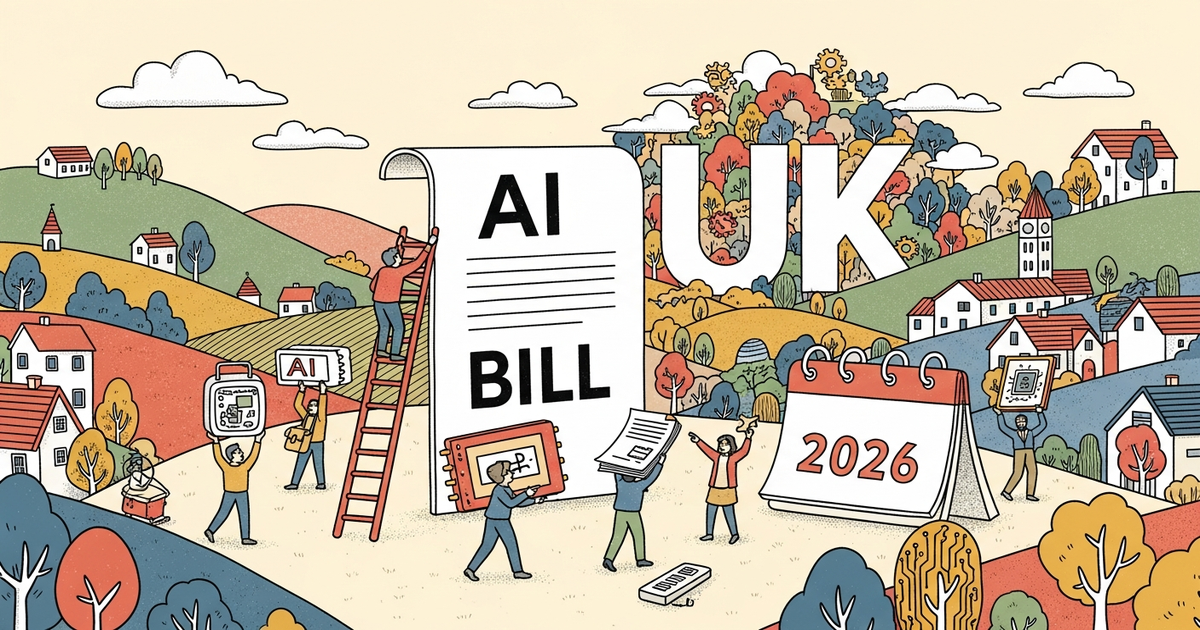
- The UK government is preparing a comprehensive AI Bill expected in the second half of 2026, moving from voluntary guidelines to mandatory oversight of the most advanced AI systems.
- The proposed legislation would convert the AI Safety Institute into an independent statutory body with legal powers to require AI developers to share frontier models for testing before market release.
- The UK’s current framework rests on five non-binding principles — safety, transparency, fairness, accountability, and contestability — enforced by existing sector regulators rather than a single AI authority.
What Happened
The United Kingdom is shifting its approach to AI regulation from voluntary cooperation to binding legislation. Peter Kyle, Secretary of State for Science, Innovation and Technology, has signaled that the government will introduce a comprehensive AI Bill, expected in the second half of 2026. The bill would establish mandatory oversight for frontier models, the most advanced AI systems capable of generating text, images, code, and video.
The move follows the UK’s 2023 White Paper, “A Pro-Innovation Approach to AI Regulation,” which established five voluntary principles for AI governance. While that framework allowed the UK to attract AI investment and avoid the compliance burdens of the EU’s AI Act, it has faced mounting criticism from lawmakers and safety researchers for lacking enforcement mechanisms.
Why It Matters
The UK has positioned itself as a middle path between the EU’s prescriptive AI Act, which imposes detailed compliance requirements across risk categories, and the largely hands-off approach of the United States. By relying on existing sector regulators and voluntary principles, the UK attracted significant AI investment from companies including OpenAI, Google DeepMind, and Anthropic.
Peter Kyle has acknowledged that Britain’s current voluntary AI testing agreements are functioning but require a “legally binding element for leading developers.” Without enforceable rules, there is no guarantee that AI companies will continue to cooperate with safety testing as competitive pressures intensify. The proposed legislation aims to convert these informal arrangements into law while preserving the flexibility that has attracted investment.
Technical Details
The current regulatory framework is built on five cross-sectoral principles from the 2023 White Paper: safety, security, and robustness; appropriate transparency and explainability; fairness; accountability and governance; and contestability and redress. These principles are non-statutory, carrying no legal force. Responsibility for applying them falls to existing regulators such as the Financial Conduct Authority, Ofcom, the Competition and Markets Authority, and the Information Commissioner’s Office.
The proposed AI Bill would make several structural changes. The AI Safety Institute (AISI), currently a division within the Department for Science, Innovation and Technology, would become an independent statutory body operating at arm’s length from the government. This would grant AISI legal authority to require AI developers to submit frontier models for safety testing before market release, rather than depending on voluntary cooperation.
The bill is also expected to address AI and copyright, one of the most contentious elements. Parliamentary amendments requiring AI companies to disclose use of copyrighted material in training datasets have been proposed but resisted by the government. Separately, a private member’s bill — the Artificial Intelligence (Regulation) Bill — was reintroduced in the House of Lords on March 4, 2025, proposing that businesses designate an AI officer responsible for compliance and that the government establish AI sandboxes for controlled testing.
Who’s Affected
The legislation would primarily affect developers of frontier AI models, including OpenAI, Google DeepMind, Anthropic, Meta, and Mistral, all of which have significant operations or user bases in the UK. It would also apply to UK-based AI startups and research labs developing large-scale foundation models.
Creative industries, publishers, news organizations, and content creators have a direct stake in the copyright provisions, which could determine whether AI companies must compensate rights holders for training data or disclose what copyrighted works were used in model development.
What’s Next
The timing of the AI Bill remains uncertain. It may be included in the spring 2026 King’s Speech, but reports suggest introduction could slip to the second half of the year. The government is still deciding whether to include copyright provisions in the AI Bill or address them through separate legislation. Until the bill is formally introduced, the UK continues to operate under its voluntary, principles-based framework, where enforcement depends on the willingness of AI companies to cooperate with regulators.
Related Reading
- India AI Governance: Pro-Innovation Guidelines Without Binding Legislation
- Australia Abandons Mandatory AI Guardrails in Policy Reversal
- Decoding the 2026 White House AI Blueprint: Federal AI Policy Takes Shape
- Brazil AI Bill: Risk-Based Framework Stalls in Congress
- Apple Pivots Its AI Strategy to App Store, Search-Like Platform Approach