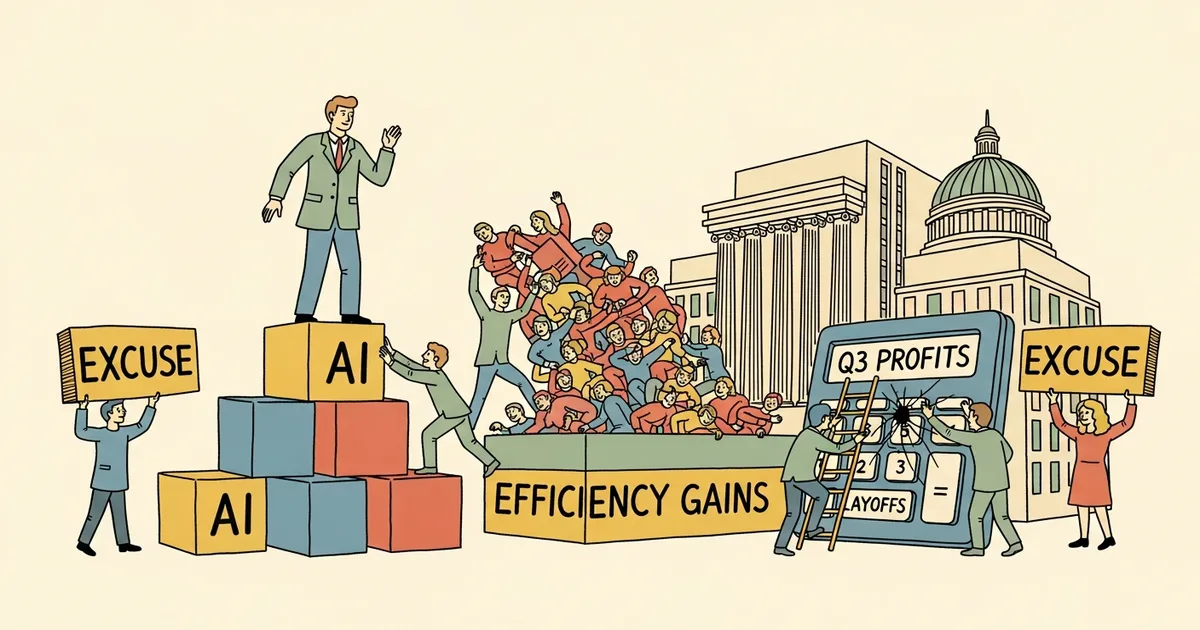
Sam Altman, CEO of OpenAI, told attendees at the India AI Impact Summit on April 10, 2026, that some companies attributing layoffs to artificial intelligence are being dishonest — and he named it directly. “I don’t know what the exact percentage is, but there’s some AI washing where people are blaming AI for layoffs that they would otherwise do,” Altman said, “and then there’s some real displacement by AI of different kinds of jobs.” This is the head of the world’s most commercially influential AI company confirming, on record, that corporate America is using his industry as an alibi.
The Quote That Reframes the Debate
Altman’s framing is careful but precise. He distinguishes between two phenomena: AI washing — deliberate misattribution of layoffs — and genuine AI-driven displacement. The fact that he articulates both in the same breath, with apparent confidence, suggests this is not speculation. The person most briefed on where AI actually replaces human labor is telling you that a meaningful fraction of announced AI-related cuts are not that.
The context amplifies the significance. The India AI Impact Summit draws senior government and enterprise leadership from a country where AI-outsourcing narratives have direct political consequences. India’s IT sector employs roughly 5 million people in roles that corporate AI framing directly implicates. Altman was not speaking into a neutral room.
OpenAI‘s own commercial footprint makes the admission structurally unusual. Deals like OpenAI’s $1 billion Disney partnership are built on the premise that AI meaningfully transforms enterprise operations. Acknowledging that some companies exploit that premise as cover for unrelated cuts introduces a credibility liability the CEO would have had every reason to avoid.
What AI Washing Actually Means
AI washing, as Altman used the term, is the deliberate misattribution of layoffs to artificial intelligence when the real cause is operational failure, over-hiring during the 2020–2022 growth bubble, or pre-planned cost reduction. It borrows its logic from greenwashing: attach a socially acceptable, forward-looking narrative to a decision that would otherwise invite scrutiny.
The business logic is airtight. Cutting 15% of your workforce because your 2021 headcount projections proved wrong is a management error. Cutting 15% because “AI is transforming how we work” is strategic adaptation. One triggers shareholder questions about capital allocation. The other generates analyst upgrades about efficiency gains and operating leverage.
The downstream effect on public discourse is harder to isolate but real. Every AI-washed announcement reinforces the AI-as-job-destroyer narrative, pulling policy attention and media scrutiny toward regulatory responses that address a misdiagnosed problem.
The Companies Most Likely Doing It
The pattern concentrates in enterprise software, financial services, and tech-adjacent media — industries that overhired by 20–40% between 2020 and 2022, according to workforce analytics firm Revelio Labs, and are now executing corrections under an AI cover story.
The tells are consistent. IBM announced a hiring freeze for 7,800 roles it said AI would replace — while simultaneously maintaining near-equivalent hiring for AI-adjacent positions, according to LinkedIn workforce tracking data. Klarna credited AI with eliminating 700 customer service roles, then revised its headcount figures when independent analysts examined actual employment data. Duolingo attributed contractor reductions to AI deployment while internal timelines showed the contractor model had been under review since late 2023.
The forensic test is always the financial filing. When an AI-displacement announcement coincides with below-plan revenue, elevated debt ratios, or post-acquisition integration costs, the AI narrative is almost certainly doing cover work for something else.
Why CEOs Choose This Narrative Over the Truth
“AI made us do it” is the only layoff story that satisfies all constituencies simultaneously. Shareholders hear efficiency gains. Regulators hear innovation. Remaining employees hear inevitability rather than mismanagement. No equivalent story exists.
“We over-hired because our growth assumptions were wrong” is a board-level admission of strategic failure. “Our legacy product lines are losing to competitors” carries disclosure risk. “AI is transforming how we operate” writes its own press release and carries a valuation premium in the current market environment.
The Humans First movement, which expanded significantly through 2025 and into 2026, emerged in direct response to this pattern — workers and policy advocates who recognized that “AI displacement” was functioning as ideological cover for decisions rooted in conventional business failure, not machine learning capability.
Altman’s willingness to name it creates a structural problem for other AI executives. If the CEO of OpenAI acknowledges AI washing exists, every future unsubstantiated AI-displacement announcement becomes a documentation question rather than a narrative to accept.
How AI Washing Corrupts the Displacement Data
The measurement problem runs deep. Economists estimating AI’s labor market impact rely heavily on company disclosures and announced layoff rationale. If a material percentage of those disclosures misrepresent the actual cause, the resulting displacement estimates are systematically overstated.
The World Economic Forum‘s 2025 Future of Jobs Report projected 85 million jobs displaced by AI — a figure now circulating widely in policy and legislative contexts without any accounting for AI-washed reductions in the underlying dataset. Governments designing retraining subsidies, universal basic income pilots, and AI workforce transition programs are partly operating on a corrupted signal.
MegaOne AI tracks 139+ AI tools across 17 categories, and the actual capability trajectory of these tools — while rapid — does not match the displacement pace corporate announcements imply. Most enterprise AI deployments in 2025 augmented existing workflows rather than eliminated roles outright. Full role elimination remained concentrated in narrow, high-volume task categories: document processing, tier-1 support triage, and routine code maintenance.
What Real AI Displacement Actually Looks Like
Genuine AI-driven job displacement is specific, identifiable, and slower than announced. McKinsey Global Institute projects 12 million U.S. workers in high-automation-exposure roles facing occupational transition by 2030 under a moderate scenario — a significant number, but far below the figures that AI-washed narratives generate and policy responses are now calibrated to.
The productivity data from enterprise AI deployments is also more measured than layoff press releases suggest. A 2025 Stanford Digital Economy Lab study analyzing AI tool integration across 300 enterprise deployments found an average 14% task efficiency improvement — meaningful productivity gain, but not the full role-elimination transformation that quarterly communications describe.
The distinction matters for individual workers making career decisions and for the AI industry’s own commercial credibility. OpenAI’s expansion into enterprise — including the series of high-profile acquisitions and partnerships it has pursued — depends on enterprises trusting that AI is a productivity tool, not a convenient scapegoat. AI washing erodes exactly that trust from the inside.
The Documentation Standard Going Forward
Altman’s India statement establishes a useful benchmark. Companies attributing layoffs to AI should now be expected to demonstrate it: which systems were deployed, what roles those systems replaced, and what productivity data supports the claim. Without that evidence, AI displacement announcements are unverified marketing.
That documentation standard should apply consistently — the same way undocumented ESG claims faced enforcement pressure after the greenwashing reckoning of 2021–2023. Journalists, investors, and regulators should treat unsubstantiated AI-attribution claims as a disclosure flag rather than a human-interest story about technological progress.
The counterintuitive result of that scrutiny is that it benefits the AI industry. Strip AI washing out, and the actual productivity gains from genuine AI deployment become more legible, more credible, and easier to build sound policy around. The noise of manufactured disruption has been drowning out the signal of real capability for three years.
Altman named the pattern publicly, in front of a room that needed to hear it. Demanding proof from every company that follows is the only logical next step.
![Editorial illustration for: OpenAI Killed Sora — Here Are 5 AI Video Generators That Are Actually Better [Ranked 2026]](https://megaoneai.com/wp-content/uploads/2026/04/sora-alternatives-2026-600x450.webp)