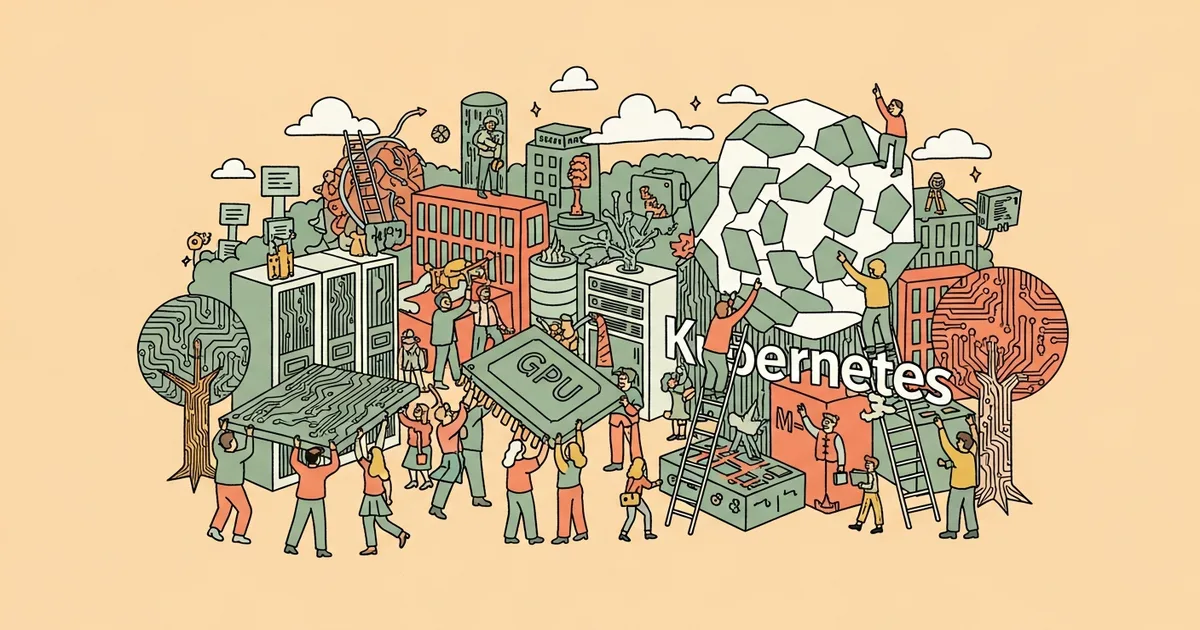
NVIDIA announced at KubeCon Europe in Amsterdam on March 24 that it has donated its Dynamic Resource Allocation (DRA) Driver for GPUs to the Cloud Native Computing Foundation under the Kubernetes project. The contribution makes NVIDIA’s GPU scheduling technology available as open-source infrastructure, allowing Kubernetes clusters to dynamically allocate and share GPU resources across AI workloads without proprietary tooling.
The DRA Driver enables fine-grained GPU allocation in containerized environments — a capability that has become critical as AI training and inference workloads move from dedicated GPU servers to shared Kubernetes clusters. Previously, organizations needed NVIDIA’s proprietary operators or custom scheduling solutions to efficiently distribute GPU access across multiple containers and teams. The donated driver targets Kubernetes 1.32 and later, with full DRA support requiring version 1.33 or newer.
The donation aligns with NVIDIA’s broader strategy of making its software stack open while selling the hardware it runs on. By commoditizing the scheduling layer, NVIDIA removes a friction point that slowed Kubernetes adoption for GPU workloads — and by extension, slowed GPU purchases. Every organization that adopts Kubernetes-based GPU scheduling becomes a more efficient consumer of NVIDIA hardware, potentially buying more GPUs as utilization improves and new workloads become feasible.
For the Kubernetes ecosystem, the contribution fills a significant gap. GPU resource management has been one of the weakest aspects of Kubernetes for AI workloads, with most organizations relying on static allocation that leaves expensive GPUs idle between jobs. Dynamic allocation — where GPUs are assigned to containers on demand and reclaimed when unused — can improve utilization by 30 to 50 percent in typical mixed workloads, according to NVIDIA’s benchmarks.
The timing coincides with growing competition from AMD and Intel in the data center GPU market. By donating the DRA driver, NVIDIA ensures that Kubernetes GPU scheduling is optimized for its hardware architecture first, establishing a reference implementation that competitors would need to match or adapt. The CNCF’s governance means the project will accept contributions from all vendors, but NVIDIA’s head start in driver maturity gives it a structural advantage in how Kubernetes handles GPU workloads.