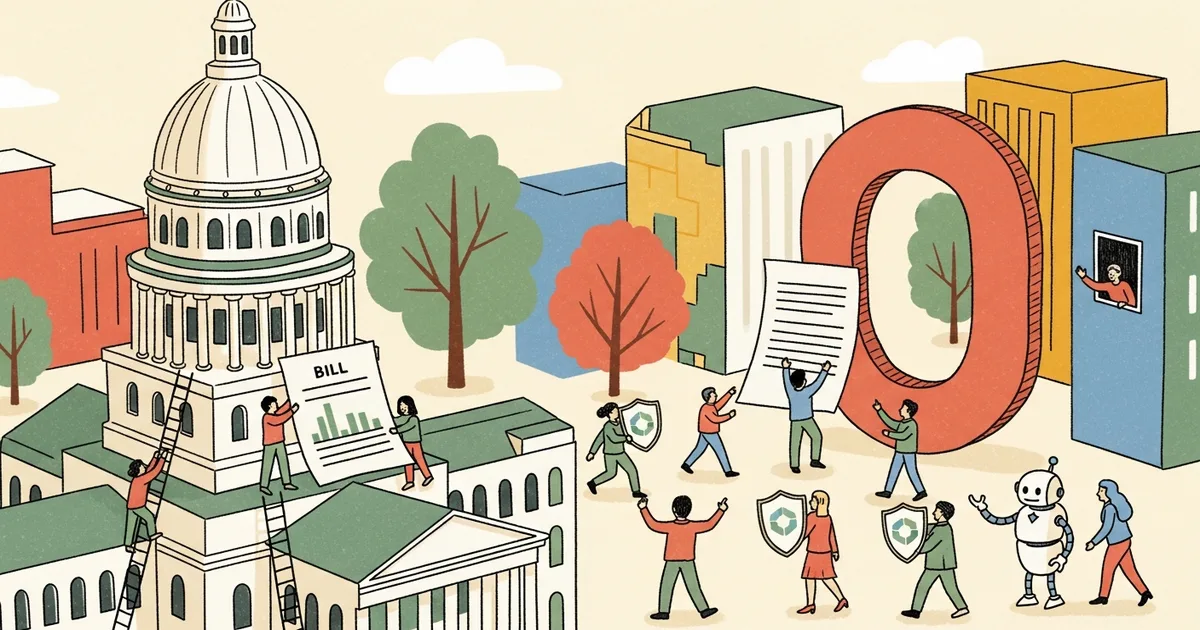
OpenAI is actively lobbying for Illinois Senate Bill 3444, a proposed liability shield that would block courts from holding frontier AI developers accountable for catastrophic harms — including mass-casualty events — unless plaintiffs can prove intentional or reckless conduct. The bill, formally titled the Artificial Intelligence Safety Act, was introduced in the Illinois General Assembly in the 2026 legislative session, with OpenAI policy representative Caitlin Niedermeyer testifying in its support before state legislators in April. If enacted, SB 3444 would make Illinois the first U.S. state to codify explicit liability protections for the world’s largest AI developers.
The timing is not coincidental. SB 3444 aligns directly with a December 2025 executive order from the Trump administration directing the Department of Justice’s newly formed AI Litigation Task Force to pursue federal preemption of state AI laws. OpenAI’s support for a state bill that structurally mirrors federal preemption policy reveals a coordinated legal strategy — not a good-faith regulatory compliance exercise.
What Illinois SB 3444 Actually Does
The bill constructs a two-tier liability framework. For standard AI harms — algorithmic bias, discrimination, privacy violations — existing tort law applies without modification. For “critical harms,” defined as events causing death, serious physical injury, or widespread economic damage, the bill restricts recovery to cases where developers acted with intent or recklessness. Negligence alone is not sufficient for a plaintiff to prevail.
This is a material departure from how product liability works in every other industry. A pharmaceutical company that negligently failed to test a drug interaction faces full civil liability. Under SB 3444, an AI developer that negligently deployed a system involved in a mass-casualty event would not.
The bill also explicitly preempts local Illinois ordinances from imposing stricter standards on covered developers — a provision Niedermeyer highlighted in her testimony as essential to avoid, in her words, “a patchwork of inconsistent state requirements.” That framing — borrowed directly from federal preemption rhetoric — signals where the bill’s real destination lies.
The Illinois AI Liability Bill’s Compute Threshold: Who Qualifies for the Shield
SB 3444 defines “frontier AI” as systems trained on more than 1026 floating-point operations (FLOPS) or developed using more than $100 million in compute costs. At current training economics, fewer than ten companies globally meet this threshold: OpenAI, Anthropic, Google DeepMind, Meta AI, xAI, and a small number of sovereign AI programs.
The compute figure is not arbitrary. It mirrors the reporting thresholds in California’s failed SB 1047 — which OpenAI also opposed — and the EU AI Act’s general-purpose AI model provisions. Independent researcher estimates cited by Epoch AI placed GPT-4’s training compute at approximately 2.15 × 1024 FLOPS in 2023. OpenAI’s subsequent model families — including the o3 and GPT-5 lineage — almost certainly cross the 1026 threshold, placing OpenAI among the primary beneficiaries of a bill its own lobbyists are pushing through a state legislature.
The threshold also has a built-in obsolescence problem. As training costs fall — Epoch AI’s efficiency curves suggest roughly 4x compute cost reduction per 18 months — the $100 million ceiling will cover a significantly larger number of models within three to five years, expanding the liability shield well beyond its stated intent without any additional legislative action.
OpenAI’s Testimony: Regulatory Fragmentation as a Deflection Strategy
Niedermeyer’s core argument before the Illinois legislature was that divergent state AI laws create compliance burdens that harm innovation and, ultimately, consumers. The fragmentation argument is OpenAI’s standard legislative playbook — deployed in California against SB 1047, in Colorado against its AI consumer protection bill, and at the federal level to resist sector-specific AI regulation.
The argument has surface appeal. A company operating in all 50 states genuinely cannot comply with 50 incompatible regulatory regimes. But the fragmentation argument works only if you accept that the solution to regulatory inconsistency is a liability floor set at the recklessness standard — the highest bar available before criminal conduct. OpenAI did not propose alternative compensation mechanisms for cases where negligence (not recklessness) causes mass injury. The testimony focused entirely on removing liability exposure, not on what replaces it for victims.
Niedermeyer’s framing also obscures a key fact: the companies that meet SB 3444’s 1026 FLOPS threshold are the companies best positioned to absorb liability costs. The argument that liability exposure threatens AI innovation applies most forcefully to startups and mid-tier labs — none of whom qualify for the bill’s protections.
Trump’s Federal Preemption Push and the Illinois Template
The December 2025 Trump executive order on AI directed the DOJ’s AI Litigation Task Force to identify and challenge state AI laws that conflict with federal interests in AI development and competitiveness. The order explicitly framed aggressive state AI regulation as a threat to U.S. strategic positioning against China’s state-backed AI programs.
SB 3444 does not require federal preemption to take effect — it is a state bill operating within Illinois law. But its architecture mirrors what a federally preemptive national standard would look like: a compute threshold, a recklessness bar for critical harms, and explicit preemption of local ordinances. Illinois passing SB 3444 creates a legislative template that the Trump administration can cite as existing state consensus when arguing for a national floor.
This is the mechanics of regulatory capture operating at scale. A friendly state passes a model bill. A sympathetic federal administration points to that bill as evidence of an emerging national standard. Federal preemption codifies the model bill’s provisions — and the liability regime ends up designed by the industry it was supposed to regulate.
The Lawsuits SB 3444 Would Affect
Several active lawsuits against OpenAI involve claims that fall below SB 3444’s “critical harm” threshold as currently defined. Cases alleging psychological harm from extended ChatGPT interactions, and at least one case drawing a causal link between ChatGPT use and a user’s suicide, are premised on negligent product design and deployment — not intentional or reckless conduct by OpenAI’s leadership.
Under current tort law in Illinois and most U.S. states, those plaintiffs can argue negligence: that OpenAI failed to implement reasonable safeguards it knew were necessary. Under SB 3444, the same factual record would not meet the recklessness standard required for critical-harm recovery. Plaintiffs would need to show OpenAI knew its system would cause harm and deployed it anyway — a standard that nearly always requires internal communications demonstrating deliberate disregard for known risk.
The growing Humans First movement, which has coalesced specifically around concerns about AI’s psychological and social impact on vulnerable users, has identified OpenAI’s consumer deployment practices as a central source of the harms they seek legal remedy for. SB 3444, as a template for national preemption, would remove that remedy.
Meanwhile, OpenAI’s commercial footprint continues to expand — including its reported $1 billion content partnership with Disney — while the company simultaneously lobbies to narrow legal exposure from consumer-facing products. The two tracks are not contradictory. They are complementary components of a single corporate growth strategy: expand revenue surface, compress liability surface.
Consumer Advocates Are Building Opposition
The Electronic Frontier Foundation and the Center for Democracy & Technology have both flagged SB 3444 as part of a coordinated industry effort to establish a national liability floor that cannot be raised by state-level innovation. The EFF has specifically noted that the recklessness standard — borrowed structurally from First Amendment defamation law as established in New York Times v. Sullivan — sets an intentionally high bar that plaintiffs rarely clear without access to internal company communications demonstrating deliberate risk-taking.
Illinois state legislators who opposed SB 3444 in committee raised specific concerns about the bill’s interaction with the Illinois Consumer Fraud and Deceptive Business Practices Act, which currently allows recovery for negligent misrepresentation by AI-powered services. SB 3444’s preemption clause could override those protections for covered developers.
As of April 2026, the bill has not reached a floor vote. But OpenAI’s lobbying presence and the structural alignment with federal preemption strategy indicate it will be pushed aggressively through the remaining legislative calendar. The pattern of OpenAI’s legislative and strategic moves through 2025 and into 2026 is consistent: establish favorable conditions early, at the state level if necessary, before federal frameworks solidify.
The Compute Threshold Gets Causation Backward
The 1026 FLOPS threshold as a proxy for frontier risk has a structural problem: it measures training cost, not deployment impact. A model trained on 1025 FLOPS — below the threshold — and deployed to 400 million active users poses a larger harm surface than a research model trained on 1027 FLOPS accessed by 500 researchers under institutional oversight.
MegaOne AI tracks 139+ AI tools across 17 categories, and the consistent pattern across high-impact consumer AI products is that deployment scale, not training compute, determines real-world harm exposure. SB 3444 protects the largest, best-resourced labs — the ones most capable of absorbing liability — while leaving mid-tier developers exposed despite statistically lower risk profiles at scale.
A liability framework designed around actual harm vectors — user count, deployment context, autonomy level, harm reversibility — would look entirely different from one designed around a training-cost threshold. The choice of threshold tells you whose interests the bill was designed to serve.
The Verdict on Illinois SB 3444
OpenAI’s support for SB 3444 is a liability management strategy wearing a safety label. The bill’s title — the “Artificial Intelligence Safety Act” — inverts its operational function: it reduces legal accountability for AI-caused harm rather than increasing it. A genuine safety bill would establish mandatory incident reporting, independent auditing requirements, or compensation funds for harms below the recklessness threshold. SB 3444 does none of those things.
The recklessness standard, the compute threshold, and the local preemption clause are each individually defensible in isolation. Together, they construct a near-impenetrable liability shield for the companies most capable of causing — and most capable of funding lobbying against accountability for — large-scale harm.
If a federal AI liability standard is appropriate — and there are credible arguments that national consistency has value — it should be negotiated at the federal level with substantive consumer protection input, adversarial expert testimony, and full legislative deliberation. Establishing that standard through a state template drafted with industry lobbyists, then citing that template as national consensus, is not a safety process. It is a preemption strategy. Illinois legislators should recognize the difference before voting.