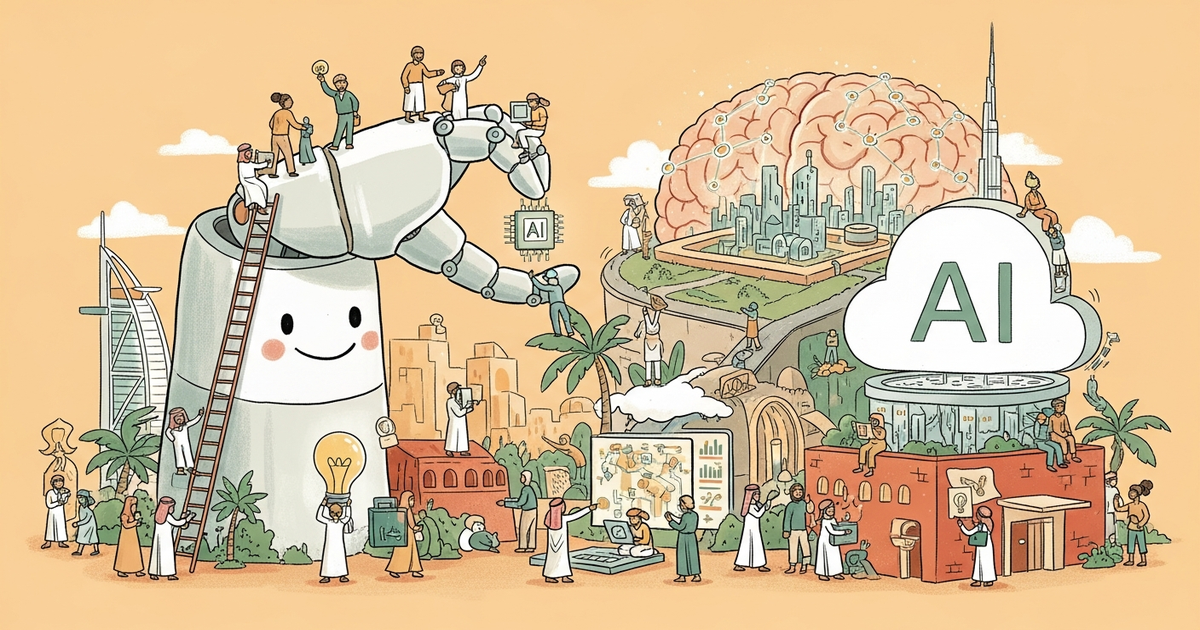
- Saudi Arabia and the UAE are investing more than $100 billion combined in AI infrastructure, including data centers, sovereign AI platforms, and semiconductor partnerships.
- Saudi Arabia’s Public Investment Fund created Humain, a dedicated AI company, and committed $10 billion with Google Cloud to build a global AI hub in the kingdom.
- The UAE is developing a 1-gigawatt data center cluster in Abu Dhabi as part of its Stargate project, with 200 megawatts expected online in 2026.
- Both countries are using AI investment as a strategic tool to diversify economies away from oil and strengthen ties with U.S. technology firms.
What Happened
Saudi Arabia and the United Arab Emirates have committed well over $100 billion in combined AI infrastructure spending, positioning the Gulf region as one of the largest AI investment zones outside the United States and China. The spending covers hyperscale data centers, sovereign AI models, and strategic partnerships with American technology companies including Google, Microsoft, NVIDIA, and OpenAI.
Saudi Arabia’s Public Investment Fund launched Humain in 2025, a standalone AI company responsible for building and operating AI infrastructure across the kingdom. In May 2025, Google Cloud and PIF formalized a $10 billion partnership to establish a global AI hub in Saudi Arabia. Separately, the $2.7 billion Hexagon data center, a hyperscale facility with 480 megawatts of planned capacity, is under development for GPU-intensive AI workloads.
The UAE has pursued a parallel strategy. In 2017, it became one of the first countries in the world to appoint a Minister of State for Artificial Intelligence. Its current flagship project is a massive data center cluster in Abu Dhabi, developed with support from OpenAI and NVIDIA as part of the broader Stargate initiative.
Why It Matters
The scale of Gulf AI spending reflects a strategic pivot away from hydrocarbon dependency. Both nations have relied on oil revenues for decades, and AI investment serves a dual purpose: economic diversification and geopolitical positioning. By hosting data centers and co-investing with U.S. firms, Saudi Arabia and the UAE insert themselves into the global AI supply chain at the infrastructure layer rather than simply purchasing finished products.
According to a Foreign Policy analysis, the investments also function as a form of diplomatic currency. Hosting critical AI infrastructure for American companies creates mutual dependency, reinforcing security relationships at a time of shifting alliances in the Middle East. The analysis notes that Gulf states see AI infrastructure as “partly about U.S. protection,” connecting technology spending to broader defense considerations.
For the global AI industry, Gulf capital represents a significant new funding source. As AI infrastructure costs continue to rise, American and European companies increasingly look to sovereign wealth funds in the region for the capital-intensive buildouts that private venture funding alone cannot sustain.
Technical Details
Saudi Arabia’s national AI strategy, managed by the Saudi Data and AI Authority (SDAIA), targets 75 billion Saudi riyals (approximately $20 billion) in AI investments by 2030. The Hexagon data center is designed specifically for GPU-intensive workloads, with 480 megawatts of planned power capacity spread across multiple construction phases. Aramco, the national oil company, operates its own internal AI research division alongside the government-led initiatives.
The UAE’s Abu Dhabi data center cluster plans for 1 gigawatt of total capacity. The first 200-megawatt phase is expected to come online in 2026, which would make it one of the largest single-site AI compute facilities in the Middle East. The project involves co-packaged optics and liquid cooling systems designed for high-density GPU racks.
Both countries face challenges in power supply and cooling. Desert climates increase energy costs for data center operations, and water scarcity complicates the liquid cooling approaches that are becoming standard in high-density GPU clusters. Saudi Arabia is exploring nuclear and renewable energy sources to power its data center ambitions without increasing carbon output from existing power plants.
Who’s Affected
Global cloud providers benefit directly, gaining access to new markets and co-investment capital. Google, Microsoft, and Oracle have all signed infrastructure deals in the region. U.S. chipmakers like NVIDIA gain additional demand for their GPUs, though export controls on advanced AI chips to certain Middle Eastern entities remain a regulatory variable that could limit deployment scope.
Local populations may see long-term effects through job creation in data center operations and AI-related services. However, the immediate impact is concentrated at the sovereign and corporate level rather than the consumer level. Both countries are also investing in AI education programs to build domestic talent pipelines.
What’s Next
Saudi Arabia’s 2030 AI spending target is still several years away, and the pace of construction will determine whether commitments translate into operational capacity. The UAE’s 200-megawatt Stargate phase is the nearest milestone, expected later in 2026. U.S. export controls on AI chips remain a potential constraint, and any tightening of restrictions on GPU sales to Gulf states could slow deployment timelines and push both countries toward alternative suppliers, including Chinese chipmakers competing for the same market.
Related Reading
- Tennessee Just Banned AI Therapists With a 94-0 Vote — 5 More States Are About to Follow
- 7 States Are Banning Dangerous AI Chatbots This Month — Red and Blue Agree on This for the First Time
- Iran Strikes Took Down AWS in the Gulf — Cloud Infrastructure Is Now a Military Target
- CoreWeave Expands Meta Deal to $21 Billion for GPU Capacity Through 2032