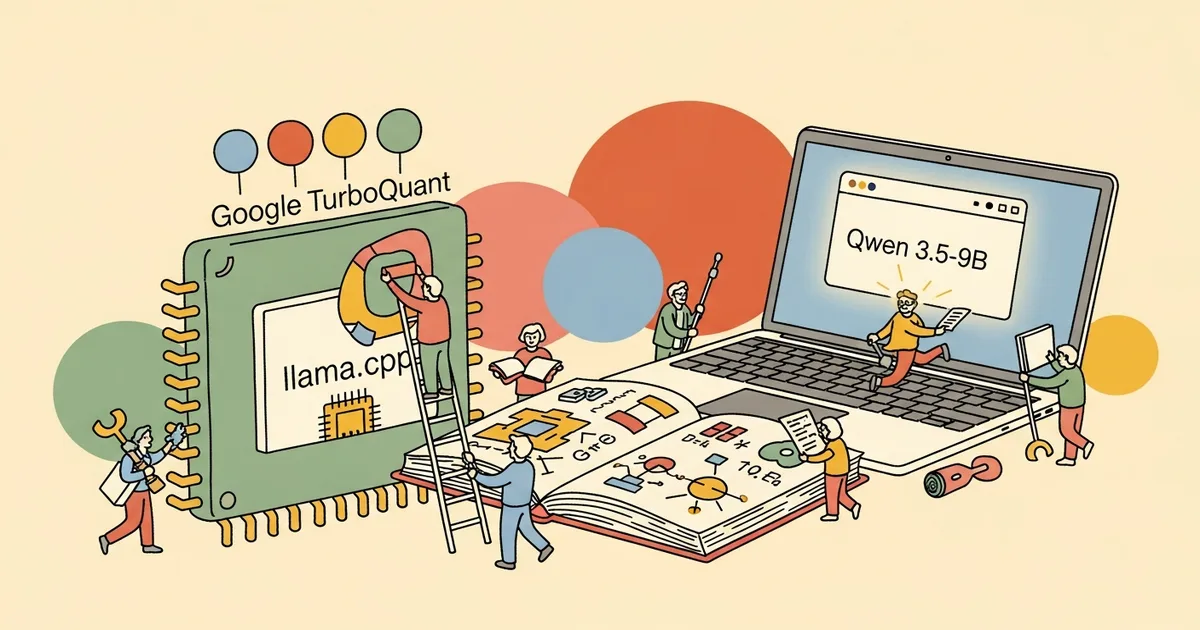
A developer has successfully patched the llama.cpp framework with Google’s TurboQuant compression method to run Qwen 3.5-9B on a standard MacBook Air with M4 chip and 16GB RAM, handling 20,000 token contexts that were previously impossible on the device. The experiment was shared on Reddit’s LocalLLaMA community by user gladkos.
“Previously, it was basically impossible to handle large context prompts on this device. But with the new algorithm, it now seems feasible,” the developer wrote in the Reddit post. The implementation enables running large language models on consumer hardware without requiring Pro-level specifications.
The technical achievement involves integrating Google’s TurboQuant compression algorithm into llama.cpp, an open-source inference engine for large language models. The setup successfully processed 20,000-token contexts on a MacBook Air M4 with 16GB of memory, demonstrating that high-capacity language model inference can run on entry-level Apple Silicon devices.
The developer noted that while the system “is still a bit slow,” newer chips are improving performance. They referenced their open-source application atomic.chat as a platform for running these models locally and mentioned the potential for running “OpenClaw” on regular consumer devices.
The experiment suggests that Google’s TurboQuant compression technique can significantly reduce the hardware requirements for running large language models locally. The developer has made their MacOS application available as open-source software and asked the community whether others have attempted similar implementations.