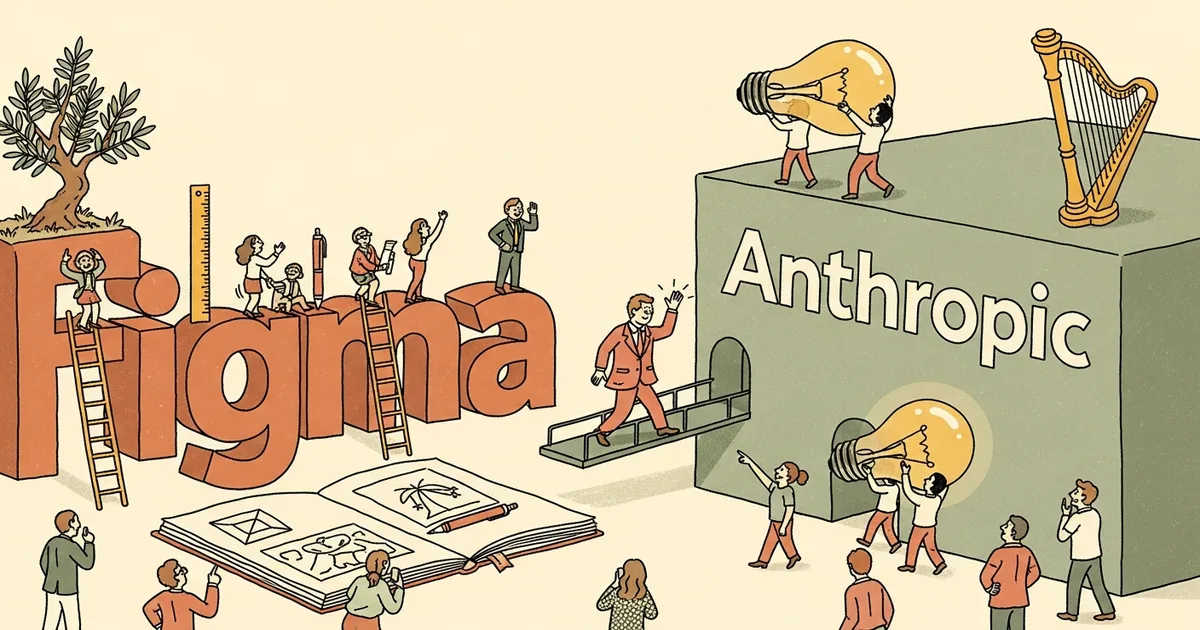
Anthropic Chief Product Officer Mike Krieger filed an SEC Form 4 notice on April 14, 2026, resigning from Figma‘s board of directors. The filing landed during the same week Anthropic announced a web-design tool that converts AI-generated code into editable Figma files — a direct competitive encroachment on Figma’s core product territory. The conflict was not subtle, and the exit confirms it was recognized as such.
Krieger is no ordinary CPO. As the co-founder of Instagram — which sold to Meta for $1 billion in 2012 — he brings rare consumer product instincts to Anthropic. His board seat at Figma was a strategic relationship, not a passive directorship. When Anthropic crossed into design tooling, that relationship became structurally untenable.
The SEC Filing That Said Everything
Board members owe fiduciary duties to the companies they serve. Staying on Figma’s board while Anthropic developed competing design tools would have constituted a direct breach of those duties — access to material non-public information about Figma’s roadmap, partnerships, and competitive positioning makes this not just an ethical issue but a legal one.
The Form 4 filing is the clearest evidence available: Krieger formally separated from Figma’s governance at precisely the moment Anthropic entered Figma’s market. Board resignations filed in the same week as a competing product launch are not coincidences — they are disclosures. The timing removes any ambiguity about causation.
What Anthropic’s Design Tool Actually Does to Figma’s Position
Anthropic’s new design capability generates web interfaces from natural language prompts through Claude and exports the output as editable Figma-compatible files. The workflow bypasses Figma’s own design process entirely — users don’t start in Figma, they end there, treating it as an export format rather than a creative environment.
This is the pattern that displaces incumbents gradually, then rapidly. If enough users begin generating UI through Claude and importing to Figma only for engineering handoff, Figma’s position as the source of truth for design teams erodes. The tool doesn’t eliminate Figma from the workflow — it demotes it. That distinction matters for enterprise contracts in the near term but threatens them over a three-to-five-year horizon. Anthropic has been expanding its product footprint aggressively, and design tooling is the newest layer of that expansion.
Who Mike Krieger Is, and Why the Conflict Ran Deep
Krieger co-founded Instagram in 2010 and served as its CTO through the Facebook acquisition and its first years of hypergrowth. He joined Anthropic as Chief Product Officer in 2023, shifting the company’s product posture from research-adjacent to commercially aggressive. His Figma board seat was structurally appropriate at that point — both companies operated at the intersection of developer tools, design, and consumer software.
That same overlap is precisely what made the conflict so textbook once Anthropic’s design tool materialized. Krieger wasn’t receiving quarterly updates at arm’s length — board members at companies at Figma’s stage receive detailed competitive roadmap information. Sitting on Figma’s board while Anthropic shipped a product designed to route design workflows through Claude would have been indefensible by any governance standard.
His Instagram background is also relevant to what Anthropic is building toward. Krieger has seen firsthand what happens when a new tool reaches product-market fit and begins replacing incumbent workflows at scale. Anthropic did not hire a consumer product founder as its CPO to remain an enterprise API business.
Figma’s Share Price Reacted — The Market Read It Correctly
Figma’s share price fell on the week of Anthropic’s announcement. Figma still holds deep enterprise penetration and a dominant position in collaborative interface design, but the structural risk to its core workflow is no longer speculative — it has a product number, a launch date, and an SEC filing attached to it.
The broader context makes the drop harder to dismiss as noise. Adobe attempted to acquire Figma for $20 billion in 2022; European regulators blocked the deal in 2023 on competition grounds, arguing the merger would harm the design tools market. The irony is acute: two years after that blockage, an AI company is doing structurally more competitive damage to Figma without triggering any antitrust review — because it is building a new category rather than acquiring an existing one.
Software Stocks Are Already Down 26% in 2026
The S&P 500 Software and Services Index has fallen nearly 26% in 2026 as AI tools systematically threaten the revenue models of traditional software companies. The pattern is consistent across categories: AI generates, incumbent SaaS captures — except AI companies are increasingly skipping the capture step and building end-to-end pipelines themselves.
Figma is not alone in facing this pressure. The same dynamic has already hit coding tools, writing platforms, and video editing software. AI-native competitors in video production have materially disrupted the Adobe Premiere ecosystem over the past 18 months. Design represents the next category in the queue, and Anthropic — with $7.3 billion raised and a CPO who has built a product used by a billion people — has the resources and instincts to push hard into it.
What This Signals About Anthropic’s Product Strategy
Anthropic built its market position on safety-focused large language models and enterprise API access. The design tool represents a deliberate expansion into consumer and creative workflows — territory that OpenAI has been targeting through direct media industry relationships. OpenAI’s $1 billion Disney deal showed how AI labs are constructing direct relationships with creative industries, bypassing the traditional software vendors that used to sit between AI infrastructure and end users.
Anthropic is following the same logic. MegaOne AI tracks 139+ AI tools across 17 categories, and the trend is uniform: model providers are vertically integrating. Claude is not merely an API layer for developers — it is becoming a product that ships directly into design, coding, writing, and creative workflows. The board resignation is the governance record of that strategic decision being made.
The fact that Krieger vacated his Figma seat over this tool — rather than over a tangential AI feature — signals that Anthropic’s design capabilities are serious product strategy. Companies do not trigger board-level governance reshuffles over marginal experiments. This one came with an SEC filing.
The Boardroom Is Where Strategy Gets Exposed
For Figma, the question is no longer whether AI disruption is coming to collaborative design. It is whether the company can absorb this competitive pressure and maintain its position as the collaboration layer for design teams — or whether it is gradually reduced to a Figma file export format in a Claude-generated world. The market’s 26% software sector decline suggests investors have already started pricing in that structural uncertainty.
Anthropic’s move into design, confirmed by a board-level governance exit, marks a new phase in how AI labs position themselves against the software stack. The boardroom is where corporate strategy gets formalized — and this formalization was unambiguous.