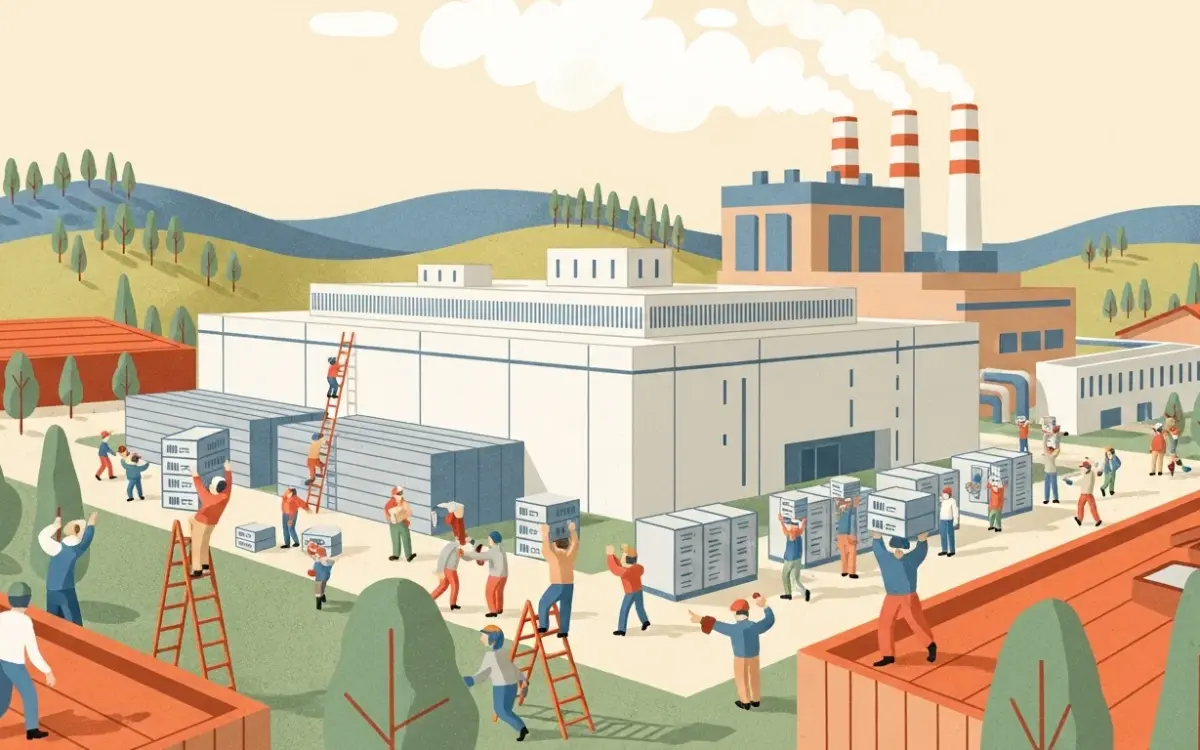
- SoftBank plans a $500 billion AI data center complex in Piketon, Ohio, on a 3,700-acre former uranium enrichment site with 10 gigawatts of planned power capacity.
- The project includes a $33.3 billion gas-fired power plant and $4.2 billion in transmission upgrades, with Phase 1 targeting 800 megawatts by early 2028.
- CEO Masayoshi Son framed the facility as delivering “one campus” instead of “many locations, many years,” signaling a bet that AI growth will be constrained by power infrastructure rather than model architecture.
What Happened
SoftBank Group announced plans to build what would become one of the largest AI data center complexes in the United States, located on a 3,700-acre former uranium enrichment site in Piketon, Ohio, approximately 70 miles south of Columbus. The project carries a total investment target of $500 billion and is part of a broader $550 billion Japanese investment in the United States negotiated in exchange for reduced trade tariffs.
Commerce Secretary Howard Lutnick and Energy Secretary Chris Wright attended the announcement. CEO Masayoshi Son said SoftBank would deliver “one campus” instead of “many locations, many years,” framing the project as a departure from the incremental data center buildouts that have defined the industry. Son described the project’s goal as developing “the smartest intelligence in the world,” language that suggests the Ohio facility is intended for frontier model training rather than inference serving.
Why It Matters
The project reflects a growing consensus that AI infrastructure expansion is bottlenecked by power availability, not model development. Large AI training clusters consume hundreds of megawatts of continuous power, and existing grid capacity in most US regions cannot support new facilities at the scale SoftBank envisions. By building its own generation capacity, SoftBank bypasses the multi-year queue for grid interconnection that has delayed data center projects nationwide.
The total investment figure of $500 billion rivals the GDP of mid-sized nations and exceeds the individual infrastructure commitments of most Western technology companies outside of Microsoft. If completed at the announced scale, the complex would compete with facilities planned or under construction by Microsoft, Google, and Amazon across the United States and Middle East for the title of largest single-site AI compute installation globally.
Technical Details
The facility targets 10 gigawatts of total power capacity. For context, one gigawatt can power roughly 750,000 homes. Phase 1 will deliver approximately 800 megawatts at a cost of $30 billion to $40 billion, with completion targeted for early 2028.
A dedicated gas-fired power plant with 9.2 gigawatts of total generation capacity will cost $33.3 billion. SB Energy, SoftBank’s energy subsidiary, and AEP Ohio will invest an additional $4.2 billion in transmission lines and grid upgrades. The first turbine is expected within one year, with remaining turbines coming online by the end of the decade.
The choice of natural gas over renewables reflects pragmatic energy economics: gas plants can be built faster than equivalent renewable installations with battery storage, provide continuous baseload power without intermittency, and cost less per megawatt of reliable capacity. Environmental groups have criticized the approach as locking in decades of fossil fuel consumption.
Who’s Affected
The project is connected to the broader Stargate venture involving OpenAI and Oracle, announced 14 months earlier. Customers for the Ohio facility have not been announced. The existing site infrastructure, including high-voltage power lines from the former enrichment complex, gives the location a head start over greenfield alternatives.
Industry skepticism persists. Ohio’s grid operator had not been formally notified before the announcement, raising questions about the feasibility of integrating 10 gigawatts of new load into the regional transmission network. Local communities near Piketon face potential impacts from construction activity, increased natural gas demand, and the transformation of a site that has been largely dormant since the enrichment facility closed.
What’s Next
Phase 1 completion is targeted for early 2028. SoftBank plans to raise external capital to reach the full $500 billion investment figure, though the sourcing and timeline for that financing remain unspecified. The project is part of the broader Stargate initiative that has already opened its first data center in Texas and announced sites in New Mexico, with Ohio joining the expanding footprint.
Whether the project can deliver on its power targets without triggering grid reliability concerns in the Ohio region is an open question that regulators have not yet publicly addressed. The gap between the announcement’s ambition and the infrastructure realities of connecting 10 gigawatts to an unprepared grid will determine whether this becomes the largest AI campus in the world or another megaproject that scales back from its original vision.
Related Reading
- DOE Announces 10-Gigawatt Data Center at Former Ohio Uranium Enrichment Site
- Kandou AI Raises $225M from SoftBank, Valued at $1.8B for Edge Inference Chips
- Legal AI Startup Harvey Reaches $11 Billion Valuation After $200 Million Round
- India AI Summit Draws 300,000 Attendees, Yields $250 Billion in Investment Pledges