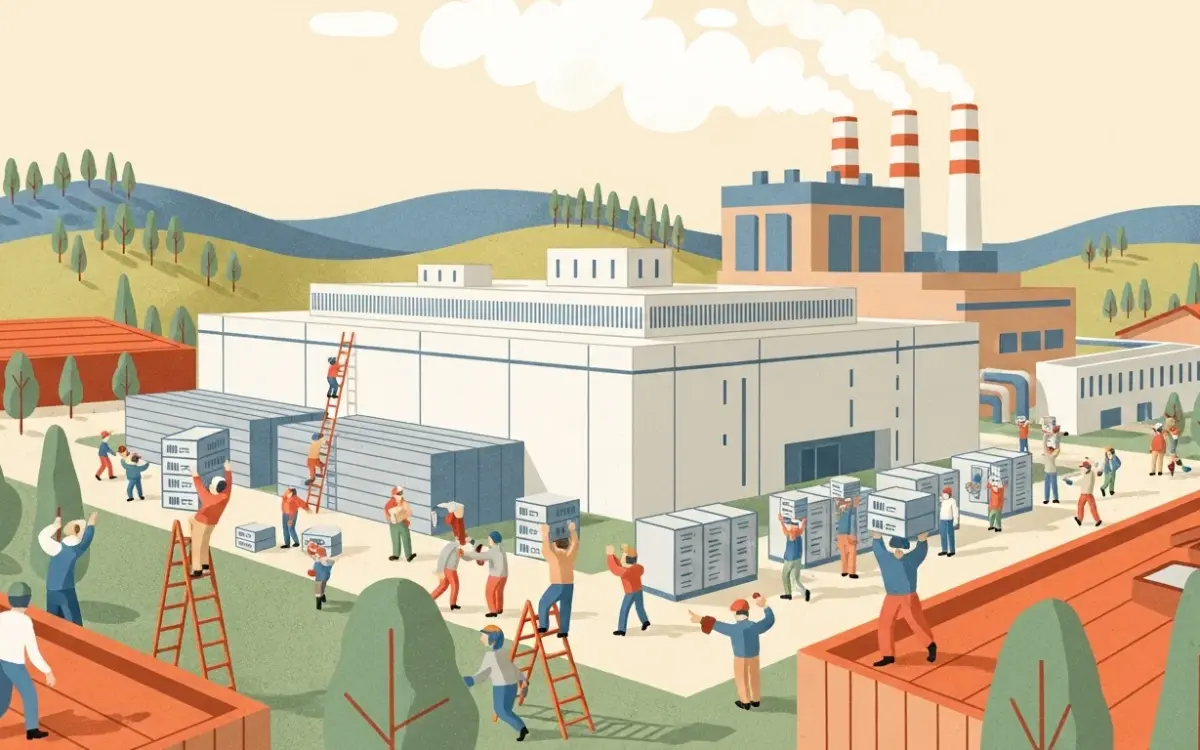
SoftBank Group has announced plans to build one of the largest AI data center complexes in the United States, located in Ohio and powered by a purpose-built gas-fired power plant. The project, part of a broader $550 billion Japanese investment in the US negotiated in exchange for reduced trade tariffs, represents SoftBank CEO Masayoshi Son’s bet that the next phase of AI development will be constrained by power infrastructure rather than model architecture.
The financial scale is substantial. The data center and associated equipment will cost between $30 billion and $40 billion. The gas-fired power plant carries a construction budget of $33.3 billion. SB Energy, SoftBank’s energy subsidiary, and AEP Ohio will invest an additional $4.2 billion in transmission lines and grid upgrades to connect the facility. Total investment, including external capital SoftBank plans to raise, reaches $500 billion — a figure that rivals the GDP of mid-sized nations.
The decision to build a dedicated power plant addresses the central bottleneck facing AI infrastructure expansion. Large AI training clusters consume hundreds of megawatts of continuous power, and existing grid capacity in most US regions cannot support new facilities at the scale SoftBank envisions. By constructing its own generation capacity, SoftBank bypasses the multi-year queue for grid interconnection that has delayed data center projects across the country.
The choice of gas-fired generation over renewable sources reflects pragmatic energy economics. Natural gas plants can be built faster than equivalent renewable installations with battery storage, provide continuous baseload power without intermittency, and cost less per megawatt of reliable capacity. Environmental groups have criticized the approach, arguing that locking in decades of fossil fuel consumption contradicts the technology industry’s stated climate commitments.
Son described the project’s goal as developing “the smartest intelligence in the world” — language that suggests the Ohio facility is intended for frontier model training rather than inference serving. If completed at the announced scale, the complex would be among the largest single-site AI compute installations globally, competing with facilities planned or under construction by Microsoft, Google, and Amazon in the US and Middle East.