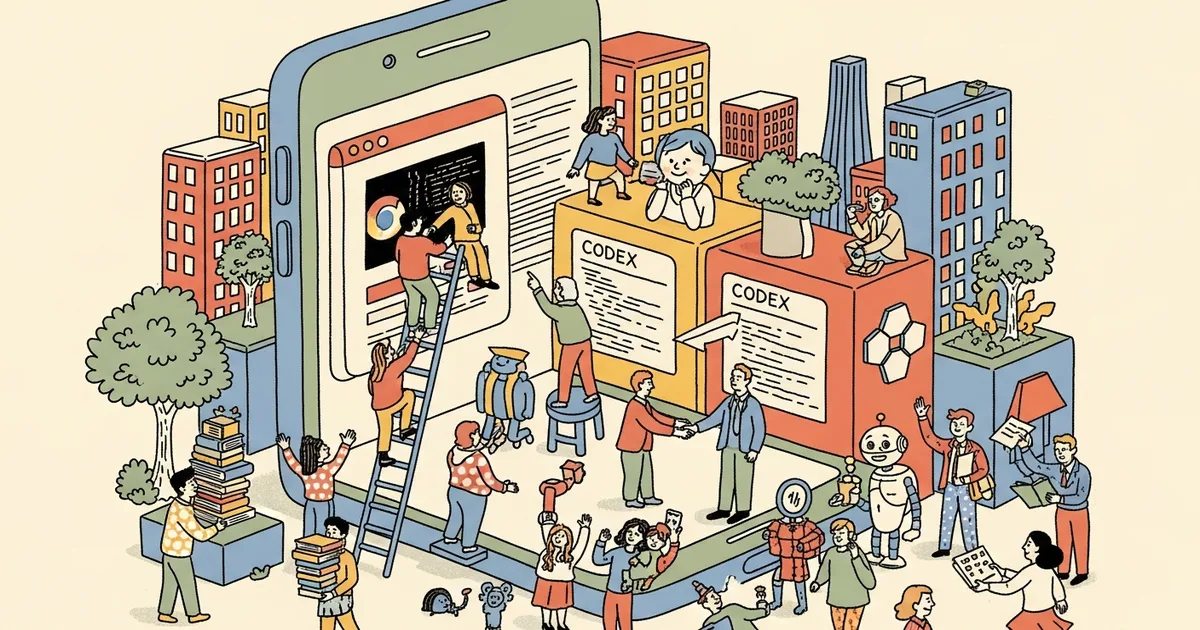
OpenAI plans to consolidate ChatGPT, the ChatGPT Atlas browser, and the Codex programming assistant into a single desktop application, according to a Wall Street Journal report published March 20. The move would eliminate the current fragmentation across separate products and create what internal planning documents describe as a unified interface for conversational AI, web research, and code generation.
The superapp consolidation addresses a practical problem: users currently switch between ChatGPT for general tasks, Atlas for web browsing, and Codex for programming — three products with overlapping capabilities and inconsistent interfaces. Merging them simplifies the user experience and reduces OpenAI’s internal engineering overhead, allowing a single team to ship updates across all capabilities simultaneously rather than coordinating releases across separate product lines.
Separately, OpenAI is developing an AI tool it describes as a “research intern” — an agent designed to automate tasks that typically take scientists several weeks of focused work. The company expects to launch this offering by September 2026. The research intern represents a step toward OpenAI’s stated longer-term objective of building a “fully automated multi-agent research system” by March 2028, a timeline that would put autonomous scientific research capabilities on a two-year horizon from today.
The superapp strategy mirrors consolidation moves by competitors. Google has integrated Gemini into Search, Workspace, and Android. Microsoft has embedded Copilot across Office, Windows, and Edge. By combining its products, OpenAI aims to match the distribution advantages that platform owners enjoy while maintaining its position as the default standalone AI application. ChatGPT Atlas, which debuted in 2025, would bring real-time web access into the unified experience — a feature that has become table stakes as Perplexity and Google’s AI Overviews have normalized search-integrated AI responses.
No timeline has been announced for the superapp launch. The research intern product, with its September 2026 target, will likely arrive first as a separate offering before being folded into the consolidated application. For developers building on OpenAI’s platform, the key question is whether the superapp will expose new integration points or whether API access will remain the primary interface for programmatic use.