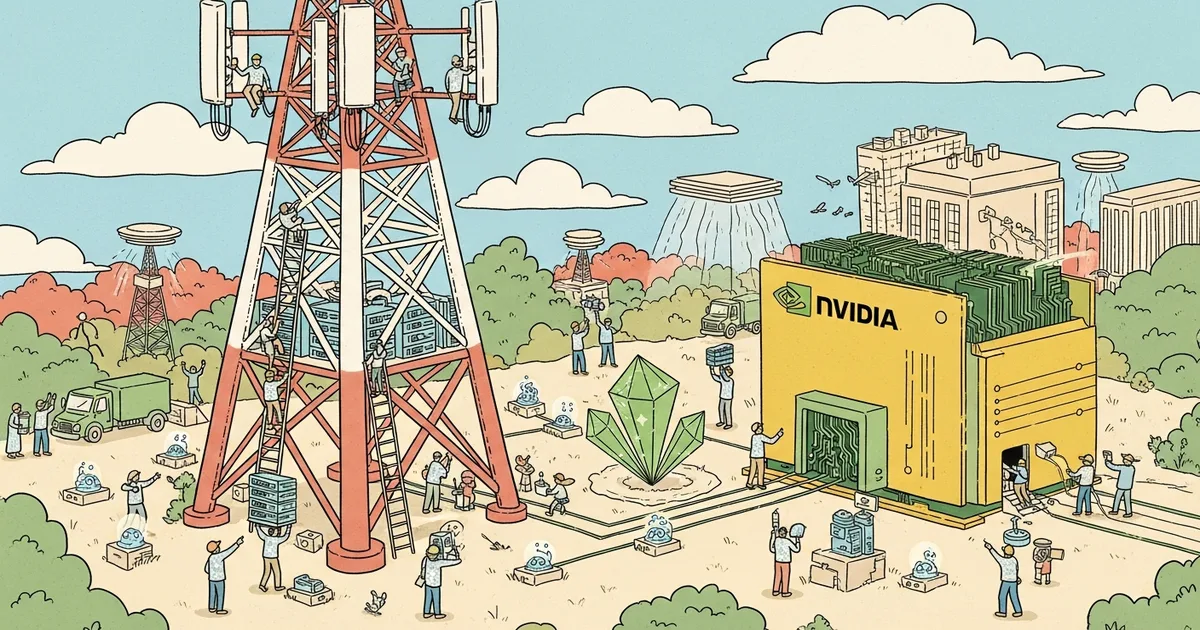
NVIDIA and T-Mobile announced a partnership at GTC to integrate AI infrastructure with 5G connectivity, enabling real-time vision and reasoning AI agents to run at the network edge rather than in centralized data centers. The collaboration, which includes Nokia and a growing developer ecosystem, aims to bring physical AI — systems that perceive and act in the real world — to enterprise and municipal deployments using T-Mobile’s 5G network as the connectivity layer.
T-Mobile has begun piloting NVIDIA’s RTX PRO 6000 Blackwell-based workstations for edge AI processing, with early deployments focused on computer vision applications in manufacturing, logistics, and city operations. The City of San Jose is a flagship deployment, targeting 5x faster incident response times using integrated computer vision agents and a digital twin of city infrastructure. The system processes video feeds from existing cameras in real time, identifying incidents that would otherwise go undetected in the vast majority of surveillance footage that is never reviewed.
The scale of the opportunity is defined by a striking statistic: over 1.5 billion cameras capture footage globally, but less than 1 percent is reviewed by humans. NVIDIA’s Metropolis VSS 3 blueprint addresses this gap, enabling AI to scan video feeds 100x faster than real-time and locate specific events in under five seconds. By running these workloads at the edge — on hardware physically close to the cameras rather than in distant cloud data centers — the system eliminates the network latency that makes centralized processing impractical for time-sensitive applications like traffic incident detection, workplace safety monitoring, and security response.
The partnership positions T-Mobile as more than a connectivity provider. By hosting NVIDIA edge AI hardware within its network infrastructure, T-Mobile creates a platform that enterprise customers can deploy AI applications on without building their own edge computing infrastructure. This mirrors the strategy AWS pursued with Outposts and Azure pursued with Stack — extending cloud capabilities to the edge — but using the telco’s existing physical presence in towers, switching centers, and metropolitan facilities as the deployment substrate.
For NVIDIA, the T-Mobile partnership extends the Blackwell platform’s reach beyond traditional data centers into distributed edge deployments where individual GPU nodes process local workloads independently. The model requires hardware that is compact, power-efficient, and capable of running inference workloads without continuous cloud connectivity — a different engineering challenge than the large-scale training clusters that have driven NVIDIA’s recent revenue growth. The GTC announcement suggests NVIDIA sees edge AI as the next volume market after data center training.