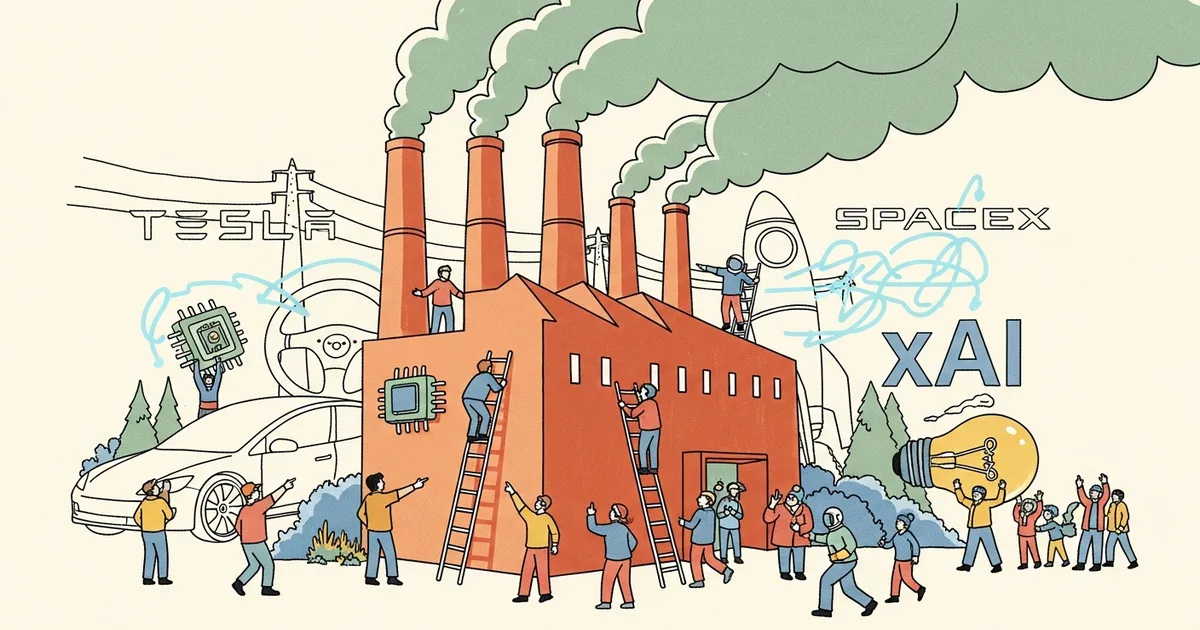
Elon Musk has announced Terafab, a $20-25 billion chip manufacturing facility in Austin, Texas, as a joint venture between Tesla, SpaceX, and xAI. The factory, unveiled during a livestream on X, will produce 2-nanometer chips and targets one terawatt of computing power annually — a figure that would make it one of the highest-output semiconductor facilities in the world if achieved.
The facility will be located near Tesla’s existing campus in eastern Travis County, leveraging the infrastructure and workforce that Tesla has already built in the Austin area. By manufacturing its own chips, Musk aims to reduce the three companies’ dependence on external semiconductor suppliers — particularly TSMC and Samsung — for the custom silicon that powers Tesla’s autonomous driving systems, SpaceX’s satellite communications, and xAI’s Grok model training infrastructure.
The 2-nanometer process node places Terafab at the leading edge of semiconductor manufacturing, a capability currently limited to TSMC, Samsung, and Intel’s foundry operations. Building a greenfield 2nm fab from scratch is among the most capital-intensive and technically challenging industrial projects possible — Intel’s own 2nm efforts have required over $100 billion in total investment across multiple facilities. Musk’s $20-25 billion budget for a single facility is ambitious by industry standards.
The one-terawatt annual output target is extraordinary. For context, NVIDIA’s H100 GPU consumes approximately 700 watts at peak load. One terawatt of annual computing capacity would theoretically power over 1.4 million H100-equivalent processors running continuously — a scale that exceeds any single company’s current compute deployment. Whether this target refers to peak theoretical output or sustained production capacity remains unclear from the announcement.
The joint venture structure across Tesla, SpaceX, and xAI creates potential conflicts of interest that Musk’s companies have navigated before. Tesla shareholders may question whether the factory’s output will be allocated fairly across the three entities, particularly if xAI’s training compute demands compete with Tesla’s need for autonomous driving chips. The vertical integration strategy — owning chip design, manufacturing, and deployment — mirrors the approach Apple has pursued with its M-series silicon, but at a scale and across a corporate structure that has no precedent in the semiconductor industry.