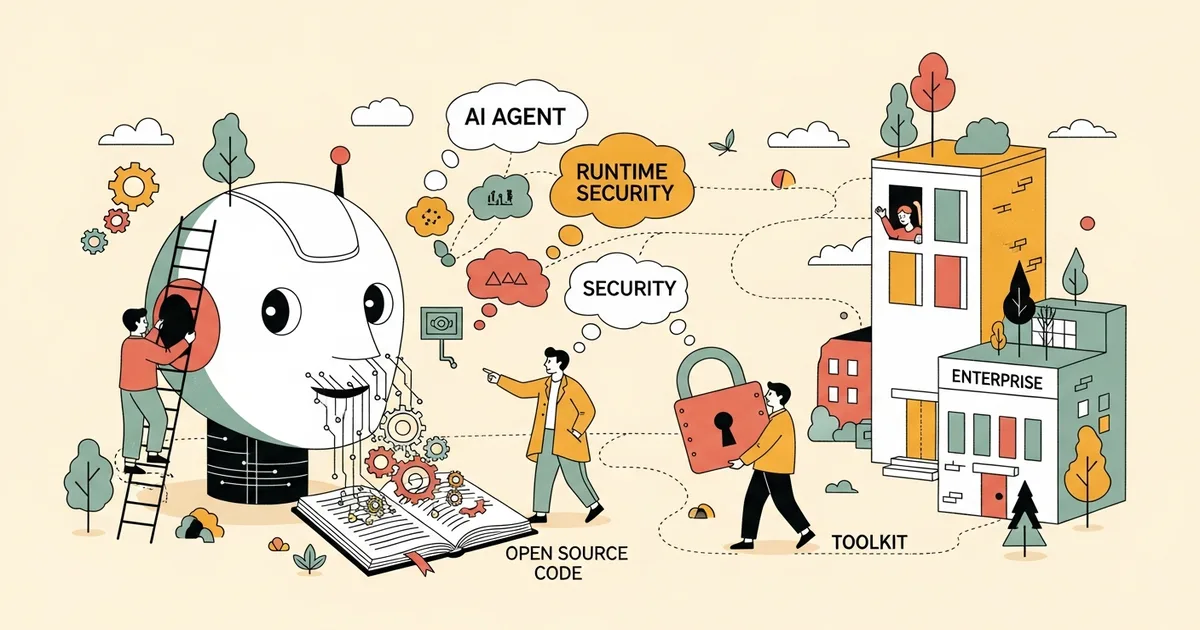
- Microsoft released an open-source toolkit on April 8, 2026 that enforces security governance on AI agents during live execution, not only at deployment time.
- The toolkit targets a gap created by autonomous language models now executing code and accessing corporate networks faster than traditional policy controls were designed to handle.
- Enterprise AI has shifted from advisory copilots to agents capable of consequential action, expanding the attack surface beyond what perimeter-based controls address.
- The release is open-source, allowing security teams and platform engineers to audit and integrate it into existing MLOps pipelines.
What Happened
Microsoft published an open-source security toolkit on April 8, 2026 aimed at enforcing governance on enterprise AI agents at runtime — the moment a model is actively executing tasks — rather than relying on pre-deployment configuration alone. The release was reported by AI News and addresses what Microsoft characterizes as a structural lag between how fast agentic AI is being deployed and how fast enterprise security controls can respond. The toolkit is open-source and targets organizations deploying language model-based agents that can write and run code, call external APIs, and traverse corporate networks autonomously.
Why It Matters
Enterprise AI has moved well beyond read-only copilots and conversational interfaces. Autonomous agents now take consequential actions — submitting data, triggering workflows, modifying files — and that shift has exposed the limits of static, perimeter-based access control frameworks that were never designed to evaluate the chain-of-reasoning behind an AI-generated system call. Traditional role-based access control assigns permissions to users and service accounts; it has no native mechanism for assessing whether an LLM agent’s request is consistent with its stated intent. Runtime interception addresses this by placing governance at the point of execution rather than at the edge of the network.
Technical Details
The toolkit’s core mechanism is runtime interception: security policies are evaluated dynamically as agents execute actions, rather than being enforced only at configuration or provisioning time. This means an agent requesting database access mid-task can be evaluated against policy in real time, not merely checked against a static allowlist set at deployment. The approach is designed to catch privilege escalation attempts and prompt injection attacks — attack vectors where a malicious instruction embedded in external content causes an agent to take unintended actions. Microsoft open-sourced the project, making its integration APIs and supported frameworks available for public audit and extension.
Who’s Affected
Platform engineering and enterprise security teams deploying AI agents on Azure or self-managed infrastructure are the direct audience. Organizations in regulated sectors — financial services, healthcare, and government — face particular pressure, as emerging regulatory frameworks in the EU and United States increasingly require logged, auditable decision trails for automated systems that interact with sensitive data or execute consequential transactions. Security vendors building agent orchestration layers will also need to evaluate how runtime governance tooling integrates with existing SIEM and SOAR stacks.
What’s Next
With the toolkit open-sourced, third-party review and community contribution will shape how broadly the runtime governance pattern is adopted. Microsoft has not disclosed a timeline for integrating the toolkit into managed Azure AI services, and independent security researchers will now be able to audit its claims against real-world agentic workloads.