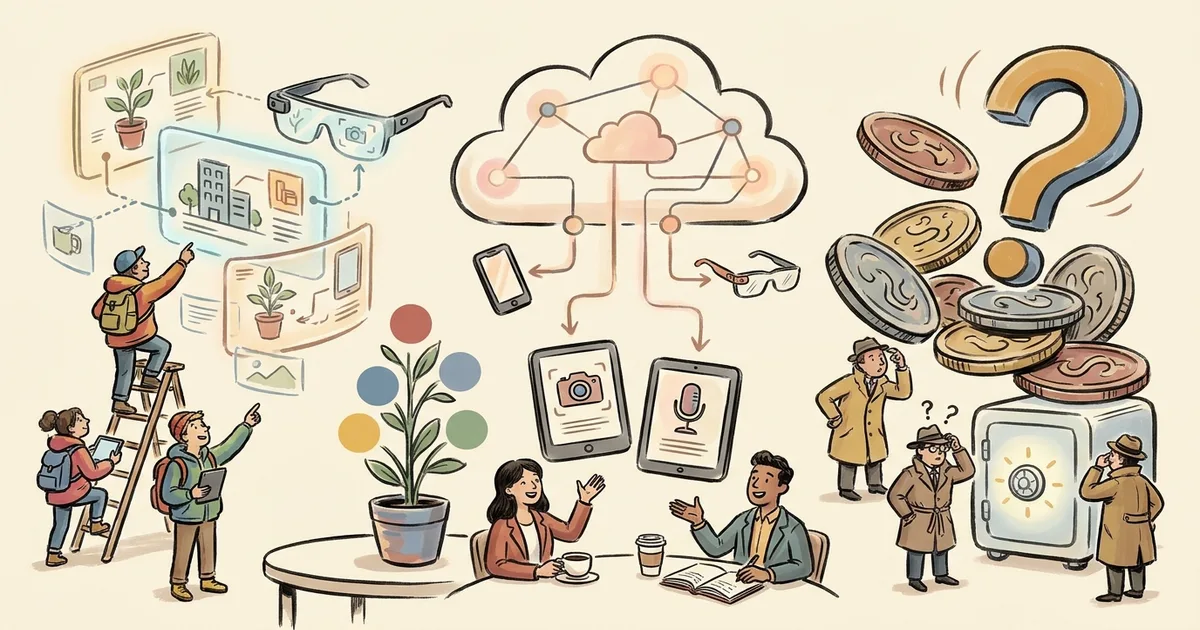
- Google’s Project Astra is still a research preview in November 2026 — access runs through a trusted-tester waitlist, not a public product launch.
- Astra’s core trick is real-time multimodal understanding: it processes live video and audio together so a voice assistant can see what a user sees and respond with almost no lag.
- Rather than shipping as a standalone app, Astra’s capabilities are being folded into Gemini Live through staged feature releases.
- “Astra AI” is also the name of unrelated cryptocurrency tokens (AstraAI, Astra Nova) that have nothing to do with Google’s research project — a common source of search confusion.
| Key Facts | |
|---|---|
| Product | Google Project Astra (Gemini research prototype) |
| Status (November 2026) | Trusted-tester waitlist; not a public product |
| Built on | Gemini multimodal models, feeding features into Gemini Live |
| Core capability | Real-time video + audio understanding with low-latency voice replies |
| How to access it | Through staged Gemini Live feature rollouts, not a separate app |
| Price | Free where available; tied to whatever Gemini/Gemini Live tier a user has |
What Is Google Project Astra?
Project Astra is Google DeepMind’s research prototype for a “universal AI assistant” that can see, hear, and talk back in something close to real time. Unveiled as a research demo, it was built to show what happens when Gemini’s multimodal models are given a live camera feed and a live microphone feed at once, rather than a single photo or a block of text. In November 2026, Astra itself remains a limited research preview — Google has not turned it into a downloadable consumer app, and only a small number of trusted testers can use the original Astra experience directly. Most people encounter Astra’s work secondhand, through features that have already migrated into Gemini Live.
That distinction matters for anyone searching “Astra AI” expecting to find an app to download: there isn’t one. What exists is a research pipeline that feeds polished, production-ready pieces of itself into Google’s shipping products over time.
How Project Astra Works
Astra’s demos are built around three capabilities working together. First, real-time video understanding lets the assistant continuously observe a scene through a phone or glasses camera, track objects as they move, and answer questions about what’s currently happening rather than what was in a single still frame. Second, advanced voice interaction cuts the latency of a typical voice assistant dramatically, allowing a more natural back-and-forth where a user can interrupt the assistant mid-sentence and get a relevant response instead of a dropped turn. Third, a multimodal memory layer lets the assistant carry details across a session — remembering where a user said they left their keys ten minutes earlier, for example, without being re-told.
None of this requires a new foundation model distinct from Gemini; Astra is better understood as an interaction layer and a set of latency/engineering breakthroughs sitting on top of Gemini’s existing multimodal capabilities, built specifically to make live conversation feel instant rather than turn-based.
What’s Actually Available Right Now
As of November 2026, the pieces of Astra that have reached real products live inside Gemini Live, not inside a separate “Astra” app. Google has been shipping Astra-derived features — faster voice responses, interruptible dialogue, and limited live-camera understanding — into Gemini Live in stages rather than as one bundled release. The full, unrestricted version of Astra that Google first demoed — with extended live sessions and broader tool use — is still being tested with a waitlist of trusted users rather than opened to the public.
Two specific things worth tracking for anyone following the project: a firm date for Astra’s camera features reaching Google’s smart glasses hardware, and longer Live sessions that don’t require the workarounds (like periodic reconnects) that current public Gemini Live users sometimes hit.
Project Astra vs. Gemini Live
| Aspect | Gemini Live (public) | Project Astra (research preview) |
|---|---|---|
| Availability | Available now to Gemini app users | Waitlist-gated trusted testers only |
| Video understanding | Limited, expanding as Astra features roll in | Full real-time scene tracking and object persistence |
| Session length | Shorter, with occasional reconnects | Longer continuous sessions in testing |
| Purpose | Shipping consumer product | Testbed for features that later reach Gemini Live |
In practice, Gemini Live is what Astra becomes once a capability is stable, efficient, and ready for general availability — the two aren’t competing products so much as the same technology at different stages of maturity.
The “Astra AI” Name Confusion — It’s Not a Crypto Token
Searches for “Astra AI” turn up more than Google’s research project. Several unrelated cryptocurrency tokens — including one marketed as “AstraAI” and a separate crypto-AI project called Astra Nova — use similar branding and have no connection to Google or DeepMind. Astra Nova made headlines of its own in 2026 after reporting roughly $10 million in token losses tied to a disputed market event, an incident entirely separate from anything Google has built. Google has never issued a cryptocurrency tied to any Gemini-related project, and model or research announcements routinely trigger opportunistic token launches that borrow a trending name. Anyone encountering an “Astra” coin, token presale, or wallet-connect prompt should treat it as unrelated to Google’s AI research and apply the same caution warranted by any unverified crypto asset.
What to Watch Next
The clearest signal of Astra’s progress will keep coming through Gemini Live’s release notes rather than a standalone Astra launch announcement. Expect incremental rollouts: broader live-camera understanding, longer uninterrupted sessions, and expanded tool-use (letting the assistant actually act on what it sees, not just describe it) are the features Google has signaled are still moving from the Astra research track into the shipping product.
How to Try Astra’s Features Today
There are two realistic paths for someone who wants hands-on access. The first is joining Google’s waitlist for the full Astra research preview directly, which is gated to a small number of trusted testers and carries no guaranteed timeline for approval. The second, far more accessible path is simply using Gemini Live itself: because Astra’s stable capabilities are released into Gemini Live in stages, anyone with access to the Gemini app is already using a downstream version of Astra’s engineering whenever they use Gemini Live’s voice and camera features, even without ever joining the dedicated Astra waitlist. For most people curious about “what Astra can do,” testing Gemini Live’s current live-camera and voice tools is a more practical starting point than waiting on the waitlist.
Limitations to Keep in Mind
Astra’s demos are intentionally impressive, but the shipping reality is narrower than the research footage suggests. Session length, tool-use depth, and camera-understanding accuracy inside the public Gemini Live product all lag behind what Google has shown in controlled Astra demonstrations. Latency, while much improved over older voice assistants, still isn’t instantaneous in every scenario, and live understanding can degrade in poor lighting, fast motion, or crowded scenes. Treating current Gemini Live features as a preview of the direction Astra is heading, rather than the finished version of Astra itself, sets more accurate expectations.
Frequently Asked Questions
Can I download Project Astra right now? Not as a standalone app. Its features arrive through Gemini Live, which is publicly available, while the full Astra research preview remains limited to a trusted-tester waitlist.
Is there an “Astra AI” cryptocurrency from Google? No. Google has not issued any token tied to Astra or Gemini. Crypto projects using similar names are unrelated and unaffiliated with Google.
Is Astra a different AI model than Gemini? No — it’s built on Gemini’s multimodal models, with Astra representing the real-time interaction engineering layered on top rather than a separate foundation model.
Bottom Line
Project Astra is Google’s live-video-and-voice research preview, not a product most people can install today — the parts of it that are ready for prime time are already showing up inside Gemini Live, and the rest is still moving through a trusted-tester program. The surge of search interest in “Astra AI” reflects curiosity about that research project and its eventual rollout, not a new consumer launch, and it has no connection to the various crypto tokens trading under similar names.
Related Reading
- North Carolina Parents Sue Google Over AI Chatbot’s Role in Teen’s Crisis
- Google Launches Playground, Where Gemini Turns Text Prompts Into Playable Games
- AI Shopping Assistants Quote the Rich Higher Prices, a 325,000-Test Study Finds
- Google Launches Gemini 4 Argon, Claiming the Benchmark Lead With a Cybersecurity Specialty
- Google Tests Letting Users Buy From Flipkart Through Gemini and AI Mode in India