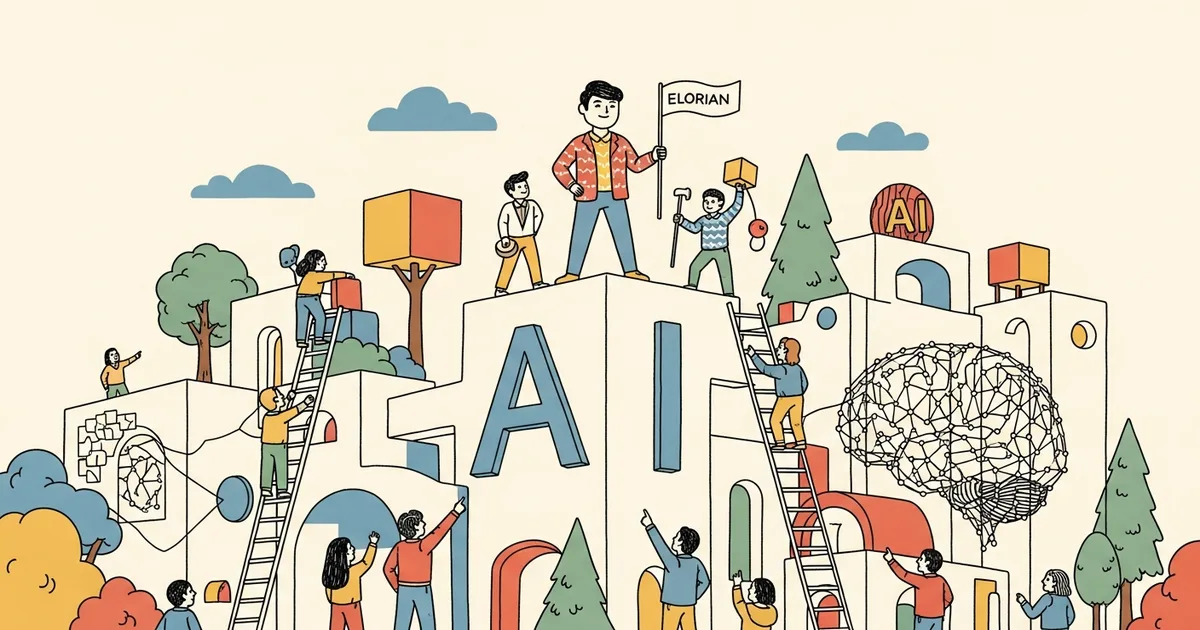
- Andrew Dai, a former Google DeepMind researcher, has co-founded Elorian, a new startup focused on improving AI visual understanding.
- Dai argues that leading AI models perform at roughly a 3-year-old child’s level when interpreting visual prompts, pointing to a persistent gap in multimodal capability.
- Elorian debuted publicly on April 9, 2026, according to Bloomberg, making it one of the first AI startups to explicitly target visual reasoning as a primary research objective.
- The company’s founding signals growing investor and researcher interest in addressing weaknesses in vision-language model performance beyond text benchmarks.
What Happened
Andrew Dai, a researcher who previously worked at Google DeepMind, publicly launched a new artificial intelligence startup called Elorian on April 9, 2026, according to Bloomberg. The company is focused on visual AI — specifically on closing what Dai characterizes as a fundamental gap between how large language models process text and how they interpret images. Elorian’s debut adds to a growing wave of AI startups founded by researchers departing major labs.
Why It Matters
Visual reasoning has emerged as one of the more contested frontiers in AI research. Models such as OpenAI’s GPT-4o, Google’s Gemini 1.5, and Anthropic’s Claude 3 family all include multimodal capabilities, but independent evaluations have repeatedly shown degraded performance on tasks requiring spatial reasoning, counting, compositional scene understanding, and fine-grained visual differentiation. Dai’s framing of the problem is pointed: he contends the field has achieved adult-level text reasoning while visual cognition in leading models remains at an early developmental stage.
Technical Details
Dai told Bloomberg that current AI models have “the intelligence of a 3-year-old kid, at least when it comes to making sense of visual prompts” — a characterization that maps onto known benchmark limitations. Standard vision-language evaluations such as MMBench, MMMU, and SeedBench have documented consistent failure modes in multi-step visual inference and attribute binding, areas where human performance diverges sharply from model output. The specific architectural approach Elorian plans to take was not disclosed at launch, but the framing suggests a research focus on the visual encoder and cross-modal alignment layers rather than on scaling text capabilities alone.
Who’s Affected
The startup’s focus area puts it in direct competition — or potential complementarity — with vision teams at Google DeepMind, OpenAI, Meta AI, and Mistral, all of which have active multimodal research programs. Developers building applications that depend on document parsing, medical imaging analysis, robotics perception, or video understanding stand to benefit most if Elorian’s work produces transferable improvements. Enterprise customers in sectors such as healthcare, manufacturing, and autonomous systems have particularly strong incentives to track progress in robust visual AI, given that text-only benchmarks do not reflect their deployment conditions.
What’s Next
Elorian has not yet announced a product, research publication, or funding round as of April 9, 2026. Bloomberg’s reporting marks the company’s first public appearance. Additional technical disclosures, a seed round announcement, or an early research preprint would be the expected next milestones for a lab-spinout at this stage.