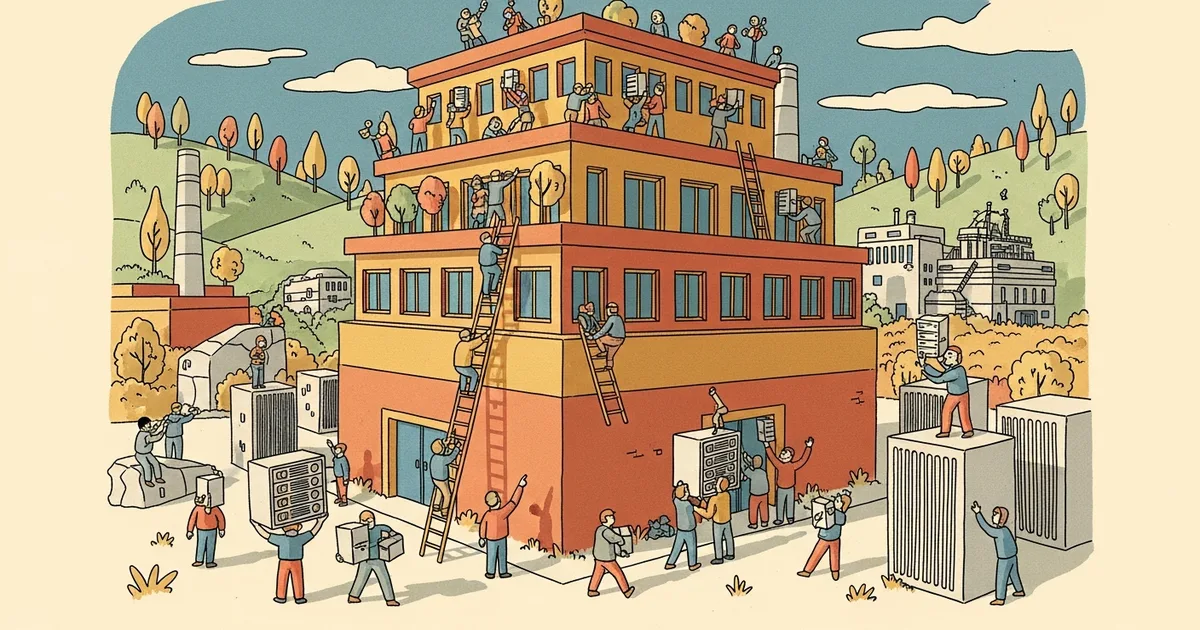
The U.S. Department of Energy has announced a public-private partnership to build a 10-gigawatt data center complex and up to 10 gigawatts of new power generation at the decommissioned Portsmouth Gaseous Diffusion Plant in Pike County, southern Ohio. The project, announced by Trump administration officials, repurposes a former uranium enrichment facility into what would be one of the largest AI compute installations in the world.
The power generation component includes 9.2 gigawatts of natural gas capacity, funded in part by $33.3 billion in Japanese investment tied to SoftBank’s broader AI infrastructure commitment. SB Energy, SoftBank’s energy subsidiary, and AEP Ohio will invest an additional $4.2 billion in grid upgrades and new transmission lines to connect the facility to the regional power network. The total infrastructure investment — spanning data center construction, power generation, and grid connectivity — places the project among the most capital-intensive AI infrastructure developments announced to date.
The choice of the Portsmouth site reflects both practical and political considerations. The decommissioned uranium plant sits on approximately 3,700 acres with existing industrial infrastructure, rail access, and proximity to high-voltage transmission corridors. Converting the site avoids the lengthy permitting process required for greenfield development while providing the administration with a narrative of economic revitalization for a community that lost thousands of jobs when enrichment operations ceased.
At 10 gigawatts of compute capacity, the facility would dwarf existing hyperscale data centers. For comparison, a typical large data center campus operates at 100-500 megawatts. Ten gigawatts is equivalent to the output of approximately ten nuclear power plants and would represent a measurable increase in total U.S. electricity consumption. The scale underscores how AI training and inference workloads are becoming infrastructure challenges comparable to industrial manufacturing rather than traditional IT operations.
Environmental organizations have criticized the project’s reliance on natural gas generation, arguing that 9.2 gigawatts of new fossil fuel capacity contradicts federal climate commitments and locks in decades of carbon emissions. Proponents counter that gas-fired plants can be built faster than equivalent renewable installations and provide the continuous baseload power that AI training clusters require. The tension between AI infrastructure expansion and emissions reduction is emerging as a defining policy challenge for the current administration.