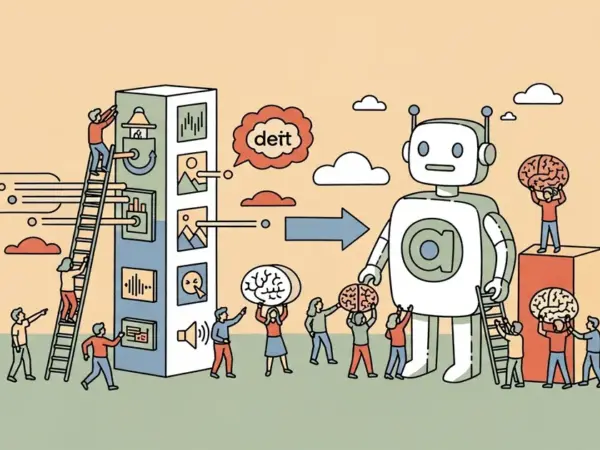
Developer Oguz Bilgic published Agent Kernel to GitHub, a lightweight open-source system that gives AI coding agents persistent memory across sessions using three markdown files and a git repository — no database or external framework required. The project has accumulated 299 stars and 31 forks since its release.
- Agent Kernel provides cross-session memory for AI coding agents through three markdown files: AGENTS.md, IDENTITY.md, and KNOWLEDGE.md.
- The system works with Claude Code, OpenCode, Codex, Cursor, and Windsurf without modifying those tools.
- Memory is stored in two forms: a knowledge directory for current facts and an append-only notes directory for session logs.
- A companion runtime called kern-ai extends the system with daemon mode, Telegram, and Slack integration via a single CLI command.
What Happened
Oguz Bilgic released Agent Kernel as a minimal, framework-free approach to giving AI coding agents stateful behavior between sessions. The repository, hosted at github.com/oguzbilgic/agent-kernel under an MIT license, currently has 17 commits, 299 stars, and 31 forks. Its README describes the project’s core promise: “Your agent remembers between sessions, takes notes, and builds on past work. No framework, no database — just three markdown files and a git repo.”
Why It Matters
Most AI coding agents — including Claude Code, Cursor, and Codex — operate statelessly by default. Each new session starts without memory of prior interactions unless the developer manually re-supplies context. This forces users to re-explain project details, preferences, and in-progress work at the start of every session.
Agent Kernel exploits an existing behavior common to these tools: nearly all major AI coding environments already read a project-level instruction file at startup — AGENTS.md, CLAUDE.md, or .cursorrules. “This kernel uses that mechanism to teach the agent how to remember,” Bilgic writes in the repository documentation. “The agent doesn’t need a database, a vector store, or a custom framework.”
Technical Details
The system comprises three markdown files with distinct roles. AGENTS.md is the generic kernel — the file AI coding tools read as project-level instructions — and it teaches the agent the memory protocol itself. IDENTITY.md stores the agent’s persona and identity, written and maintained by the agent across sessions. KNOWLEDGE.md serves as an index of all knowledge files the agent has created or updated over time.
Memory is divided into two storage directories with different write behaviors. The knowledge directory holds current-state facts; agents overwrite entries when information changes. The notes directory is append-only — agents write a session log after each interaction, preserving a chronological record of what occurred. This separation prevents the agent from inadvertently erasing historical context when updating a fact.
Because each Agent Kernel instance is an independent git repository, multiple specialized agents can run in parallel. The README describes one intended use pattern: “You can have a homelab agent, an investing agent, a health agent — all running the same OS.” Each is initialized by cloning the repository into a new directory and launching the preferred coding agent inside it. On first run, the README describes the onboarding: “The agent reads the kernel, realizes it’s new, asks who you want it to be. You tell it. It remembers.”
Who’s Affected
Agent Kernel targets developers who use AI coding agents as persistent, long-running assistants rather than one-off query tools. Compatibility is confirmed for OpenCode, Claude Code, Codex, Cursor, and Windsurf — covering the majority of widely-used AI coding environments. Users running ongoing workflows such as home automation management, research tracking, or multi-project development are the primary intended audience.
Bilgic has also shipped a companion runtime called kern-ai, available via npx kern-ai init my-agent. kern-ai adds daemon mode and messaging integrations for Telegram and Slack, allowing one agent brain to operate across multiple communication channels simultaneously under a unified memory store.
What’s Next
As of publication, the repository has no open issues or pull requests and no published roadmap beyond the kern-ai runtime. The system depends on each AI coding tool correctly reading and writing the kernel files — behavior that will vary across tools and models, and which Bilgic does not benchmark or document by agent. Agents running on models with limited context windows may also encounter degraded performance as KNOWLEDGE.md indexes grow large over extended use.
Author details beyond the GitHub username oguzbilgic were not available at time of publication.