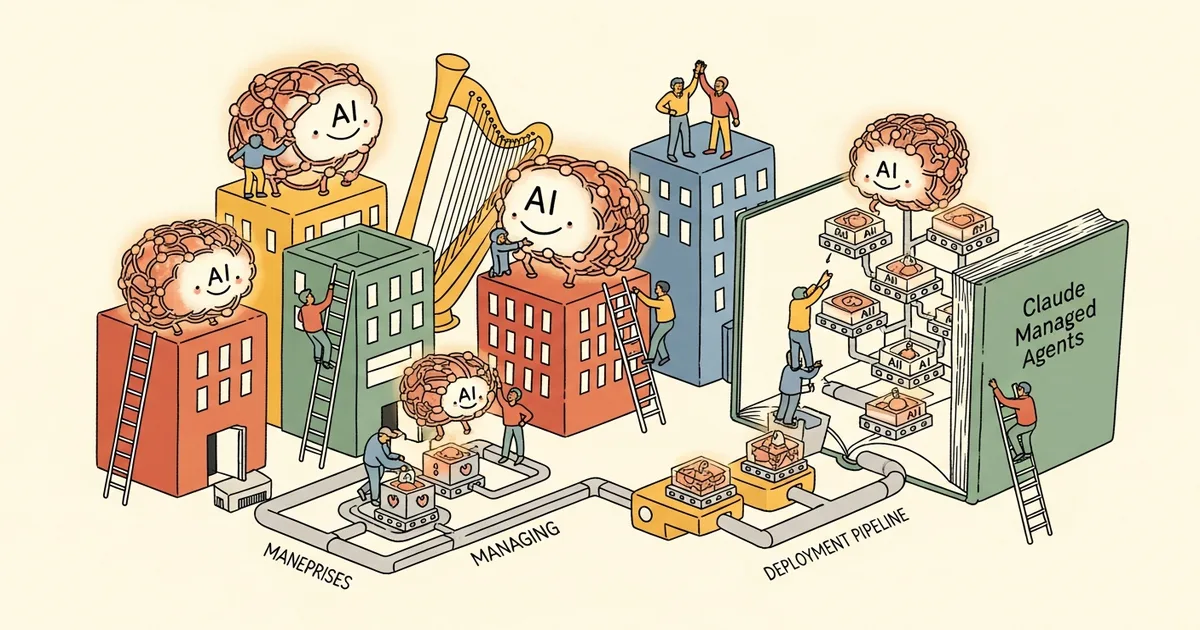
- Anthropic launched Claude Managed Agents on April 8, providing developers with ready-made infrastructure to build and run autonomous AI agent systems at scale.
- The product bundles an agent harness, sandboxed execution environment, long-running cloud sessions, a real-time monitoring dashboard, and granular tool-access permissions.
- Anthropic’s annualized recurring revenue has surpassed $30 billion, approximately three times its December 2025 level, with most growth attributed to the Claude Platform enterprise API.
- Notion demonstrated an early integration, using Managed Agents to automate client onboarding workflows within its productivity platform.
What Happened
Anthropic on April 8, 2026, announced Claude Managed Agents, a product that provides developers with out-of-the-box infrastructure to build and deploy autonomous AI systems using Claude models. The launch is designed to reduce the distributed-systems engineering burden that has historically made agent deployments difficult for enterprises without large platform engineering teams. Angela Jiang, Anthropic’s head of product for the Claude Platform, said the tool “enables any business to take the best-in-class infrastructure and deploy a fleet of Claude agents to do whatever work they need.”
The announcement came one day after Anthropic disclosed that its annualized recurring revenue has surpassed $30 billion — roughly three times the figure reported in December 2025 — underscoring the commercial pressure behind the launch. Jiang noted that while developers have been using Anthropic’s API to deploy agents such as Claude Code, a notable gap exists between what Claude models are technically capable of and what most businesses have been able to implement in practice.
Why It Matters
The Claude Platform enterprise API has been the primary driver of Anthropic’s recent revenue growth, according to Jiang. Claude Managed Agents extends that platform by abstracting away infrastructure complexity that previously required dedicated engineering resources to build and maintain. OpenAI operates a competing agent platform called Frontier, and both companies are reported to be preparing for initial public offerings as soon as this year, making enterprise platform differentiation a near-term commercial priority.
Wall Street investors have grown cautious about traditional software-as-a-service stocks as Anthropic has expanded its enterprise offerings. Analysts have speculated that agentic AI platforms could reduce enterprise dependence on conventional SaaS applications, though Anthropic itself acknowledged in remarks to Wired that significant adoption ground remains before most enterprises are running fully on Claude.
Technical Details
Claude Managed Agents delivers what Anthropic calls an agent harness — the complete software infrastructure surrounding a model to enable agentic behavior — including tool integrations, memory systems, and orchestration logic. The product ships with a built-in sandboxed environment in which agents can spin up software projects securely without accessing production systems. It also supports long-running autonomous sessions that operate for hours in the cloud, a real-time monitoring dashboard for visibility into individual agent activity, and permission toggles that control which tools each agent may access.
Katelyn Lesse, head of engineering for the Claude Platform, described the infrastructure problem the product addresses: “When it comes to actually deploying and running agents at scale, that is a complex distributed-systems engineering problem. A lot of customers we’re talking about previously had a whole bunch of engineers whose job it would have been to build and run those systems at scale. Now that we are giving them that bit out of the box, they’re able to have those same engineers be focused on the core competencies of their business and of their product.”
Who’s Affected
Enterprise software developers and the organizations that employ them are the direct target users. In a demonstration shared with Wired, AI productivity startup Notion provided an early example of the product in use. Eric Liu, a Notion product manager, showed how a Claude Managed Agent could autonomously process a queue of client onboarding tasks inside Notion, while a parallel Claude Platform dashboard displayed the agent’s activity and tool usage in real time.
If agent harnesses become standardized infrastructure, companies that previously needed platform engineering teams to build agentic systems may redirect those resources toward domain-specific product work. Wall Street analysts have flagged Anthropic’s expanding enterprise portfolio as a potential pressure point for traditional SaaS vendors whose recurring-subscription models depend on workflows that agentic platforms now claim to automate.
What’s Next
Anthropic has not announced a public roadmap for additional Managed Agents features or disclosed pricing details. With both Anthropic and OpenAI reported to be targeting public offerings in 2026, enterprise platform scale is expected to remain a central focus for both companies. How quickly larger enterprises move from pilot deployments to full-scale adoption will determine whether Anthropic’s current revenue trajectory reflects durable usage or early-stage experimentation.
Related Reading
- Meta Has a Secret Leaderboard Where Employees Compete to Use Claude the Most — It’s Called ‘Claudeonomics’
- He Spent 8 Years Wanting to Build a Project — AI Got It Done in 3 Months
- The New York Times Just Fired a Writer Because His AI Tool Secretly Plagiarized The Guardian — 3 Journalists Down in 2026