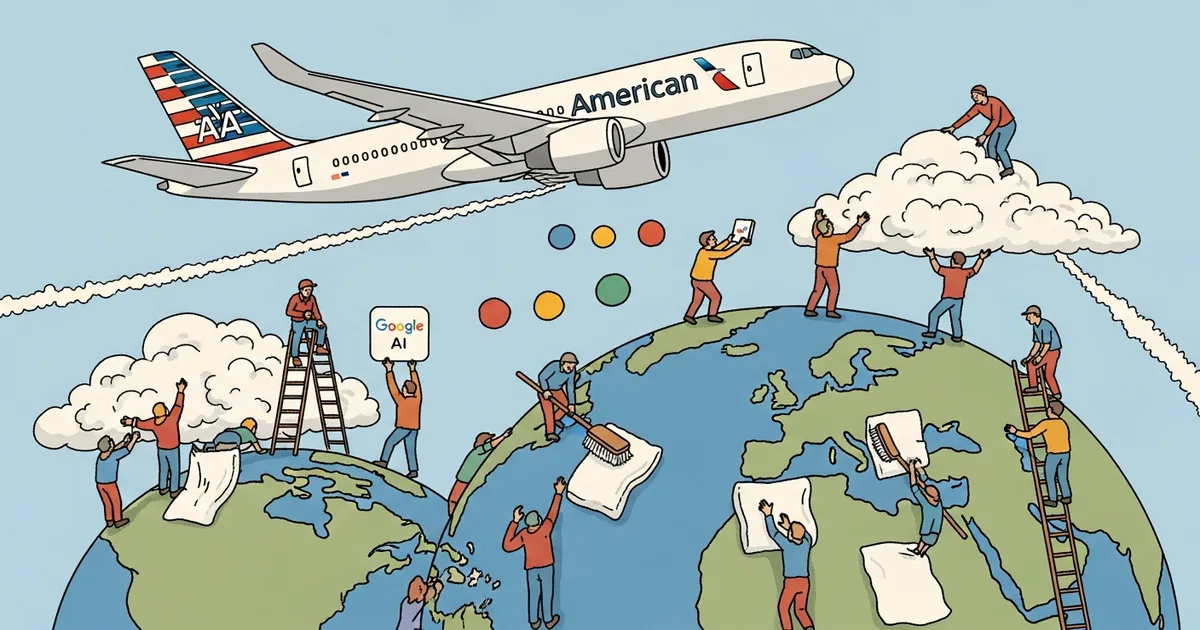
American Airlines and Google have demonstrated that AI-driven flight path adjustments can reduce contrail formation by 62 percent on transatlantic routes, building on initial trials that showed 54 percent reductions on domestic flights. The latest results come from a trial of 2,400 transatlantic flights conducted between January 15 and May 13, 2025, where 112 flights that followed AI-recommended contrail-avoidance paths were compared against a control group flying standard routes.
Contrails — the white lines aircraft leave across the sky — trap heat in the atmosphere and are estimated to account for roughly 35 percent of aviation’s total climate impact, a contribution that rivals the direct carbon emissions from jet fuel combustion. Unlike CO2 emissions, which persist in the atmosphere for decades, contrails form and dissipate within hours. This means that avoiding contrail formation delivers an immediate climate benefit without requiring changes to aircraft design, fuel type, or engine technology.
Google’s AI system predicts where contrails are likely to form based on atmospheric data — temperature, humidity, and wind conditions at specific altitudes along flight paths. When conditions favor contrail formation, the system recommends altitude adjustments of typically 1,000 to 2,000 feet, which move the aircraft out of the atmospheric layer where ice crystals would form around engine exhaust. The fuel penalty for these altitude changes is minimal — estimated at 1 to 2 percent additional fuel burn on affected segments.
The improvement from 54 percent to 62 percent reduction between the domestic and transatlantic trials reflects refinements in Google’s atmospheric modeling. Transatlantic routes traverse the jet stream and upper-troposphere conditions that are more complex than domestic flight corridors, making accurate contrail prediction harder. The higher reduction rate on these more challenging routes suggests the AI system is improving rather than encountering diminishing returns as it scales.
American Airlines plans to expand the program across its full route network. If the 62 percent reduction holds at scale, the airline would effectively eliminate more than half of its contrail-driven climate impact — an outcome equivalent to removing tens of millions of tons of CO2-equivalent warming without reducing a single flight. For an industry facing mounting regulatory pressure on emissions, AI-driven contrail avoidance offers a rare combination: measurable environmental benefit at negligible operational cost.