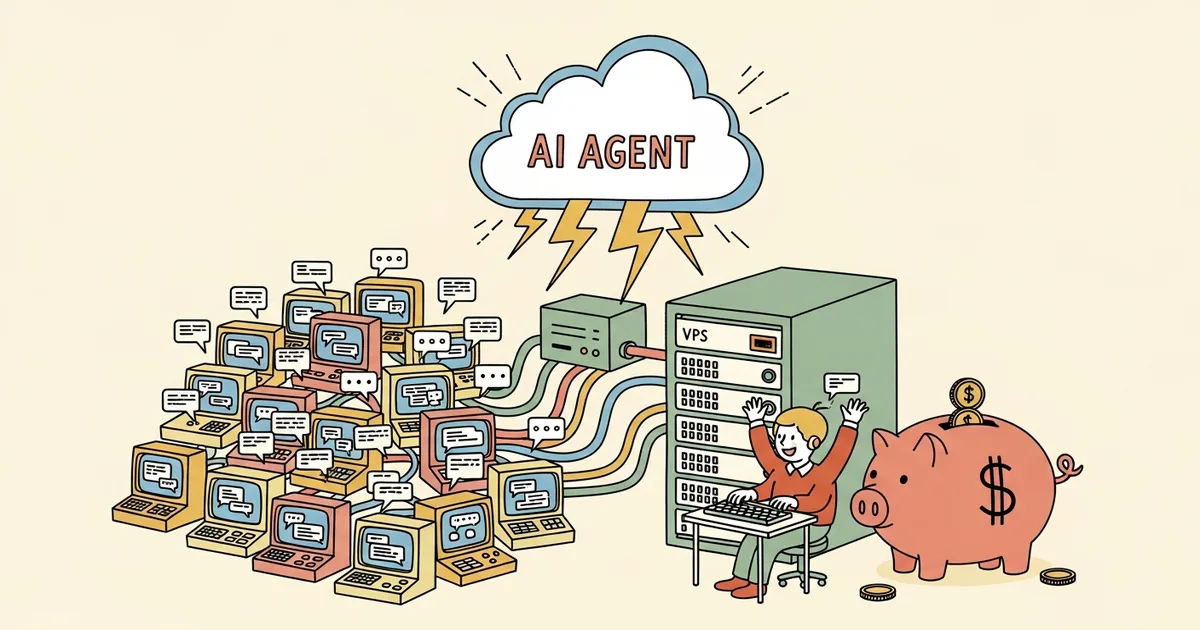
Software engineer George Larson deployed a functional AI agent on a $7-per-month virtual private server using IRC — a protocol from 1988 — as the communication layer. The project, showcased on Hacker News on March 23, 2026, demonstrates that useful AI agents can run on minimal infrastructure without cloud AI platforms, Kubernetes orchestration, or enterprise-grade servers.
The system runs two agents. Nullclaw is a public-facing agent built as a 678-kilobyte Zig binary that consumes approximately one megabyte of RAM. It connects to an Ergo IRC server and responds to visitors via a Gamja web client embedded on Larson’s website or through any standard IRC client. Ironclaw is a private agent handling email and scheduling, accessible only over Tailscale using Google’s Agent-to-Agent protocol.
The inference architecture uses a tiered approach to control costs. Conversational tasks route to Claude Haiku 4.5 — the cheapest capable model — while complex operations requiring tool use escalate to Claude Sonnet 4.6. A strict daily cost cap of $2 prevents runaway API spending. The agent can clone GitHub repositories, analyze code, and provide actionable responses, all within this budget constraint.
The technical choices are deliberately minimal. IRC provides a persistent, well-understood transport layer that works with any client and requires negligible server resources. Zig produces a tiny binary with minimal memory overhead. Tailscale handles secure networking without exposing services to the public internet. Each component was chosen for efficiency rather than trendiness.
The project serves as a counterpoint to the prevailing narrative that AI agents require significant infrastructure investment. While enterprise deployments justifiably use Kubernetes, load balancers, and managed services, a single developer’s AI assistant does not. The $7 VPS plus $2-per-day inference budget — roughly $67 per month total — delivers a persistent, capable AI agent for less than the cost of a ChatGPT Pro subscription.
The approach resonates with developers skeptical of vendor lock-in and infrastructure complexity. By using open protocols, minimal dependencies, and a cost cap, Larson demonstrates that the economics of personal AI agents are already accessible to anyone willing to do basic system administration. The bottleneck for individual AI agent deployment is not cost or infrastructure — it is the willingness to assemble the pieces yourself.