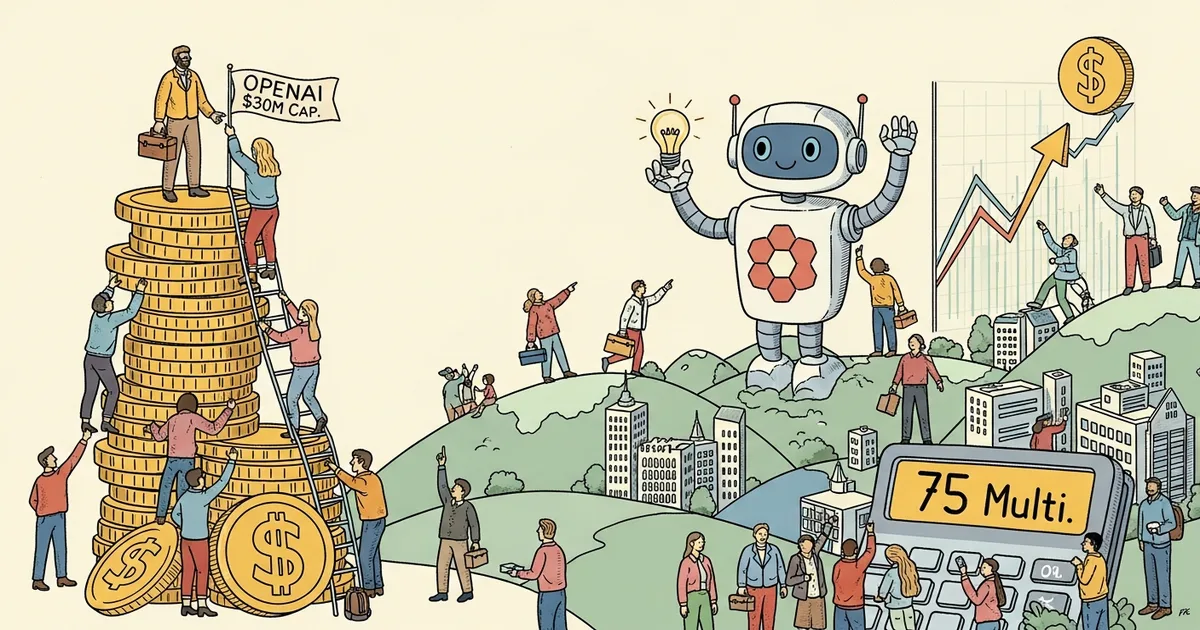
- Approximately 75 OpenAI employees each cashed out the $30 million per-person maximum in the October 2025 secondary share sale.
- The full secondary transaction totalled $6.6 billion and involved more than 600 current and former OpenAI employees.
- OpenAI tripled the per-person cap from $10 million to $30 million at investor request ahead of the sale.
- President Greg Brockman disclosed in court filings that his shares are worth roughly $30 billion.
What Happened
Roughly 75 current and former OpenAI employees each cashed out the maximum $30 million cap in the company’s October 2025 secondary share sale, The Decoder reported Monday, citing earlier Wall Street Journal coverage. The total transaction came to $6.6 billion across more than 600 participating employees. In a “secondary” sale, existing shares change hands without OpenAI raising new capital; the proceeds flow to selling employees rather than to the company.
Why It Matters
The figures provide one of the cleanest external measurements of how much wealth has accumulated inside OpenAI ahead of any potential public listing. Employee secondary sales typically signal two things at once: that early investors and employees want liquidity, and that incoming buyers are willing to fund that liquidity at the prevailing primary-round valuation. OpenAI’s October 2025 secondary closed at an implied valuation consistent with the company’s later $852 billion Series G valuation in March 2026, suggesting strong continuity between secondary and primary market pricing.
OpenAI tripled the per-person cap from $10 million to $30 million “at investor request” before the sale, per The Decoder, meaning incoming investors specifically wanted to deploy more capital into the secondary than the original $10 million cap allowed.
Technical Details
Employees were required to hold their shares for at least two years before participating, meaning many at OpenAI cashed out for the first time since ChatGPT‘s November 2022 launch. Early buyers from approximately seven years prior — dating to the 2018–2019 era when OpenAI’s valuation sat in the low single-digit billions — saw their shares appreciate more than a hundredfold. The 75-employee figure refers specifically to those who maxed the $30 million cap; the broader pool of 600-plus participants includes many who sold smaller amounts. President Greg Brockman disclosed in a court filing referenced by The Decoder that his own equity is worth roughly $30 billion, putting him among the largest individual shareholders outside of the OpenAI Foundation.
Who’s Affected
The 600-plus selling employees gain meaningful personal liquidity, which historically correlates with both retention risk (as employees become financially independent) and continued retention (when participation requires forward equity vesting). Incoming secondary buyers — typically a combination of dedicated late-stage funds, sovereign wealth vehicles, and family offices — obtain pre-IPO exposure at a defined entry valuation. For comparison, Stripe’s 2024 employee tender raised $1 billion at a $70 billion valuation; OpenAI’s $6.6 billion at materially higher valuation underscores the order-of-magnitude scale difference.
What’s Next
OpenAI has not announced a public-listing timeline. The company’s $122 billion primary round in March 2026 brought aggregate raised capital to roughly $180 billion and pushed valuation to $852 billion, per the company’s most recent funding disclosures. With the OpenAI Deployment Company launching this week with $4 billion of additional outside capital, OpenAI’s capital stack continues to evolve toward a corporate structure resembling a holding company more than a research lab. Future employee tenders are expected, though OpenAI has not disclosed cadence or cap levels for any next round.