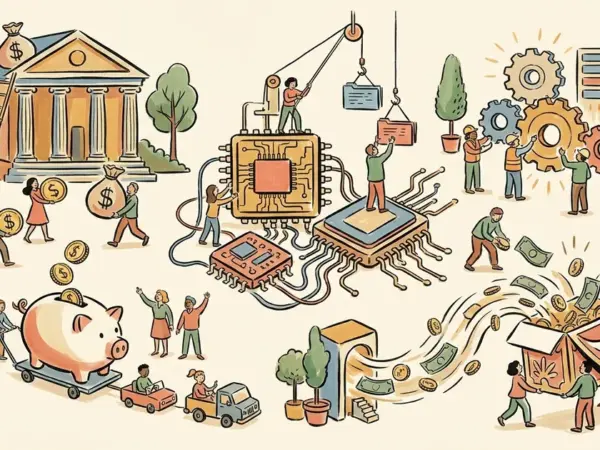
- Meta classifies AI data centers as “pilot models” and Nvidia chips as experimental materials for a federal research credit.
- Savings reached $3.9 billion in 2025, up from $2 billion in 2024 and $700 million in 2023.
- Meta’s SEC filings warn the strategy could be challenged; uncertain-tax reserves jumped 45% to $18.74 billion.
- Auditor EY approved the scheme it helped design — and is pitching it to other companies.
What Happened
Meta is using a 1981 federal research tax credit to save billions by classifying its AI data centers as “pilot models” and Nvidia chips as experimental materials, The Decoder reported on September 30, 2026, citing the New York Times. The company saved $3.9 billion in 2025 — the most of any publicly traded company — up from $2 billion the year before and $700 million in 2023.
Why It Matters
The “experiment” label is hard to square with Meta’s own story. Mark Zuckerberg has announced plans to invest hundreds of billions in compute for superintelligence, with the multi-gigawatt Prometheus cluster already partly online and Hyperion scaling toward 5 GW — infrastructure he said would drive Meta’s core products and business. James Shannon, the congressman who wrote the 1981 credit, told the NYT that Meta’s use has gone “way, way beyond what anybody could have imagined.” As the AI buildout’s financing becomes a story in itself — from lease backstops to $60 billion debt raises — the tax code turns out to be another quiet subsidy line.
Technical Details
Meta defends the practice by pointing to $200 billion of R&D spending over five years. But its own filings treat the position as fragile: SEC disclosures warn the savings could be challenged, and reserves for uncertain tax positions jumped 45 percent to $18.74 billion. Even a successful IRS clawback might leave Meta ahead, since the capital compounds in the meantime. Auditor EY approved the strategy, helped design it, and is now pitching the approach to other companies.
Who’s Affected
US taxpayers absorb the forgone revenue. Rival hyperscalers face pressure to copy the EY playbook or explain why they didn’t. The IRS inherits a test case on whether production superintelligence clusters count as research.
What’s Next
Watch for an IRS challenge, congressional interest in tightening the credit, and whether other AI builders adopt the same classification.