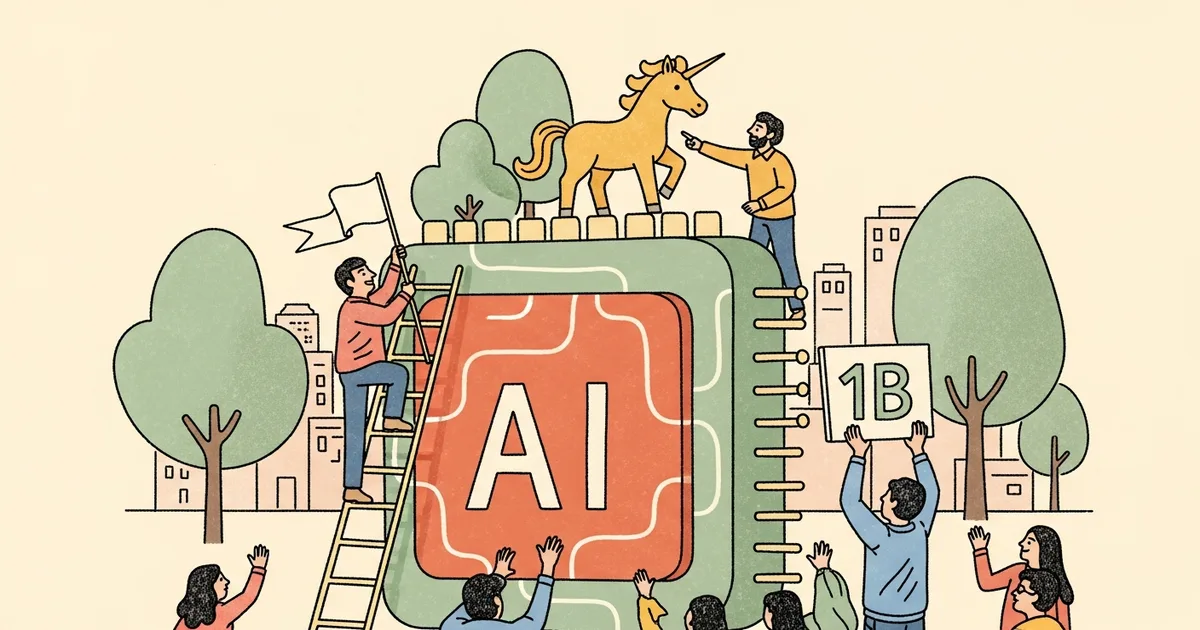
Krutrim, the Indian AI startup founded by Ola and Ola Electric chief executive Bhavish Aggarwal, has reached unicorn status after securing $50 million in equity funding backed by $230 million in committed financing — becoming India’s first AI company to cross the $1 billion valuation threshold, as of April 2026. The $280 million total raise is the largest capital commitment to a domestic Indian AI company in history, and it marks a substantive turning point in the global race to build sovereign AI infrastructure.
This is not a symbolic milestone. Krutrim is building GPU cloud infrastructure, Indian-language foundation models, and an AI application layer simultaneously — with a founder who has already created two companies worth billions of dollars.
How 0 Million Made Krutrim a Unicorn
The funding structure deserves scrutiny. The $50 million equity component establishes the $1 billion valuation directly. The $230 million in committed financing — typically structured as milestone-linked debt tranches or convertible instruments — provides operational runway without immediate equity dilution. For a capital-intensive AI infrastructure company, this structure is sensible: it preserves founder ownership while securing the balance sheet for GPU procurement and data center buildout.
For context: India’s entire AI funding ecosystem attracted approximately $1.1 billion across all of 2024, according to Nasscom’s State of the Tech Startups report. Krutrim’s single round absorbs roughly 25% of that annual figure. The company was incorporated in 2023; the unicorn milestone arrived faster than any Indian AI company in history.
Aggarwal personally anchored Krutrim’s seed funding, with external investors including Matrix Partners India participating in subsequent tranches. The committed nature of the $230 million matters: unlike aspirational ‘targeting to raise’ announcements, committed financing means counterparties have contractually agreed to deploy capital. Krutrim’s balance sheet is materially different from a company announcing fundraising ambitions.
What Krutrim Actually Builds
Krutrim operates across three distinct layers of the AI stack:
- Foundation models: LLMs trained from scratch on Indian languages — Hindi, Tamil, Telugu, Kannada, Bengali, and 19 additional languages — plus English. Training from scratch, rather than fine-tuning Western base models, produces meaningfully different linguistic competence for Indian-language tasks.
- Krutrim Cloud: A GPU cloud platform providing inference and training compute, positioned as a domestic alternative to AWS, Azure, and Google Cloud for Indian developers and enterprises.
- AI applications: Consumer and enterprise products including a voice-native assistant optimized for code-switching between English and Indian languages.
The vertical integration is deliberate. Infrastructure without models is a commodity rental business. Models without infrastructure depend on foreign compute and data centers. Aggarwal is building the full stack — the same approach he used when Ola built proprietary mapping, payments, and driver-matching systems in-house rather than licensing from Google or third-party APIs.
Krutrim vs. Sarvam AI — Two Paths to Indian AI Sovereignty
Krutrim is not India’s only serious AI contender. Sarvam AI, founded in 2023 by Vivek Raghavan (former AI4Bharat lead at IIT Madras) and Pratyush Kumar, pursues a different approach: open-weight models, academic collaboration, and language-first design over infrastructure ambitions.
| Company | Founder(s) | Model Strategy | Infrastructure | Primary Market | Total Funding |
|---|---|---|---|---|---|
| Krutrim | Bhavish Aggarwal | Proprietary, closed-weight | Own GPU cloud | Consumer + enterprise + developer | $280M |
| Sarvam AI | Vivek Raghavan, Pratyush Kumar | Open-weight, research-led | Third-party cloud | Enterprise, government, B2B | ~$41M (2024) |
The philosophical divergence matters. Sarvam’s open approach enables faster academic validation and government adoption — India’s Ministry of Electronics and IT has cited Sarvam models in IndiaAI Mission documentation. Krutrim’s proprietary approach enables tighter product control and monetization, but requires more sustained capital to maintain a competitive moat.
Neither strategy dominates yet, and framing them as rivals may be premature. India has 1.4 billion people, 22 scheduled languages, and an AI infrastructure deficit that neither company can fill independently. Sarvam is building India’s research layer. Krutrim is building its commercial layer.
Bhavish Aggarwal’s Playbook
Aggarwal’s track record earns him the benefit of the doubt that most AI founders do not have. He took Ola from a two-city taxi app to a 250-city transport network with 1.5 million driver-partners. He then built Ola Electric into India’s largest electric two-wheeler manufacturer — the company went public in August 2024 at a valuation exceeding $4 billion at IPO.
The pattern is consistent across both companies: identify a market dominated by foreign incumbents, build local infrastructure that incumbents cannot or will not replicate, scale aggressively through distribution advantages, then monetize through layered B2C and B2B revenue. With Krutrim, the foreign incumbents are OpenAI, Google DeepMind, and Anthropic. The local infrastructure deficit is GPU compute and Indian-language training data. The addressable market is India’s 600 million smartphone users.
Aggarwal has argued publicly that training on Indian data while serving Indian users through foreign data centers constitutes a form of digital resource extraction — a framing that resonates with Indian enterprise buyers and government procurement in ways that foreign AI vendors cannot replicate. The global conversation around AI, sovereignty, and cultural data ownership gives Krutrim’s positioning real commercial traction beyond nationalist sentiment.
The Market Krutrim Is Targeting
Roughly 90% of India’s population is not fluent in English — yet virtually every frontier AI model is English-first by design and capability. Hindi alone has over 600 million speakers. Tamil and Telugu each exceed 80 million. Bengali accounts for more than 230 million speakers globally.
McKinsey’s 2024 AI economic impact estimate for India puts potential annual value at $450 billion to $500 billion by 2030, with language-native AI identified as a key multiplier for agriculture (150 million smallholder farmers), healthcare (where approximately 70% of first consultations occur in regional languages), and financial services.
Krutrim Cloud is also targeting Indian enterprises currently routing inference traffic through US-based data centers — a latency and cost issue for real-time applications, and an emerging compliance concern as India’s Digital Personal Data Protection Act (DPDPA) tightens data residency requirements. For regulated sectors such as banking and healthcare, domestic AI infrastructure will eventually become a compliance checkbox rather than a preference.
What the Committed Financing Structure Signals
The $230 million committed financing component is the more strategically revealing number. Unlike a clean equity raise, committed financing typically does not reflect full investor consensus on a $1 billion valuation — it reflects investors seeking upside exposure while managing downside risk on a pre-scale company. This is standard practice for capital-intensive infrastructure plays where deployment timelines stretch years.
Similar structures have financed AI infrastructure globally. Nebius Group’s $10 billion Finland data center buildout combined equity and committed debt to de-risk a multi-year infrastructure program. Building competitive GPU clusters costs hundreds of millions before a single inference request is served commercially; pure equity financing at those amounts destroys founder ownership before the product reaches scale.
Krutrim’s capital structure suggests its investors believe in the India AI thesis but want milestone-gated deployment — preserving flexibility on both sides if market conditions or competitive dynamics shift materially.
The Competitive Risks Worth Naming
Krutrim’s primary competitive threat is not Sarvam. It is Google and Meta.
Google has built Indian-language capabilities directly into Gemini, including dedicated fine-tuning for 9 Indian languages and Google Translate coverage spanning 22. Meta’s LLaMA model family is open-weight and freely available — dozens of Indian research institutions have fine-tuned LLaMA variants for Indian languages at zero licensing cost. Both companies bring training data volumes, compute scale, and global developer ecosystems that Krutrim will not approach for years.
The counterargument — that data sovereignty requirements, latency optimization, and DPDPA compliance will drive Indian enterprises toward domestic AI — is plausible but not certain. AWS already operates three India regions. If multinational cloud providers satisfy data residency requirements through domestic infrastructure, Krutrim’s compliance moat shrinks considerably.
Aggarwal won against Uber by mastering local market nuances — driver incentive structures, cash payment preferences, city-specific routing — better than a well-funded foreign competitor. Global AI consolidation is accelerating fast, and the window for regional AI companies to establish defensible positions is narrowing. Whether the playbook transfers to AI depends on whether Indian-language quality and regulatory alignment become the decisive enterprise purchasing criteria, or whether ecosystem maturity and cost favor the incumbents regardless.
That is the precise question $280 million is being deployed to answer. Krutrim has the capital, the founder, and the market thesis. Execution against well-resourced global competitors over a multi-year infrastructure buildout is the test that determines whether India’s first AI unicorn becomes a durable platform — or an expensive proof of concept.