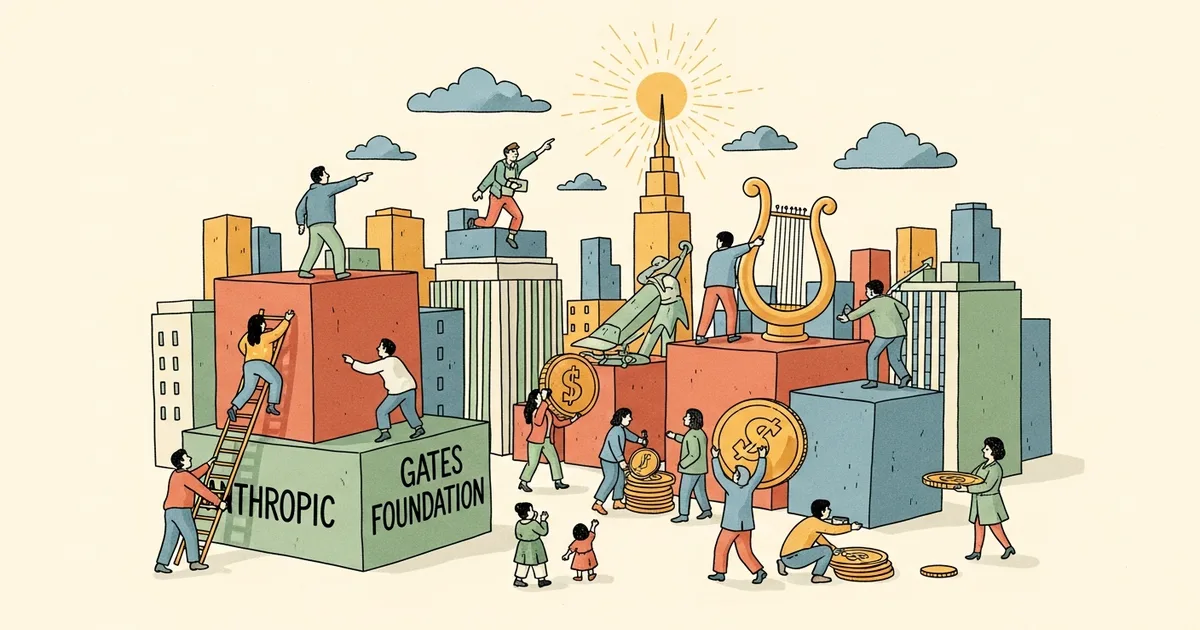
- Anthropic committed $200 million in grant funding, Claude usage credits, and technical support to the Gates Foundation over the next four years.
- The partnership targets global health, life sciences, education, and economic mobility — implemented with partners in the U.S. and globally.
- The largest part of the partnership focuses on improving health outcomes in low- and middle-income countries where 4.6 billion people lack access to essential health services.
- The commitment is delivered through Anthropic‘s Beneficial Deployments team, which provides Claude credits and engineering support to nonprofit partners.
What Happened
Anthropic announced a $200 million partnership with the Gates Foundation on Thursday, committing grant funding, Claude usage credits, and technical support to programs in global health, life sciences, education, and economic mobility over the next four years. The programs will be implemented with partners in the United States and globally.
Why It Matters
The Gates Foundation partnership is one of the most concrete philanthropic-AI alignments to date. Anthropic frames the commitment as central to extending the benefits of AI in areas where markets alone will not — a positioning that contrasts with the predominantly commercial-deployment narratives from OpenAI, Google, Microsoft, and xAI through 2025-2026.
The structural design — a major model provider committing capital, compute credits, and engineering capacity to a single tier-one philanthropic institution — establishes a template that other frontier labs may follow. Comparable prior arrangements have been more limited: discounted nonprofit pricing, one-off grants, and access programs. The four-year horizon and the combination of capital plus compute plus engineering capacity is structurally different.
Technical Details
The partnership is led by Anthropic’s Beneficial Deployments team, which provides Claude credits and engineering support to partners in the four priority areas. The team also develops AI-related public goods including public-health datasets and evaluation benchmarks, and offers nonprofits and education institutions discounted Claude access.
The largest part of the partnership focuses on global health and life sciences. Around 4.6 billion people in low- and middle-income countries lack access to essential health services. Anthropic will work with the Gates Foundation and others to accelerate development of new vaccines and therapies, and to help governments use health data for faster, better-informed decisions. The work includes creating connectors that give Claude direct access to other platforms and tools, plus benchmarks and evaluation frameworks for healthcare applications.
Who’s Affected
The Gates Foundation’s network of grant recipients and implementing partners in over 130 countries gains access to Claude credits and engineering support. Global health agencies — WHO, GAVI, the Global Fund, country-level health ministries — gain potential infrastructure for accelerated decision-making. Other frontier AI labs — OpenAI, Google DeepMind, Microsoft, Mistral — face a structural model for philanthropic-AI alignment that they may need to respond to. AI policy advocates gain a concrete commercial-versus-beneficial-deployment contrast point. Anthropic’s own commercial narrative gains a counter-balance to the for-profit IPO discussion across the AI category.
What’s Next
Anthropic plans to share more about its approach to beneficial deployments and the impact of the programs supported. The specific grant awards and program timelines have not been disclosed publicly. The partnership is positioned as the first of an increasing investment in beneficial deployments rather than a one-off; subsequent partnerships with other major philanthropic foundations are anticipated.