Suno Inc., the AI music generation startup that attracted 12 million registered users and a $125 million Series B at a reported $500 million valuation in 2024, has seen its music licensing negotiations with Universal Music Group (UMG) and Sony Music Entertainment collapse, the Financial Times reported in April 2026. Two years of back-channel conversations between the world’s most prominent AI music company and the world’s two largest record labels have ended without a deal — and without a roadmap to one.
The breakdown doesn’t just hurt Suno. It signals that the music industry has decided to let courts, not contracts, determine whether AI companies owe compensation for the training data that made generative music possible.
Why Suno’s Music Licensing Talks Failed
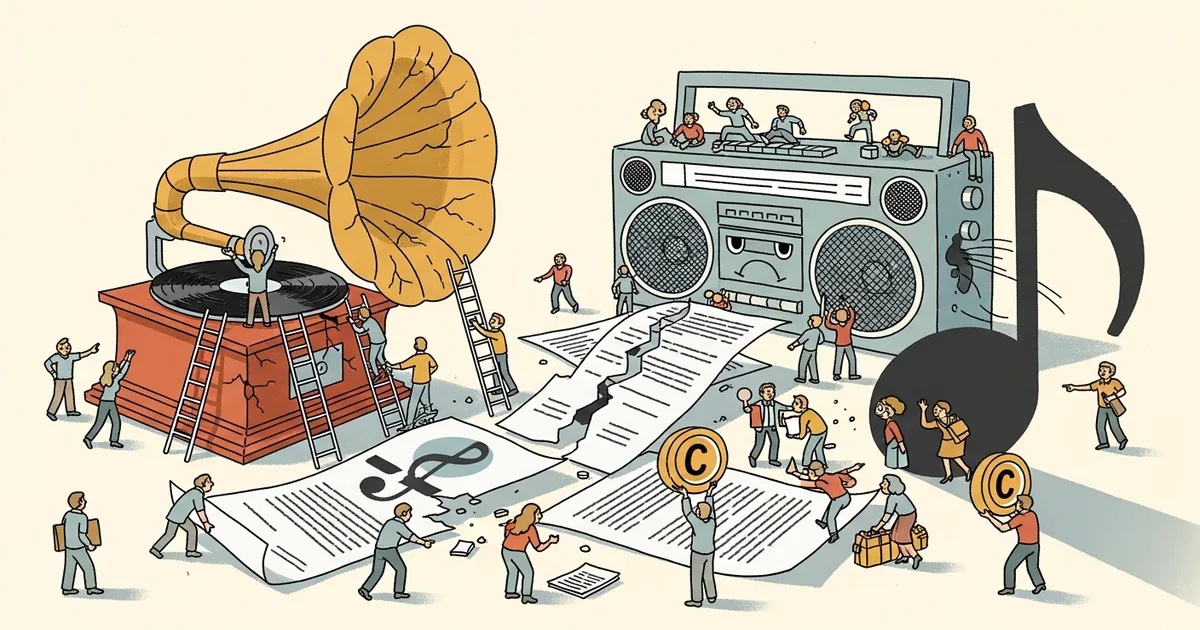
Universal Music Group and Sony Music Entertainment reportedly sought two things from Suno: retroactive licensing fees for the copyrighted recordings used to train its model, and a forward-looking royalty structure on AI-generated music distributed through streaming platforms, according to Financial Times reporting.
The retroactive demand is the critical sticking point. UMG and Sony’s position is that Suno’s text-to-music model — capable of generating full tracks in any genre within seconds — was built on decades of human-created recordings ingested without permission. Paying for past training data use would validate the legal theory that AI training constitutes copyright infringement rather than fair use.
For Suno, that’s an existential concession. Accepting the labels’ framing would set a precedent restructuring the entire generative AI industry’s relationship with content owners — from music to images to code. The company reportedly declined both demands, and talks broke down.
The RIAA Lawsuit Already in Play
The negotiations didn’t happen in a vacuum. In June 2024, the Recording Industry Association of America (RIAA) filed suit against Suno and fellow AI music startup Udio in federal district courts, on behalf of Universal Music Group, Sony Music Entertainment, Warner Music Group, and other labels. The complaints alleged that both companies had copied “decades worth of human artistry” without authorization or compensation.
US copyright law authorizes statutory damages of up to $150,000 per infringed work for willful violations. AI music models train on millions of recordings. The theoretical liability in the RIAA suit against Suno runs into the billions — a figure that dwarfs the company’s entire funding history. Suno has maintained a fair use defense, but the company has not provided full discovery documentation on its training dataset, a gap courts have noted.
UMG’s Track Record With AI Music
Universal Music Group has a documented pattern of absorbing short-term revenue loss to establish long-term precedent. In January 2024, UMG pulled its entire catalog from TikTok — cutting off billions of streams — after the platform failed to address AI-generated music and artist compensation concerns. The standoff lasted months before TikTok agreed to UMG’s terms on AI content policy.
That strategy reveals UMG’s calculus: controlling AI licensing precedent outweighs any individual revenue deal. A settlement with Suno that acknowledged training data liability would give UMG leverage over every AI company in the creative sector — not just music generators. Sony has pursued a parallel approach, sending legal notices to hundreds of AI companies and streaming services demanding license compliance or content removal, according to prior reporting.
Why the Spotify Precedent Doesn’t Apply
Suno’s defenders invoke the Spotify parallel: when Spotify launched in 2008 without complete licensing agreements, the music industry eventually negotiated the streaming royalty framework that now generates tens of billions annually. That comparison breaks down at the foundational level.
Spotify distributed recognizable copies of original recordings and required licenses to operate legally from day one. The dispute with labels was about rates and equity stakes — not whether licensing was required at all. Labels received equity stakes in Spotify during early negotiations, aligning financial interests that produced the streaming economy. That deal structure required Spotify to concede the principle that licensing was necessary.
Suno’s legal position argues that AI training doesn’t require a license in the first place. That’s not a rate negotiation — it’s a dispute over the fundamental legal architecture of how AI models are built. Labels have no financial incentive to settle unless that principle is resolved in their favor. The same structural impasse has defined OpenAI’s content licensing discussions with Disney — where even well-capitalized AI companies have struggled to reach terms when the underlying legal question remains unresolved by courts.
AI Music’s Structural Copyright Problem
Suno’s situation isn’t isolated — it’s the clearest expression of a structural problem affecting the entire AI music market. MegaOne AI tracks 139+ AI tools across 17 categories, and the music generation segment has been among the fastest-growing verticals since 2023. Without licensing clarity, the category faces compounding constraints that no individual company can negotiate its way out of.
Enterprise clients in advertising, film, and gaming are reluctant to license AI-generated music without legal indemnification against infringement claims. Major streaming platforms including Spotify and Apple Music face label pressure around AI-generated content, making distribution partnerships harder to structure. The unresolved litigation creates balance sheet uncertainty that complicates future fundraising across every company in the space — not just Suno.
AI creative tools in adjacent verticals face analogous copyright questions, as MegaOne AI documented in its analysis of ElevenLabs, HeyGen, and Synthesia across voice and video generation. The music industry has moved faster to litigate than Hollywood or publishing. The Humans First movement, which advocates for compensation frameworks for human creators in the AI economy, has cited the Suno litigation as a defining case study. More than 200 million tracks exist on Spotify; AI tools already generate music at a pace that outstrips human production — context that shapes how courts and regulators frame the liability question.
The Path Forward Is Narrow
Suno’s realistic options reduce to three scenarios. First: pursue licensing through legislation, supporting proposed statutory frameworks for AI training data compensation — a path measured in years, not quarters. Second: build a licensed training dataset through direct deals with independent artists, bypassing major labels — which doesn’t resolve the existing lawsuit covering current model training data. Third: sustain litigation until courts rule on fair use and restructure accordingly.
The most likely near-term resolution is judicial, not commercial. The Southern District of New York’s handling of The New York Times v. OpenAI and Ninth Circuit rulings on AI image generation cases will establish the legal framework that music copyright cases ultimately rely on. Whichever direction those rulings go, the AI music industry will restructure around the outcome.
Suno has raised enough capital to run a multi-year litigation campaign. The question is whether its investors — and enterprise clients sitting on the sidelines waiting for legal clarity — can tolerate that timeline. The labels appear to be betting they can’t.