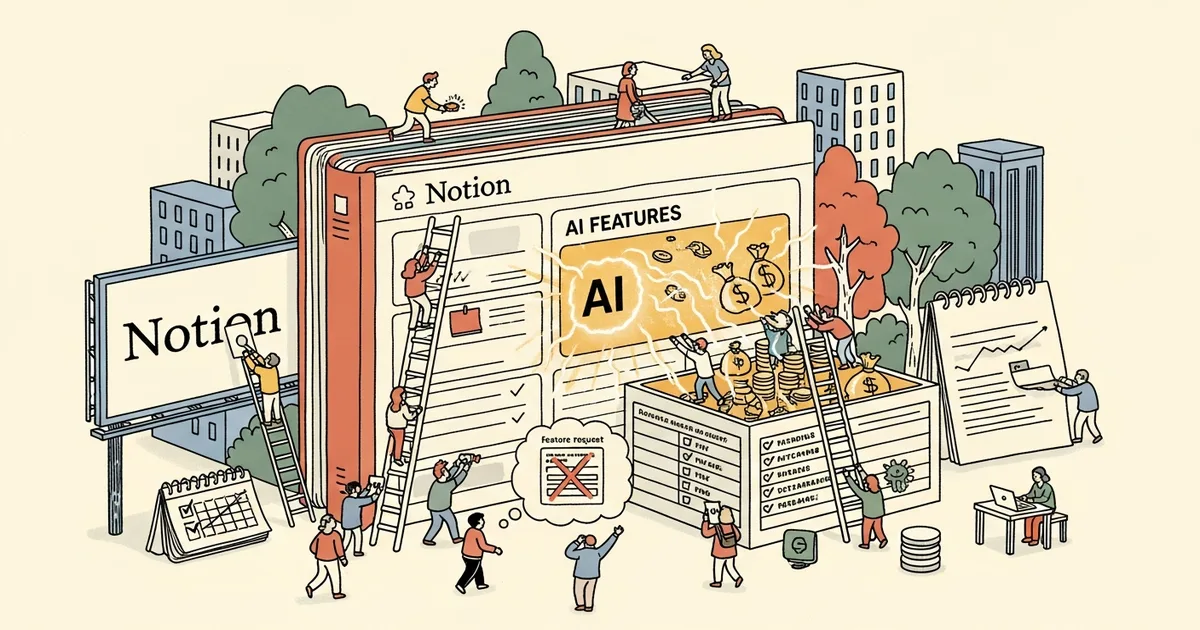
- Notion’s paid AI attach rate climbed from 10–20% of customers in 2024 to over 50% in 2025 — the fastest AI monetization ramp in mainstream productivity software.
- AI features now account for roughly half of Notion’s $500 million in annualized revenue, up from near-zero contribution two years ago.
- In May 2025, Notion stopped selling AI as a standalone add-on and bundled it into Business and Enterprise plans, forcing an upgrade path that accelerated the attach rate.
- Co-founder and COO Akshay Kothari confirmed the company is doubling revenue in 2025 and plans to double its sales team in the following year.
What Happened
In September 2025, Notion crossed $500 million in annualized recurring revenue and simultaneously launched an AI agent product. At the same time, co-founder and COO Akshay Kothari disclosed to CNBC that AI features now represent roughly half of that figure — a number that would have been inconceivable in 2022 when AI was a niche add-on few customers bothered with.
The attach rate trajectory Kothari described is steep. In 2024, between 10% and 20% of Notion’s paying customers had opted into any AI add-on. By early 2025 that share had reached 30–40%. By mid-2025 it had crossed 50%. The entire move from minority curiosity to majority adoption took roughly 12 months.
Notion’s overall ARR has grown from $67 million in 2022 to $250 million in 2023 to $400 million in 2024, reaching $500 million in September 2025, according to Sacra. The acceleration in 2025 is directly attributed to AI monetization rather than net-new user growth.
Why It Matters
Notion’s trajectory is the clearest data point yet that AI features inside horizontal productivity tools can convert from a marginal upsell to a primary revenue engine — but only when the product timing, pricing architecture, and feature quality all align. Most SaaS companies that launched AI features in 2023 are still reporting single-digit attach rates.
The comparison to Notion’s own history is instructive. In 2022, Notion co-founder Ivan Zhao shipped early AI writing features well before ChatGPT had normalized AI assistants for mainstream users. Adoption was slow. The company was patient, continuing to build rather than pivoting away. By 2024, the cultural shift toward AI-first workflows had caught up with what Notion had already built.
The lesson for other SaaS operators is that AI monetization is not purely a product problem — it is a timing and bundling problem. Notion did not invent better AI than competitors in 2024. It was positioned correctly when the market moved.
Technical Details
Three AI feature categories account for most of Notion’s upgrade volume. The first is AI Database Autofill, which lets users assign AI-generated properties to database rows — including automatic summaries, key info extraction, translation, and custom prompt outputs — pulling content directly from linked page bodies. This feature has direct workflow ROI for teams managing large knowledge bases or CRM-style databases.
The second is the AI Writing Block, which sits natively inside pages and handles drafting, editing, and rewriting within the same canvas where users already work. Because there is no context-switching to a separate tool, usage is frictionless enough to become habitual. The third, launched in September 2025 with the Notion 3.0 release, is the Custom AI Agent, which executes autonomous multi-step workflows for up to 20 minutes, connecting to external platforms including Slack, Google Drive, and Microsoft Teams.
On the pricing side, a structural change in May 2025 is the single biggest mechanical driver of the attach rate spike. Before that date, AI was an $8–10 per user per month add-on available to all paid tiers. After May 13, 2025, Notion removed AI from the Plus plan and bundled unlimited AI access exclusively into Business ($20/user/month billed annually) and Enterprise. Users who wanted AI features and were on the Plus plan were required to upgrade rather than add-on, collapsing the decision into one step instead of two.
Who’s Affected
Notion’s enterprise and mid-market customers are the primary beneficiaries and also the primary revenue drivers. Kothari noted that approximately 90% of Notion’s business comes from “multiplayer usage” — teams rather than individual users. Corporate clients named publicly include Kaiser Permanente, Mitsubishi Heavy Industries, Nvidia, and Volvo Cars.
For individual and small-team users on the Plus plan who did not want to upgrade, the May 2025 pricing change was disruptive. Those users lost access to AI features or faced a cost jump from roughly $16/user/month (Plus + AI add-on) to $20/user/month (Business). In practice, the trade-off appears to have worked in Notion’s favor: the attach rate accelerated sharply in the months following the restructure.
Competing productivity platforms are affected indirectly. Microsoft Copilot inside Microsoft 365 and Google’s Duet AI inside Workspace are the direct competitive threats Notion faces at the enterprise level. Kothari acknowledged to CNBC that Microsoft competition is real, but argued that Notion’s flexibility and its unified document-database-task model gives it differentiation that suite incumbents cannot easily replicate.
What’s Next
Kothari said in September 2025 that Notion was doubling revenue year-over-year and intended to double its sales team in 2026. That combination — revenue growth outpacing headcount, followed by deliberate sales investment — suggests the company views the current AI-driven expansion as durable enough to fund enterprise sales cycles.
The Custom Agent product launched in September 2025 carries its own usage-based pricing layer on top of the Business and Enterprise plans, introducing a consumption component to what had been a seat-based model. If agent usage scales, Notion’s revenue mix could shift again — from seat revenue toward usage revenue, which would make ARR forecasting more complex but also unlock higher per-customer ceilings.
SaaS operators watching Notion’s trajectory should track two specific indicators over the next 12 months: whether the agent attach rate follows the same S-curve the base AI features did, and whether Notion’s bundling playbook triggers similar restructures from competitors like Coda, Confluence, and ClickUp who are still treating AI as an optional add-on.